Facilities managers are increasingly adopting digital twins as a way to add visibility to their portfolios, and savings are possible once these models are linked to operational data layers, says one expert whose company provides the technology.
Digital twins in the last couple of years were primarily used for real estate managers to lease space or by universities and colleges to recruit students and parents by virtually walking prospects around the campus, according to Matt Judge, senior director of facilities program development at Aramark Facilities Management.
The technology is now used for more than just viewing properties digitally, with providers and clients finding ways to integrate operations data within the models. “What we’re seeing now, it’s converting over to utilization … it’s really starting to spread,” Judge said in an interview.
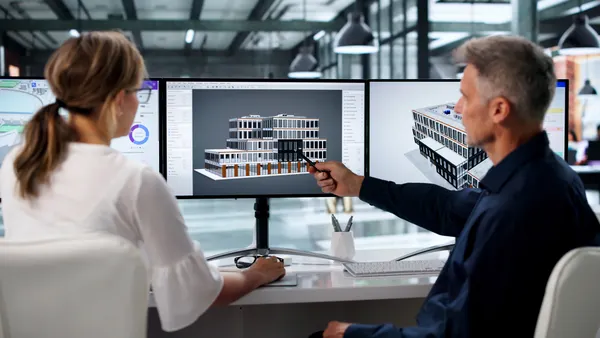
Aramark Facilities Management provides digital twin capabilities through TwinOptix, an asset and space management solution that combines lidar scans, asset information, documentation and operational data into a shared digital model of a facility. The company has digitally modeled more than 20 million square feet across 36 client locations in the U.S., according to a spokesperson.
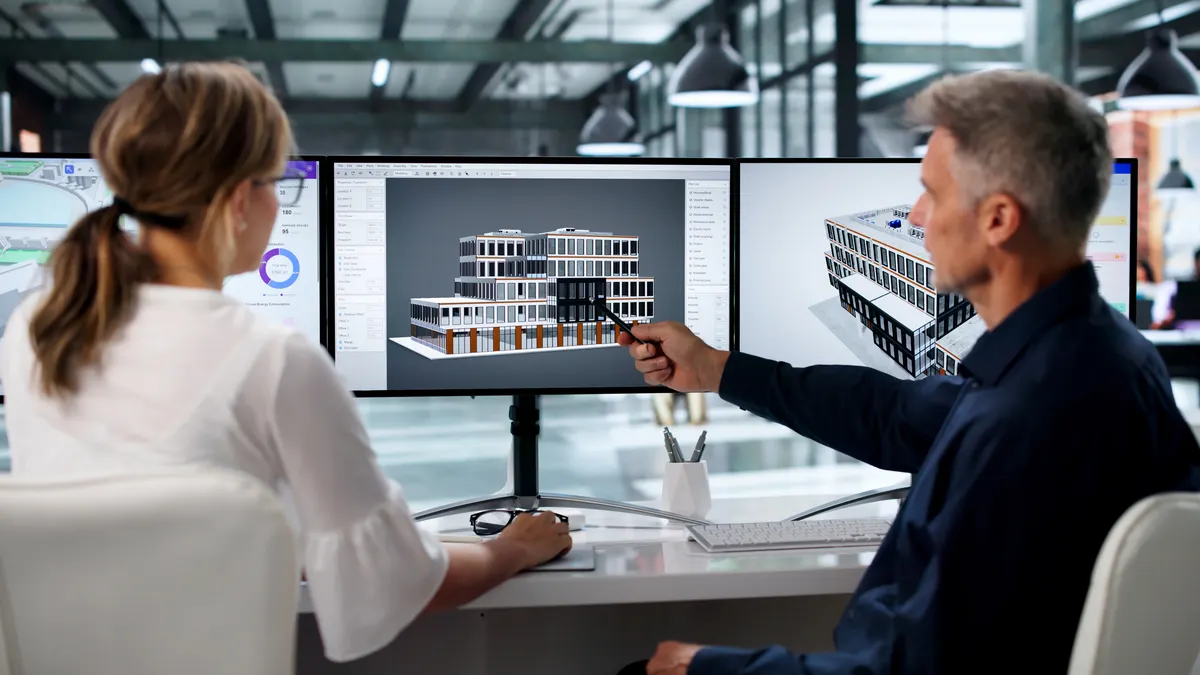
The TwinOptix suite allows facility managers to share digital notes and information with internal maintenance staff or contractors, take measurements of anything featured in the digital twin, generate 2D floor plans or review 3D models of outdoor locations for condition assessments and planning, per a fact sheet released by the company.
Digital twins are gaining traction for a few reasons, including reductions in travel, site survey costs and maintenance time, but the main benefit today is the ability to give visibility to a large range of stakeholders. On a large campus, for example, digital models can provide operators a single pane of glass to view all their buildings and reduce the time it takes for facility managers to walk across a property to coordinate between contractors, vendors and designers, Judge said.
One university president recently told Judge that they were using the system to secure funding from donors. “We were trying for the last couple years to get donors, but to get them to our buildings was very difficult,” the president said. “Now we don’t have to get them to our buildings.”
Aramark is also helping clients create virtual tours and reduce labor time to complete work orders, he said. “We’re changing the workflow process.”
“From an operations perspective, we’re trying to embed it into the program and that drives the utilization from a client perspective,” Judge said. “We’re trying to understand their needs and sharing different use cases with different clients, and then they start to use it.”
Operators who aren’t adopting digital twins usually don’t understand the use case, have trouble transitioning over to the technology or in quantifying its savings, he said. “Those folks that aren’t using it don’t really understand how they’re going to get the payback and quantify it,” he said.
Payback is not always monetary “in the sense of … operational savings,” he said. Just operating a facility off a digital twin may take time to generate savings, but “as you share that amongst the community and the industry you’re working with …. the payback gets greater.”
Historically, digital twins have most often been developed during the construction phase and have a reputation for not carrying over well across a facility's lifecycle as physical changes are made. But Aramark remedies this problem by providing pre- and post-scans, Judge said.
Pre-scans take place before the walls and ceiling are closed and include operational data, he said. “We’re actually putting the virtual tags on equipment that are above the ceilings and are in the walls that are maintainable. Anything we’re going to touch one time a year, either inspecting it or going to change belts, fans, whatever we’re going to do,” he said. “Now we know exactly where it’s at and we know all the information about that asset.”
Using Aramark’s Internet-of-Things tech platform AIWX Connect, that information can then be sent to the client’s computerized maintenance management system to create work orders and a database that includes information about the asset, such as safety or repair instructions.
“So now it becomes an operational tool,” Judge said, noting that the intent is to provide a “single pane of glass.” For example, the AIWX allows models to pull in real-time data and insights about space utilization, equipment performance, air quality, entrance door use, water leaks or energy consumption, Aramark says.