Occupancy-driven data and heat mapping can help facility managers at sports and other event venues better inform staffing, maintenance and asset management and reduce water, energy and labor costs, says Brian Grant, vice president of sports and entertainment at ABM.
The data available from smart restroom technology, for example, on how much toilet paper, paper towel and soap is being consumed has taken steps forward in the last few years, Grant told Facilities Dive. The use of robotics and autonomous cleaning has also moved forward, he said.
“Now, we’re really looking at how we can make sure that we’re being efficient with our cleaning efforts,” Grant said. “Looking at a performance-based cleaning model, but utilizing the available data and information that’s readily available to us now. And continuing to improve to make sure that we’re using as much science behind making the decisions of how we go perform services in these venues, particularly cleaning, but it’s the engineering side as well.”
Predictive analytics has been a trend in the industry and his company is trying to push forward with its use of data in decision-making, he said. The company is moving toward patron-based cleaning that focuses on where attendees are seated by integrating the ticket manifest and ticket mapping that’s available.
“Who’s sitting where? How many people are sitting there? What’s the likelihood and the volume that we’re going to have to go clean in these spaces?” Grant said. Areas with bathrooms and where food and beverages are consumed are going to be the most heavily visited areas, and also the areas where more waste is being generated, he said.
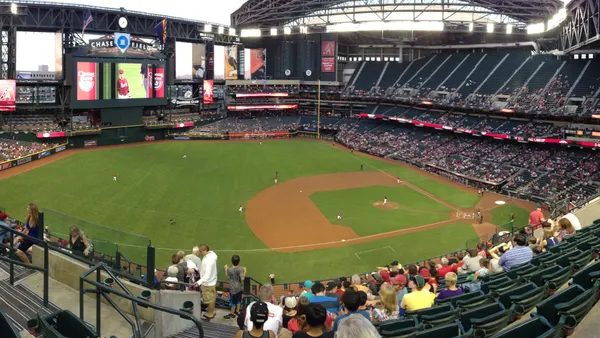
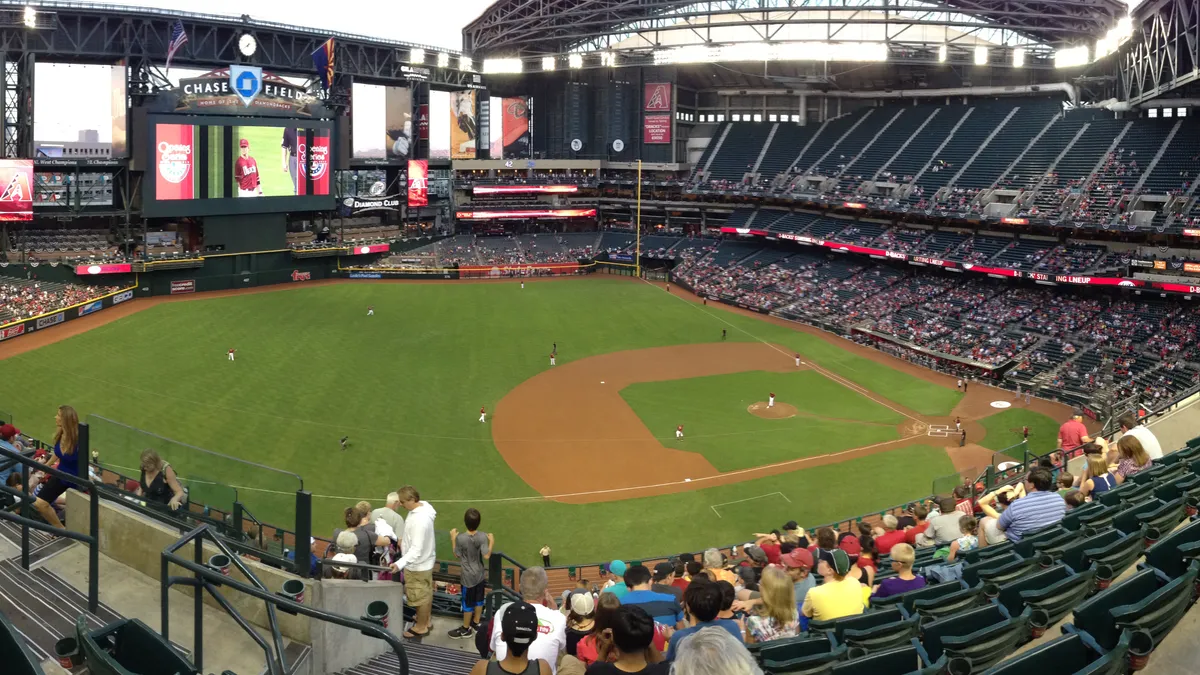
At Chase Field, home of Major League Baseball’s Arizona Diamondbacks, implementing a cleaning system based on occupancy data was able to save the venue 198,000 gallons of water and roughly $2,500 in a single month versus the uniform, clean-everything approach that was taken before, he said.
“All of those things are more available to us now in terms of the data to make those decisions than they were five years ago, and we’ve got to be mindful of that,” he said. “We’ve got to be open to the idea that continuous improvement shouldn’t be something that’s scary. It shouldn’t be something we’re afraid of or feel like is rude to the work that we’ve done previously.”
Better data today doesn’t mean that facility operators “can take their thumb off the pulse of the venue, but it does at least give us a decision point to say, ‘Let’s find an efficiency here,’” he said. For example, data can help find strategic areas for sustainability when it comes to reducing water and energy use, like when and where you need to heat, cool, light or clean a space.
”But at the very end of the day, we still need individuals to make sure that there is at least some level of field verification that says 'yes, standards are being delivered.’” However, over the next few years, Grant sees a way to utilize infrastructure in ABM’s venues — such as security cameras, but also those used for walk-through food and beverage markets that can track people through these spaces — to reach a point where you can eventually offset some of that field verification.
“There’s so much data being made available through the technology that’s coming into these venues that it’s only continuing to improve and that’ll eventually make us even more targeted and specific when it comes to how we verify work being done in the field,” he said.
Middle ground
While the sheer amount of data and solutions at play can lead to paralysis by analysis, facility leaders should live in the middle ground between no technology and too much technology, he said. “It shouldn’t be data all the time. It shouldn’t be data none of the time. There’s got to be an understanding [that] data at the right time, with the right analysis, can lead to a decision,” he said. “If we start with small to medium decisions, we can start to see better if those decisions are actually netting the intended result. If they are, then we take another step forward.”
If the far edges of a ballpark like the upper deck are not seated for day games during the work week, for example, then crews may not need to wash them down, wasting hundreds of gallons of water, Grant said. Instead, a single employee can make sure any trash, recyclables or leftover popcorn in the area are removed.
“I can address it more on a spot-by-spot basis. And if that decision leads to a positive outcome for the venue, maybe next time we look at a different way of handling the cleaning that goes up to that space,” he said.
ABM also focuses on optimizing how it uses water, particularly for cleaning. Although pressurized water plays a role in many venues because of its speed and utility, it also is a crucial resource and can damage equipment if it isn’t at the right pressure, Grant said.
Water reduction nozzles help teams make sure their water use is dialed in, he said. Operators can also pressurize water without restricting the outlet with a traditional pressure washing gun, which can help provide a powerful enough blast to remove debris but not enough to do damage to the seating bowl or traffic coating.
In bathrooms, stadiums can also reduce the amount of water that is dispensed from faucets with aerators or by reducing the amount of water utilized per flush. But in these areas, the main concern is keeping them stocked and knowing when to service them, according to Grant.
“No patron has ever been more frustrated than attending a restroom between acts on a stage or between … intermissions at a sporting event and finding no toilet paper, no paper towel or the soap is out,” he said. “Those things are really a negative impact on our guest experience, which is critically important for us and our clients.”
Smart restroom technology can help indicate use and how much usable product is left, providing opportunities for teams to know which areas need service and when. At Chase Field, the team uses a coreless paper system to ensure full roll depletion before replacement. Automated alerts enable staff to keep restrooms stocked. These changes cut paper waste to just 8%, compared to an average of 15%-20%, ABM said.
“The toilet paper used in [one particular] stall is 45% more often used than the stall at the very end of the room. Or … the soap at the sink closest to the door is the one that’s going to run out first,” Grant said. “Those are good anecdotal points, but having the data behind how much more that device or that particular location uses helps us be able to respond better, more quickly and more accurately to make sure that the guest experience is the highest area it can be.”