Dive Brief:
- Several dozen data centers on the drawing board in Nevada — the driest state in the United States — could use almost 13,000 acre-feet of water a year by 2036 for cooling, the equivalent of 4 billion gallons a year, according to a report released this month by the Desert Research Institute.
- When indirect water use is factored in, the data centers could use an additional 22,000 acre-feet a year. That additional water would be consumed at the utility level for power generation, according to the report.
- Taken together, direct and indirect water use is expected to reach 11.4 million gallons per year at a cost of almost $4 million annually. Electricity use from data centers in the state is also expected to double by 2036 and cost over $5 billion, the report shows.
Dive Insight:
“Nevada is rapidly transforming into a data center hub, and the scale of the energy and water resources required to sustain this is huge,” Erik Henzl, a staff research scientist at the nonprofit research organization and one of the authors of the DRI report, said in a statement.
The report’s water-use estimates use a midpoint between high- and low-use scenarios based on 39 proposed high-load-factor data centers requesting 16,530 megawatts of capacity, driving 43,754 gigawatt-hours of load growth by 2036.
Actual water use will vary based on factors the researchers say they can’t calculate without knowing the kind of cooling systems the data centers will use and how efficiently they will use electricity. The interplay between the type of cooling they use and the efficiency of their energy use will also affect how much indirect water they’ll use.
“Ultimately, direct water demand will depend on cooling technology and the extent to which newer, more highly efficient cooling systems (e.g. direct-to-chip and immersion) are adopted,” the report says. Indirect water use, which mainly goes to power electricity generation, will depend in part on how much more energy use will be needed based on the efficiency of the data centers’ direct water use.
“Higher energy consumption [from less efficient direct-water use] may drive greater indirect water use via electricity generation,” it says.
Assuming a midpoint water-use efficiency of 0.36 liters per kilowatt-hour, the report estimates the proposed data centers will use 12,770 acre-feet a year in direct water demand at a cost of $1.47 million, 21,283 acre-feet a year in indirect water demand at a cost of $2.45 million and 43,754 gigawatt-hours in electricity demand at a cost of more than $5 billion.
When existing data centers are added to the mix, the demand for water and electricity taken together will stretch the state’s resources, the report says.
“Nevada's data centers consumed 22% of the state's electricity generation capacity in 2024,” the report says. “With more data centers in the planning and construction stages, this is estimated to grow to nearly 100% of the state's 2024 electricity generation by 2036.”
The state’s desert climate puts water at a premium. Nevada averages 10.3 inches of rain a year, according to a University of Nevada estimate. In the southern part of the state, average rainfall is just over 7 inches. The National Oceanic and Atmospheric Administration designates Nevada the country’s driest state.
“Nevada … has a long history of extended periods of drought,” the National Centers for Environmental Information, a NOAA division, says in a fact sheet. “Rising temperatures are projected to increase the intensity of future droughts. The frequency and severity of wildfires are [also] projected to increase.”
To get the water it needs for the planned data centers, the state will have to draw on a mix of resources, the report says. “New growth will largely come from unappropriated groundwater, water reclamation, or water transfers,” it says.
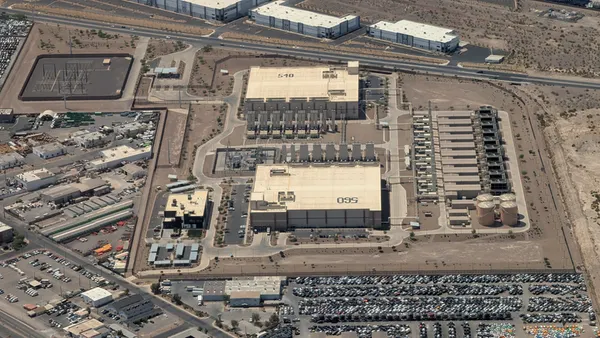
There are already more than three dozen data centers in the state. With the addition of those in the planning phase, the data center industry’s share of the state’s resources will dwarf other uses, the report says.
“Data centers currently comprise just 5% of NV Energy’s sales,” says the report, referencing the public utility that provides power to the state. “This number is expected to rise to 64% by 2046.”
DRI’s report is an update to research the organization released in January. The updated report uses 2026 estimates from the state’s utility, NV Energy, rather than 2024 estimates that were used in the earlier report. The differences between the two estimates are significant, the researchers say, reflecting a 180% increase in data center capacity requests from 2024 to 2026.