Ghost kitchen Wonder has saved about $20,000 in energy costs since it installed stationary plug-in batteries at some of its sites six months ago. The suitcase-sized batteries were provided at no cost by David Energy, a retail energy company that tries to help facilities lower their rates by shaving peak energy use. David Energy makes its money on the supplier margin from the energy it sells and by taking a share of the value its customers generate from participating in utility demand-response programs.
“Our number one goal was to figure out how we can reduce our utility bills, shave the peaks off of our utility usage,” said Abe Nasrallah, Wonder's senior vice president of real estate and development. “We were looking for any kind of solution.”
Wonder operates out of 160 locations in the Northeast United States. It installed the batteries in 21 of its New York City sites, with plans to bring more locations into the program.
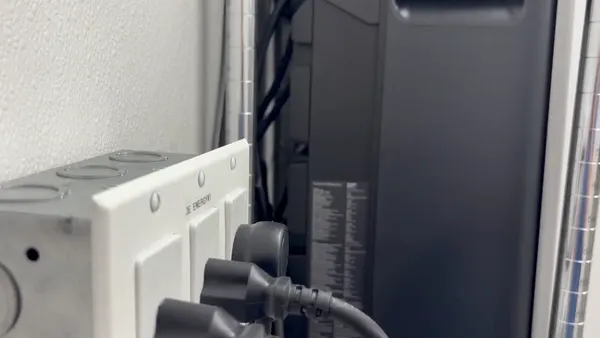
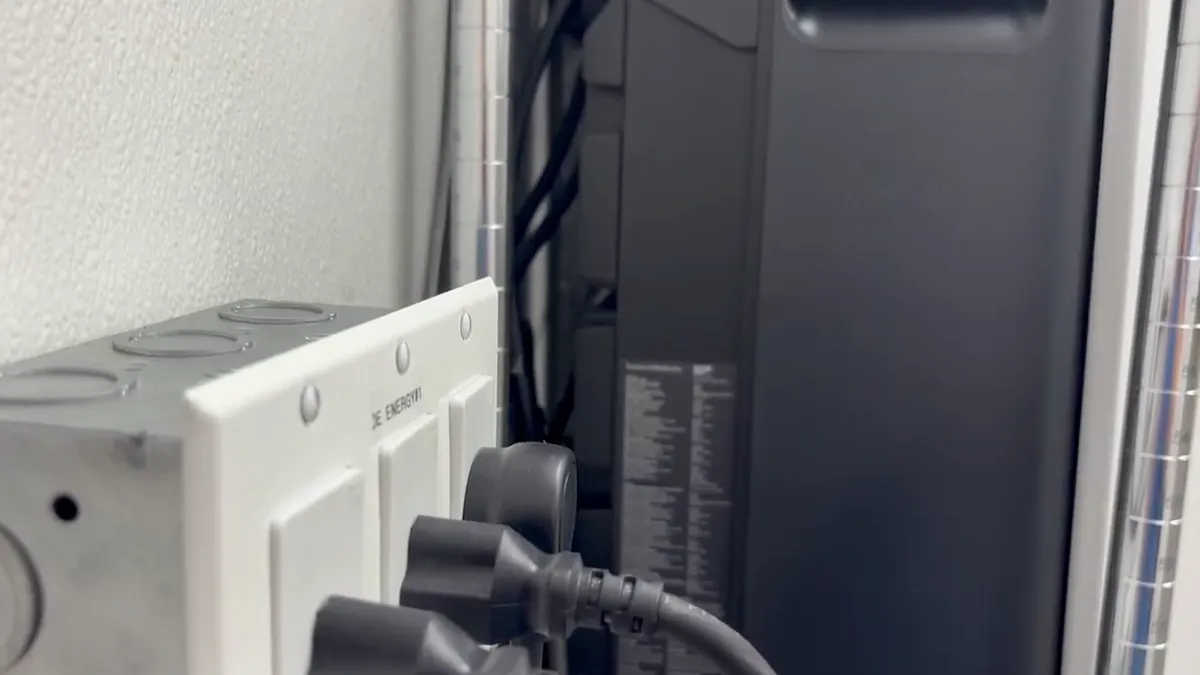
Each battery provides 2 kilowatts/6kWh of energy, according to David Energy. They’re typically clustered into pods of three batteries, connected to a 20A circuit breaker. Depending on the size of the site, half a dozen pods might be installed, generating up to 50kwh in energy. As many as three pods might be connected to a service panel.
“We tested it at one site and it was extremely simple to install,” Nasrallah told Facilities Dive in an interview. “Just plug it into an extended outlet, which is great. After we tested out one, we put it in 21 locations.”
The $20,000 in savings is 3% to 5% of its energy costs for the 21 locations, Nasrallah said.
Walmart’s former head of e-commerce Marc Lore launched Wonder in 2023. The delivery-app company partners with restaurants to produce the restaurants’ menu items in Wonder’s kitchens for home delivery.
The kitchens are all-electric, making rate management an important part of the company’s cost strategy, Nasrallah said.
“Part of [the all-electric strategy] had to do with what the business model was,” Nasrallah said. “The other part was, for a period of time, there were gas moratoriums in New York City [and] a lot of new developments just didn’t have gas. So, having built our first few units in the city, it made it easier to just continue down the path of all-electric.”
The batteries face fewer regulatory constraints than permanent battery storage systems and are easy to install, especially when compared to permanent battery systems that, because of their size, are impractical to install in a dense metropolitan area like New York City, David Energy CEO James McGinniss told Facilities Dive.
“If you think about putting a big battery in Manhattan on a roof or something like that, it’s just logistically impossible,” McGinniss said, “so these new plug-in batteries are what really enable something that’s very fast and easy to do.”
Depending on the building’s existing electricity infrastructure, installation can take little time, he said. “We just take an open breaker slot, run some conduit and plug in there,” McGinniss said. “It’s on its own dedicated circuit, so it doesn’t interfere with any of the other loads in the building.”
At one of Wonder’s locations, there were several service panels, enough for David Energy to deploy two dozen batteries in “eight pods of three,” McGinniss said. “They’re going right into the panels.”
In addition to shaving peak energy use, David Energy enrolls companies like Wonder into utility demand-response programs to serve as an emergency resource to help the grid reduce energy use during periods of high demand, like during a heat wave. David Energy holds the licenses needed for the companies to serve as energy market participants.
“We get paid directly by the utility and the market,” McGinniss said. “So, what we’re doing with Wonder helps the broader grid avoid blackouts.”
David Energy manages the batteries on its platform, using an automated process to determine the optimal times for charging and discharging energy.
In New York, McGinniss said, “the 15-minute interval of maximum demand per month [that determines the peak rate] is $40 per kW month, so one of these batteries can save $40 per month if you predict that peak well. We predict those peaks and discharge at those times…. It’s all done with software.”
The batteries are lithium iron phosphate, not nickel-based lithium, so their fire risk is minimal, McGinniss said. They’re configured to discharge energy for up to three hours; batteries capable of discharging over five hours are in the works.
McGinniss said the company is cutting its teeth in what it considers the hardest market for battery deployment — New York City — giving it experience for when it expands to other areas.
We’re “figuring out how to deploy in very dense metropolitan areas,” he said. “That means we think it’s widely applicable for every major metro.”
Facilities deploying the plug-in batteries range from 500 square feet to 10,000 square feet; managers of buildings bigger than that will want to explore bigger batteries, McGinniss said. That’s not a market David Energy is targeting. “There are enough facilities [up to 10,000 square feet] to try and serve,” he said. “We’ll figure out bigger battery installations later.”
The company is working with a solar power developer to become a power producer as well as a retail seller, which McGinniss said will enable it to help companies reduce their energy costs further.
“We’ll use the batteries at our locations to manage the intermittencies of solar,” he said. “That will lower our energy costs and create opportunities for us to save even more for companies like Wonder, so the more solar we build out, the cheaper our energy buying gets. We’ll start to pass some of those savings on to customers as we get more scale on the solar side.”