Dive Brief:
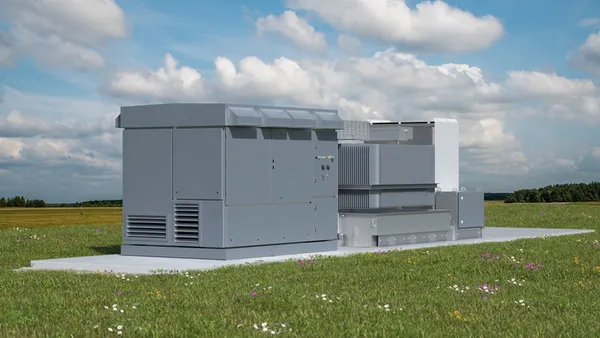
- Facilities seeking backup power will help boost annual installations in the commercial-sector energy storage market 27% in megawatt terms through 2031, according to an estimate by the American Clean Power Association and renewable power data firm Wood MacKenzie.
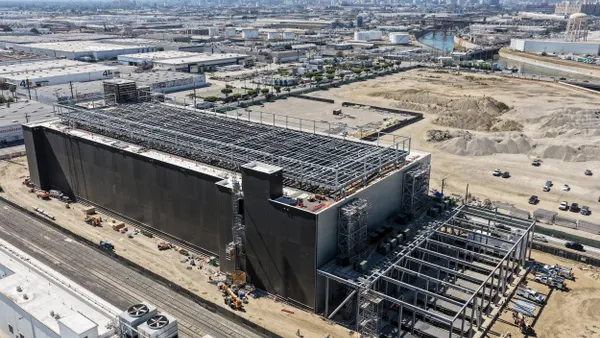
- Data centers facing grid-connection bottlenecks are a big driver of the growth. “Storage can provide needed capacity faster, cheaper and more reliably than gas alone," Allison Feeney, research analyst at Wood Mackenzie, says in a summary of the U.S. Energy Storage Monitor that the firm puts out with ACP, released this week for the third quarter of 2026.
- When utility-scale and residential sectors are factored in, annual installations of energy storage are expected to grow more than 50% in megawatt terms through 2031. Utility-scale storage will see 8% average annual growth, and residential storage 9% average annual growth, over the next five years, the report says.
Dive Insight:
Energy storage encompasses several technologies, but most commercial applications are battery systems, and about 90% of those are lithium-ion, the International Energy Agency says based on 2025 data. Hydroelectric, thermal and compressed air are among the other types of systems. Those are generally utility-scale applications, EIA says.
Innovation in the battery space is giving facilities options in addition to lithium-ion. Google, for instance, closed a deal earlier this year with Form Energy and utility Xcel Energy to install 30 gigawatt-hours of battery storage at one of its data centers in the form of iron-air batteries, which engineers tout for their duration. “By … pioneering long-duration storage … we are helping to build a more resilient system,” Amanda Peterson Corio, Google’s head of data center energy, said when the deal was announced.
Form Energy says on its website that its batteries can release energy for up to 100 hours, delivering power “for multiple days at a time.”
In the ACP-Wood Mackenzie analysis, improving durations, particularly in utility-scale and residential applications, is one reason the sector saw an increase in megawatt hours even though the number of installations dipped in the second quarter. “Longer duration … systems drove MWh growth,” the report said.
The average duration of U.S. energy storage systems increased from 2.8 hours to 3.5 hours, the report said.
Changes in public policy priorities are supporting storage growth, too. In addition to states and municipalities requiring data centers and other large load users to bring their own power, which in many cases include a storage component, public entities at local, state and federal levels are pushing virtual power plants. VPPs are programs in which utilities leverage excess capacity in commercial facilities, homes and other sources to support grid power. Storage is a frequent component of VPPs.
“Distributed storage's value proposition is broadening beyond customer-centric benefits to include grid services, as the industry seeks to position virtual power plants … as a key enabler of load growth,” the report says.
Looking at second-quarter data, the ACP-Wood Mackenzie analysis says 48 MW of energy storage was installed in the commercial property segment. That’s down from the first quarter, which was unusually high, it says, because of a rush in California by facilities and households installing storage before state tax incentives dropped. Although the reduced incentives took effect in 2023, the state’s top court didn’t settle questions about their legality until June, spurring the rush.
As a result, while the storage installed in the second quarter is lower than in the first quarter, it’s in line with historic norms, the report says.
Utility-scale deployments for the quarter totaled 4.7 GW/17.6 GWh, down 8% year-over-year in MW terms, which the report attributes to market saturation.
Residential deployments also declined, falling 15%, to 676 MW, which the report attributes in part to the federal clean energy and energy efficiency tax credits eliminated in the One Big Beautiful Bill Act.
Despite the quarterly drop among the segments, the outlook is bright for the next five years because of the broader trends favoring energy storage, the report says. “With a strong pipeline and continued technology improvements, the outlook for storage remains exceptionally strong,” John Hensley, ACP’s senior vice president of markets and policy analysis, said in a statement.