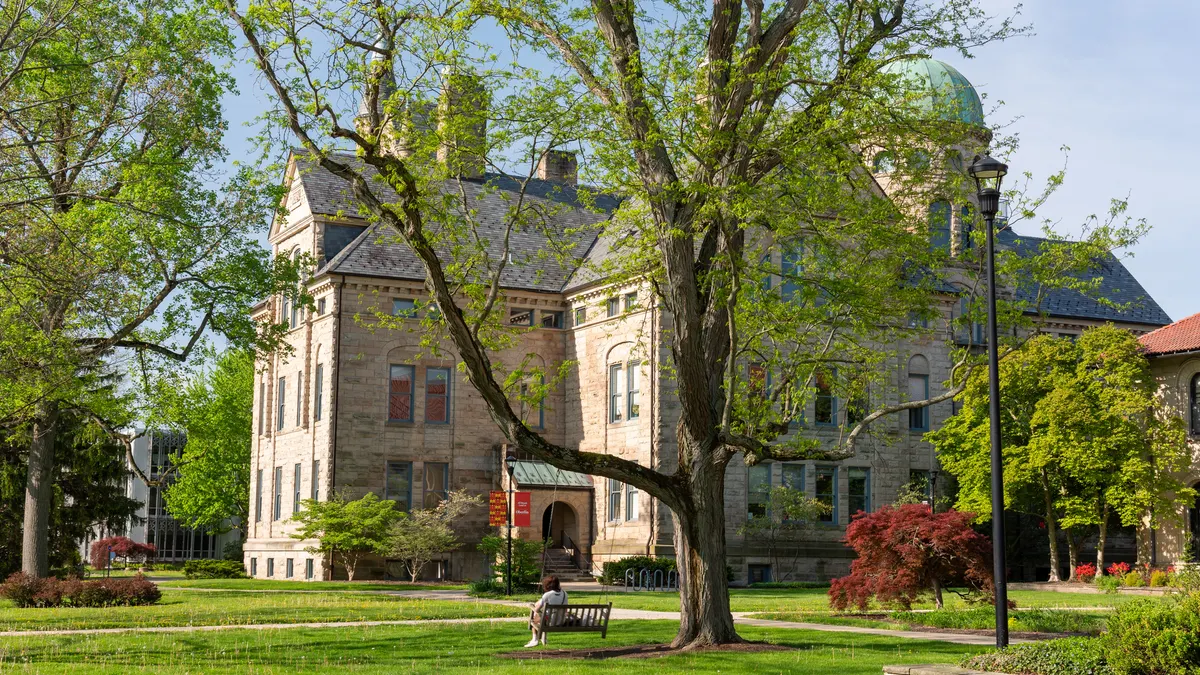
When Oberlin College and Conservatory in Ohio announced it had reached carbon neutrality last year, it was one of several universities that had shown, or was in the process of showing, the feasibility of using geothermal to cut harmful emissions.
Geothermal as a tool “is growing globally,” Rob Thornton, president and CEO of the International District Energy Association, said in an interview.
Thornton and others who worked on the project shared with Facilities Dive the process they went through to get the project to the finish line.
Early commitment
In 2006, the university committed to reaching carbon neutrality by 2025 but faced a challenge with campus infrastructure that was past the end of its useful life and failing, requiring extensive capital investment.
To overcome these challenges, the university worked with energy services firm Ever-Green Energy to create a carbon neutrality implementation plan in 2016 that included the design of a campus conversion from steam to hot water, verification of the optimal carbon-free energy supply strategies, utility organization planning, development of financing strategies and engagement, the firm says in a description of the project.
In March 2021, trustees approved a plan to convert the campus to a low-temperature hot water geothermal district energy system, expand the chilled water system, upgrade electrical systems and modernize campus buildings. The project team’s thoroughness in developing the plan and making the commitment to carbon neutrality by 2025 helped it to secure $80 million in bonds certified by the global nonprofit Climate Bonds Initiative.
“From a financial viability perspective, we were able to show through modeling that this was going to be the more cost-effective solution than if the college continued doing what it was doing,” Michael Ahern, senior vice president of system development at Ever-Green Energy, said. The team was able to secure buy-in as well because campus infrastructure was failing so significantly that leadership could see failures in real time, he said.
“We were actually in a board meeting in December, talking through our recommendation of where to go next. And at the very time we were in the board meeting, there was a steam leak out in the primary area of the campus where students convened,” he said. “There was steam coming out of the ground while we were in a board meeting, so that did help spur it, just a bit.”
Although the project predated the federal Inflation Reduction Act, which included tax credits for projects like this, the college was able to be grandfathered in to secure the credits, making the changes more affordable, Chris Norman, senior director of the Office of Energy and Sustainability at Oberlin College said.
Project implementation
Construction took place over four years, with work concentrated during the summer of each year to limit disruption, Ahern said.
“I’d be lying if I said we got to it perfectly, and I think that’s a good thing,” he said. “We were nimble enough to be able to react to circumstances as they changed.” Expectations made in 2019 for what campus would look like differed from what they actually experienced, he said. The team couldn’t predict how COVID would affect operations, for example.
“The campus was actually an active campus through the summer of ‘21, which of course was not part of the original plan,” Ahern said. “And then as college went back to a more business-as-usual, we had to adjust our planning efforts.” But the college was able to react as circumstances came up – like finding that the school’s 150-year-old water pipes were failing.
“That had to be managed as we’re working through the project [and] discovering skeletons,” Ahern said. “Not literally, but discovering issues in various buildings that had to be reacted to.”
One broader challenge was the range of buildings on campus, spanning modern facilities to historic landmarks, all with different systems, Norman said.
While some were built more recently with low-temperature hot water in mind, making retrofits easier, other buildings were pneumatic, previously running on steam. Approximately 60 of the 85 buildings in the main campus needed to be converted, Norman said.
“Some of those, we just simply ran the distribution lines to them, because the retrofit was going to be so much more involved and those are now on a capital improvement project as we plan to bring those along,” he said. “But the rest of them were converted and now are in the commissioning phase.”
“The reality is there’s very few of the 60 where everything went … exactly,” according to Hoyle. “You get into the buildings [and] they’re performing differently than you anticipated [or] there’s some infrastructure that ultimately you just have to replace. [If] you’re in the building, you’re retrofitting everything. You can’t ignore certain circumstances.”
Planning more means wasting less
Looking back at the early planning phases in 2015 and 2020, Ahern noted that he would spend more time fully vetting what existing infrastructure could have been leveraged and utilized as part of the overall conversion, “versus just going in and replacing everything.”
“The amount of runway you can utilize on the front end to test and retest and run what-if scenarios with the existing infrastructure, the more you can do that up front, the better off you’re going to be, because you’re able to mitigate millions of dollars of cost that otherwise you would spend,” he said. “We’re able to do that for the later stages of implementation because we have more runway, [but in] the earlier stages, unfortunately, there was probably some investments made that we could have avoided.”
Thornton says Oberlin’s project is part of a significant movement towards geothermal on college and university campuses. He pointed to other projects underway and completed at Princeton University, Smith College in Massachusetts, Ball State in Indiana and the University of Toronto.
These geothermal projects are being driven by carbon emissions targets, but the industry writ large is still facing headwinds related to affordability, Thornton said. But the technology can still make sense if leveraged fully.
“If there’s renewable electrons that are inexpensive when the demand is low, those can be converted to thermal and used the next day or the next week,” he said. “We’re seeing that as a tool to manage affordability.”
While the project took years and didn’t happen overnight, the length actually gave multiple classes at the institution the opportunity to engage in the planning, implementation, operation and verification of the system, Norman said.
“It’s a real-world learning lab we’re engaged in and I think it does set us apart,” he said. “We’ve got students and families that are choosing to come here because of the project. Certainly staff and faculty choose to stay here because of it.”