Dive Brief:
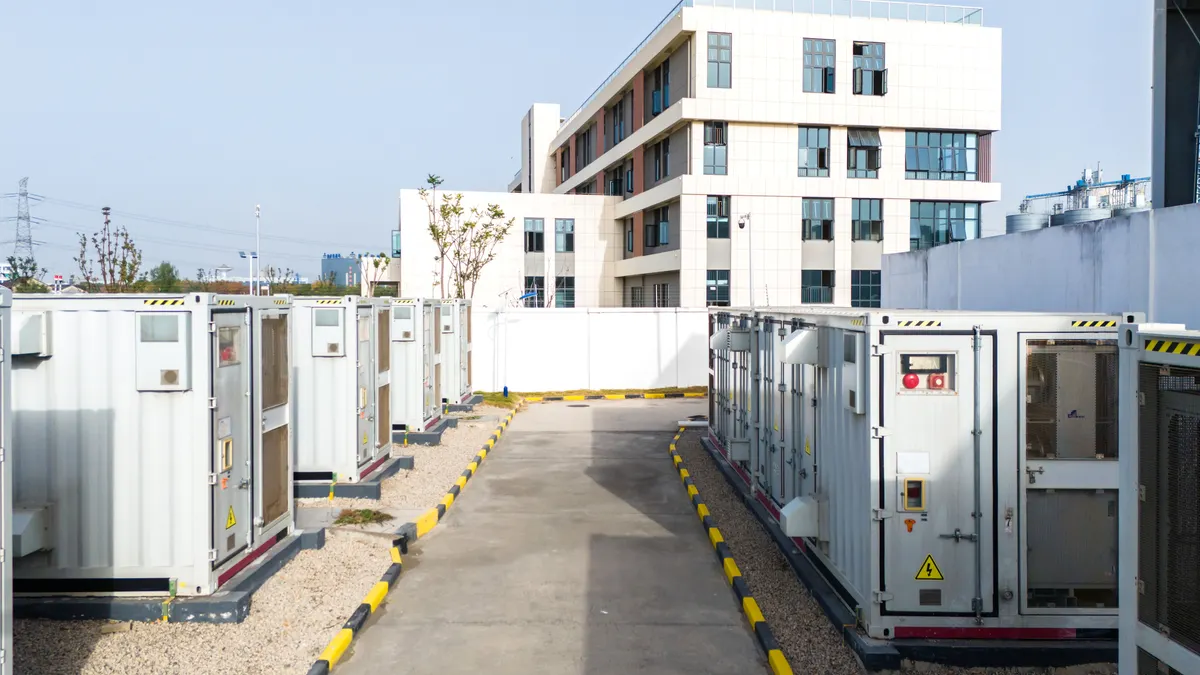
- Commercial energy intelligence company GridPoint is expanding its platform with on-site battery storage as U.S. electricity demand and costs, decarbonization commitments and grid risks drive facilities to implement battery energy storage systems at scale, the company said Wednesday.
- The company is targeting 2 gigawatts of distributed storage capacity across its footprint, which includes more than 20,000 buildings. GridPoint’s platform manages HVAC, refrigeration, lighting and other controllable loads for multi-site operators.
- The move comes as building owners turn to battery energy storage systems for resilience against grid disruptions, support for decarbonization commitments and as a way to reduce energy costs, says a joint report by the Urban Land Institute and UL Standards & Engagement.
Dive Insight:
Commercial electricity rates rose 42% across GridPoint sites over the past five years, the company said in a release. National battery storage capacity reached nearly 58 gigawatt-hours in 2025, the largest year of new capacity on record, and the market is expected to install an additional 500GWh of storage between 2026 and 2031, a 250% increase over the previous five-year period, according to the American Clean Power Association.
Although battery investment has accelerated across utility-scale, large industrial and data center applications, commercial buildings remain “largely untapped,” creating opportunity, GridPoint said.
“Despite this momentum, market adoption of BESS is still in its early stages,” ULI and ULSE say in their report, released Oct. 27. “Many property owners remain uncertain about where to start, which technologies fit their building type, and how local utility conditions affect financial returns. Community resistance in some jurisdictions, driven by fire safety concerns over large battery installations, has led to development slowdowns in select markets.”
Even with these impediments, factors including grid stress, corporate decarbonization mandates and the growing premium for energy-secure assets suggest that on-site storage will be an increasingly standard component of real estate underwriting and development strategy in the years ahead, the report says.
“GridPoint was founded on the belief that commercial buildings could play a much more active role in the energy system,” GridPoint co-founder and CEO Adrian De Luca said in a statement. “Over two decades later, the need for that is becoming much more urgent. We have the customers, the performance data, the building controls and the field infrastructure already in place to integrate storage as the next layer to transform our installed base into a much larger distributed energy resource.”
GridPoint says adding battery storage to its platform allows operators to lower energy costs and add grid revenue. BESS reduces peak demand and charges by shifting when a facility draws power from the grid, while stored energy and flexible capacity can also be used to earn payments through utility and capacity programs so commercial facilities capture value when the power system needs capacity, the company says.
Demand charges — utility fees based on a building’s peak electricity consumption — often represent 30% to 50% of a commercial electricity bill, according to research from the National Laboratory of the Rockies. The analysis estimates there are roughly 5 million commercial customers in the U.S. who can subscribe to retail electricity tariffs that have demand charges in excess of $15 per kilowatt, or over a quarter of the 18 million commercial customers nationwide.
ULI and ULSE say that these charges are a particularly powerful driver of market adoption as they allow operators to shave peaks by discharging cheap stored energy during high-demand windows. Federal incentives are also still favorable for BESS, especially when considering energy community and domestic content incentives, while 13 states have also established procurement mandates aimed at boosting behind-the-meter storage.
“Together these benefits can cut bills by up to an additional 15% at qualifying sites, on top of the 20% GridPoint customers typically save today,” GridPoint said. “As the grid becomes more strained, batteries can also provide resilience: in the past year alone, GridPoint customer sites in 26 states experienced 1,699 weather-driven outages.”