New York City saw high levels of compliance with Local Law 97 in its first enforcement year, but for those that haven’t filed or were over emissions limits, it is sending out notices of deficiency and fines, according to the city’s Department of Buildings.
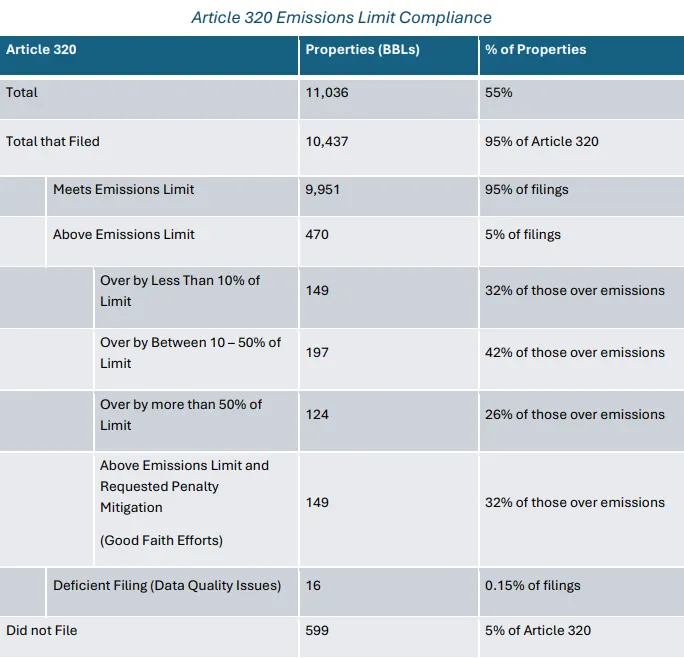
Almost all New York City building owners filed their 2024 Local Law 97 reports this year, with 95% of those meeting requirements for either emissions limits or one-time upgrades, the agency said in its year one results report, released Sept. 14.
Calendar year 2024 was the first compliance year under LL97, requiring most buildings over 25,000 square feet to meet greenhouse gas emissions limits and report compliance to the city by August 29, 2025.
Two LL97 compliance paths — Article 320 and Article 321 — had reporting requirements for this first compliance year, DOB said in its report. Of the 29,031 buildings required to report in the first compliance year, only 7%, or 1,911, did not file by the deadline. The Article 320 path requires larger commercial buildings to meet certain emission reduction requirements. The Article 321 path requires houses of worship and affordable multifamily properties to meet a different standard.
Some of the properties that haven’t met the deadline could still file, an agency official says. “At this point, there’s only a little over 1,000 properties that haven’t filed yet, and I say yet because we’re pursuing enforcement against them,” Laura Popa, deputy commissioner of sustainability at NYC DOB, said in a webinar hosted by the Urban Green Council.
Article 320 generally applies to market-rate buildings across use types and requires annual reports documenting building emissions and compliance within applicable emissions limits. Certain affordable housing buildings have later reporting start dates in 2027 and 2036, depending on the applicable program.
Some 11,000 properties, made up of almost 17,000 buildings, were required to report under Article 320 in 2025.
Forty-five percent of these properties — dubbed BBL, or “Borough, Block, and Lot”, by the agency — were multifamily housing, followed by 17% categorized as office space, 5% labeled hotel and another 8% that were split between K-12 schools or non-refrigerated warehouses.
Over 9,950 of these covered properties met emissions limits for 2024, making up 95% of filings. The majority improved their performance to meet limits through building upgrades and energy-efficiency measures, like lighting upgrades, envelope work, installing heat pumps or implementing building and energy management systems, Director of Building Energy & Emissions Performance Emily Hoffman said on the webinar.
Only 470 BBLs exceeded their 2024 emissions limits, and of those, 32% exceeded limits by less than 10%, DOB said in the webinar. Just over 40%, or 197 buildings, reported emissions 10% and 50% over limits, Hoffman said.
Local Law 97 provides alternative compliance pathways for eligible buildings to use offsets, adjustments, deductions and alternative calculation methodologies. But only a handful of properties used these tools: 79 used Affordable Housing Reinvestment Fund offsets, 31 used solar, 10 used combined heat and power systems and six used beneficial electrification credits, which reward building owners who replace fossil fuel HVAC systems with high-efficiency electric equipment.
No buildings used offsite storage, onsite storage, cell tower, fuel cell or alternative fuel deductions, per the report.
About 32% of those over limits requested penalty mitigation, which is allowable if they can show they made a good faith effort to comply.
“An owner can show they’ve made good faith efforts and … request penalty mitigation [through] several categories,” Popa said. “One can show the building is a critical facility, like a hospital, or demonstrate that work is underway, but just hasn’t been completed yet. One can submit a decarbonization plan through 2050 or even be working with a utility to increase a building’s electrical capacity.”
Out of the 149 properties that requested a penalty break for their good faith effort, more than two-thirds, or 102, chose to do decarbonization plans, she said. Fewer than 1% filed with deficient data quality, DOB said in its report.
Article 321
The Article 321 pathway enables many affordable housing properties — those with over 35% rent-reduced units — and houses of worship to meet LL97 regulations through a one-time obligation that can be satisfied through emissions performance reductions or completion of prescribed energy conservation measures.
More than 83% of Article 321 filing properties used the prescriptive pathway, which requires owners to implement at least 13 energy emissions performance improvements. Almost 30% of owners requested penalty mitigation to obtain additional time to complete required work. Among those using the performance pathway, more than 90% reported already meeting more stringent 2030 emissions limits.
Nearly half of all Article 320 properties are in Manhattan, which had the highest filing rate at 98%. It also had a very high emissions compliance rate of 95%. Brooklyn, Queens and the Bronx each had filing rates around 92% to 93%. Staten Island had the lowest filing rate at 84%, but also the smallest number of Article 320 properties, Hoffman said.
Asking for action, then forcing it through fines
Popa said DOB takes its responsibility for implementation and enforcement seriously and accomplishes this primarily through its use of notices and fines. “This first year, we issued notices of deficiency, or NODs,” she said. “They were given to owners who didn’t fulfill their obligations, like filing on time, and then basically gave them the opportunity to comply within 60 days.”
Local Law 97 places significant fines on those BBLs that don’t meet emissions limits, up to $268 for every ton of carbon dioxide equivalent emissions above their annual allowance.
DOB sent out 1,014 NODs to Article 320 buildings for Failure to File, with 239 properties filing after receiving an NOD and another 111 resolved based on exemptions or exceptions. The remaining 664 properties were entered into OATH proceedings in process, nudging another 65 to file.
“We’re down to 599 and counting. Our goal this year is … to get 100% filing,” said Popa.
New York City sent 164 NODs for emissions, with fines calculated based on emissions report submitted by the building owner and audited by DOB, according to the agency.
Owners can resolve the NOD by purchasing affordable housing reinvestment fund, or AHRF, offsets, paying the assessed penalty or working to submit a plan for noncompliance. Five owners have resolved their emissions NOD through offsets to date, while 15 have resolved through penalty payments, Popa said.
AHRF offsets are a viable pathway for compliance for some cases if the building is within 10% over its limit or “if you pay the penalty,” she said. “Now we also paired outreach with these notices of deficiency to give owners the opportunity to speak with us and NYC Accelerator about their plans for compliance and hopefully to get on a path and create a plan.”
“We have about 15 that are in the process of paying, or they’ve paid their penalties, and that total amount is around $270,000, representing those buildings that we’re collecting in penalties so far,” Popa said.
For Article 321 properties, DOB sent out 476 NODs to 321 properties. It received 50 filings out of that and has started issuing $10,000 violations to those that still haven’t filed.
“It’s important to recognize that this is the first year of compliance and a new reporting process,” Popa said. “We want to bring owners to the table and work with them, and the NODs are helping to do that. Some people need the threat of fines to act, and high fines are forcing action.”
Recognizing that properties are still learning the process, DOB is accepting filings in lieu of the fine, she said. Popa noted that if an owner has filed and is over the emissions limit, or hasn’t completed a prescribed energy conservation measure, they should reach out to NYC Accelerator and DOB and work with them to get on a path to compliance.
The department will mediate resolutions and give owners more time if they have a plan in place and are taking meaningful steps to comply, but where it’s seeing non-compliance, “we’re pursuing penalties,” Popa said. “That’s both through [the Office of Administrative Trials and Hearings, or] OATH for 320 buildings and through DOB for 321, because that’s how the law is set up.”
Looking ahead to 2030 compliance
When the law was first designed, modeling projected that 80% of covered properties were already in compliance with the initial 2024-2029 limits based on historical city benchmarking data. Popa says the much higher compliance levels seen are a result of data refinement, changes between how the city modeled square footage and how it actually measured compliance, and alternative compliance pathways were factors that influenced the jump.
But data refinement won’t help owners going forward, Popa said. “When we hit 2030, so many more building owners are going to have to do something to come into compliance,” she said. By 2030, buildings owners must slash emissions by 40%.
DOB noted that AHRF offsets have pulled in $1.7 million that are being used to fund decarbonization efforts at buildings that otherwise wouldn’t because they’re not required to. So far the funds have been allocated to two projects for deep electrification work, like heat pumps, “and we anticipate more projects will get a piece of that money in the future,” Popa said.
“Year one shows Local Law 97 working largely as designed, with high engagement, strong compliance and enforcement paired with flexibility,” Urban Green Council said in a progress report it released on the program. “Properties under Article 320 will now be submitting reports every year to monitor progress, but the real test will come as emissions limits tighten in 2030, when more buildings will need deeper retrofits to comply.”