Dive Brief:
- Researchers are touting the promise of elephant-skin inspired tiles that can cool structures more than other types of surface materials, lowering energy costs and reducing the need for air conditioning.
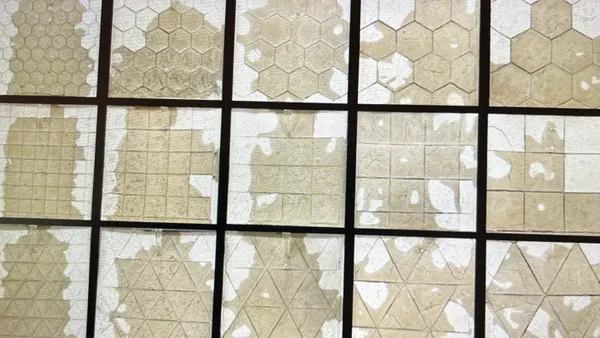
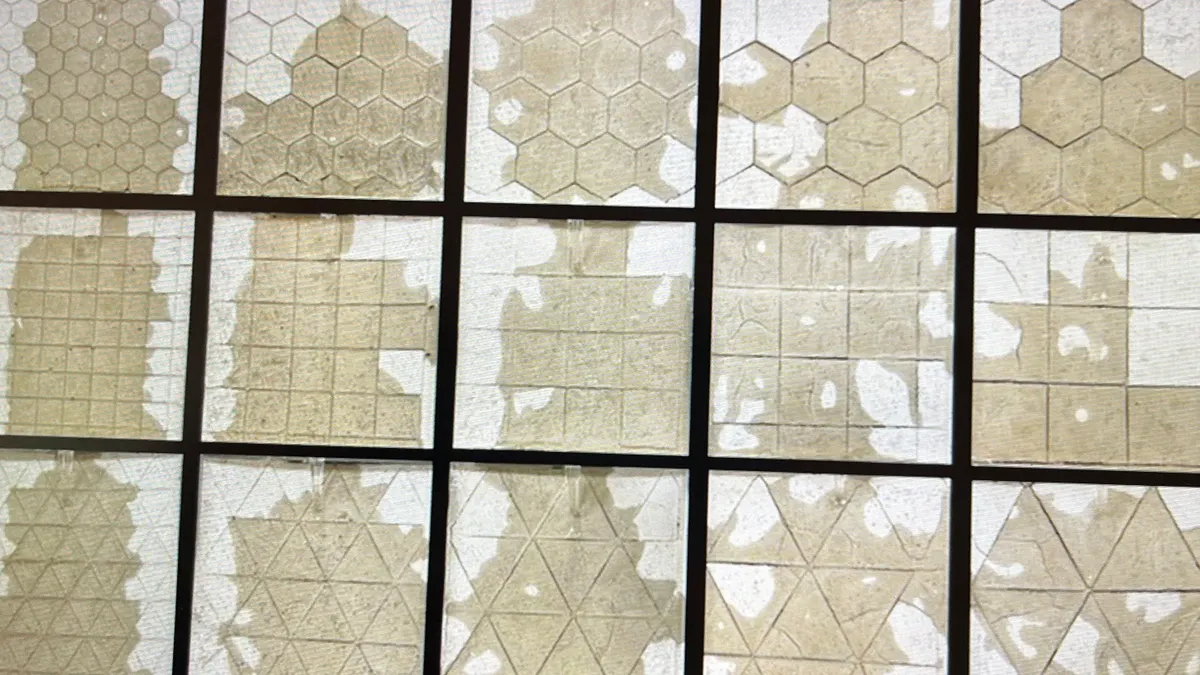
- The tiles use a concrete mixed with a chalky powder that forms microscopic cracks when it dries. When the cracks are engineered to form in a hexagonal pattern, the tiles become a store of water that covers the surface of the structure and cools it over long periods of time as the water evaporates.
- The researchers conducted a building-scale test using a prototype of the tiles and found they kept temperatures beneath the structure 89.6°F compared to 107.6°F beneath cracked commercial stucco and 125.6°F beneath non-cracked stucco.
Dive Insight:
The idea came to Dorit Aviv, an associate professor of architecture at Syracuse University, from seeing how African elephants cool themselves by spraying water over their skin. The water evaporates slowly after it spreads through their wrinkles.
“Elephants have a network of cracks in their skin that trap water,” Aviv said in a summary of the findings in Penn Today. “When they spray themselves, that water stays put and evaporates slowly, cooling them over time.” The findings were published in April in Advanced Materials.
The networks “act like capillaries capable of pulling water across the surface and holding it in place,” says Shu Yang, a materials scientist at the University of Pennsylvania.
The researchers extracted the chalky powder from diatomaceous earth — a naturally occurring material from fossilized algae. The powder is mixed with Portland cement and then dried.
The mixture can be applied to large panels using a pneumatic spray tool like a hopper gun, suggesting a way to apply it on-site during construction, the researchers said.
To trigger maximum cooling during a heat spell, building operators could spray the tiles with water.
If used in conjunction with a smart watering system, buildings could be kept cool while limiting water use to only what’s needed, the researchers said.
“By combining these materials with weather forecasts and automated water delivery systems, we could supply just enough water, exactly where and when it’s needed, to maximize cooling while minimizing water use,” said Kun-Hao Yu, an assistant professor at Syracuse University who was part of the team while at the University of Pennsylvania.