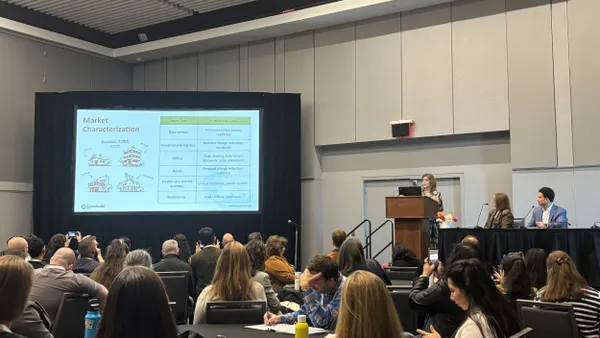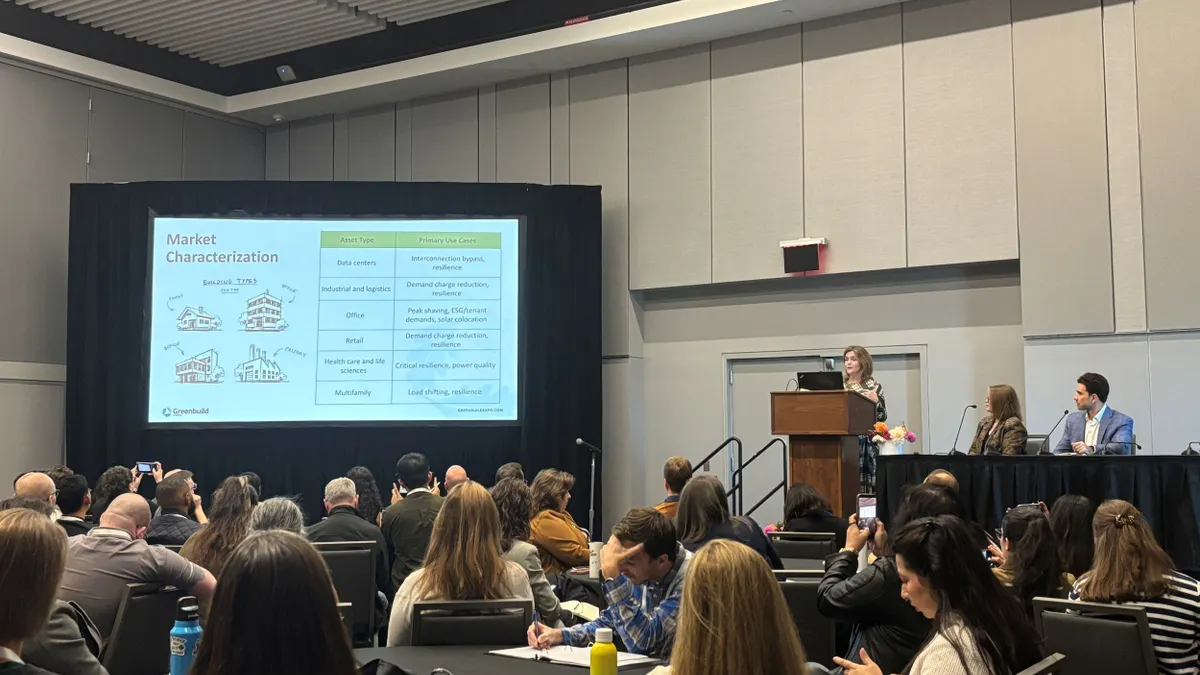
Building owners are turning to battery energy storage systems to lower energy costs, add resilience against grid disruptions and support decarbonization. Despite momentum, their adoption faces a number of persistent obstacles, said panelists at the Greenbuild conference last month.
Nationwide, nearly 58 gigawatt-hours of on-site battery storage capacity was installed in 2025, the largest single year of new battery capacity on record, according to a report by the Urban Land Institute and UL Standards & Engagement, drawing on data from the American Clean Power Association. Looking ahead, the sector is expected to install 500 GWh of battery storage between 2026 and 2032, the report says.
Notwithstanding the success of these models, several barriers are keeping the market from growing more quickly, according Jill Maltby-Abbott, senior environmental and sustainability standards engineer at UL Standards & Engagement, a panelist who contributed to the ULI and UL report.
Location-specific challenges. Even when a project makes economic sense, it can be stopped by interconnection and permitting woes, unclear approvals, shifting local requirements and unfamiliarity with the technology, according to Maltby-Abbott. Even where interconnection and permitting processes exist, commercial-scale storage projects can take years to deliver, the report said.
Long and unpredictable timelines can cause projects to accumulate soft costs — like time and money spent on community engagement or engineering fees — and be exposed to changing market conditions, incentive structures and regulatory requirements, adding to the financial risk of implementation, per the report.
Risk thresholds. Another key consideration is how municipalities view the risk and governance of these assets, Maltby-Abbott said. “How are [municipalities] defining the [risk] thresholds that they’ll accept? It’s very much on a per-project, per-owner basis, and this is a challenge that a lot of people experience with multiple emerging technologies.”
Concern over risk can lead to delays as local officials put up hurdles, Dean Apostoleris, practice leader of renewable energy development at Kimley-Horn, said at the conference. “What we see as a really big barrier in terms of penetration into new markets and, even in some situations, mature markets is resistance from the regulatory, zoning, land use and siting perspective of these batteries,” he said.
Even in really population-dense markets, where storage development has been a priority for quite some time, there has only been increased adoption of on-site battery energy storage in the past five or so years, according to Apostoleris. “That issue stems from a lack of education and lack of knowledge about what battery energy storage really is,” he said.
For example, New York state has established a mandate to procure 6 GW of battery energy storage by 2030, with Illinois and Massachusetts setting targets of 3 GW and 5,000 MW as well, respectively. But with those targets close to just three years away, New York only has 415 MW of battery storage installed, or 7% of its target, as of the presentation, Aposoleris said.
State mandates aim to spur battery adoption but development "comes down to the local and community level,” Apostoleris said. “And a lot of these communities have not yet had the bandwidth, the knowledge or the education to implement some of these regulations.”
“As a result, when you actually go to permit and construct BESS, ultimately the reviews and approvals are … preventing a lot of that mandate and that goal from being achieved,” he said.
Fire risk. Of all the risks, fire is one of the first localities worry about, said Kara Kokernak, senior director of the ULI Lewis Center for Sustainability in Real Estate. “That is something that became very apparent” when conducting research for the report, she said. “That was tagged in most of our conversations, but having fire safety teams part of that education can help ease those concerns.”
Because of this pushback, Apostoleris said, it can be much easier to implement these projects in jurisdictions that have already established BESS safety requirements and review processes, which provide more prescriptive guidance on how projects will be evaluated.
He points to the Massachusetts Energy Facilities Siting Board as a good example. It “allows a lot of developers to push through their projects in a very prescriptive manner that reduces some of the risk that often comes with uncertainty of reviews and approvals they might have at the state level,” Apostoleris said.
Even when requirements are stringent, this predictability can help project teams incorporate safety considerations earlier while supporting fire department preparedness and confidence in how potential incidents will be avoided or managed, the report says.
Community engagement, or lack thereof, can often delay, constrain or stop otherwise viable projects, the report says. For that reason, early engagement, before formal filings, is a “consistent recommendation from those who have successfully navigated community opposition,” the report says. “This gives developers the opportunity to understand specific concerns, explain safety and emergency response approaches, and adjust the project so that community input is reflected in project planning from the start.”