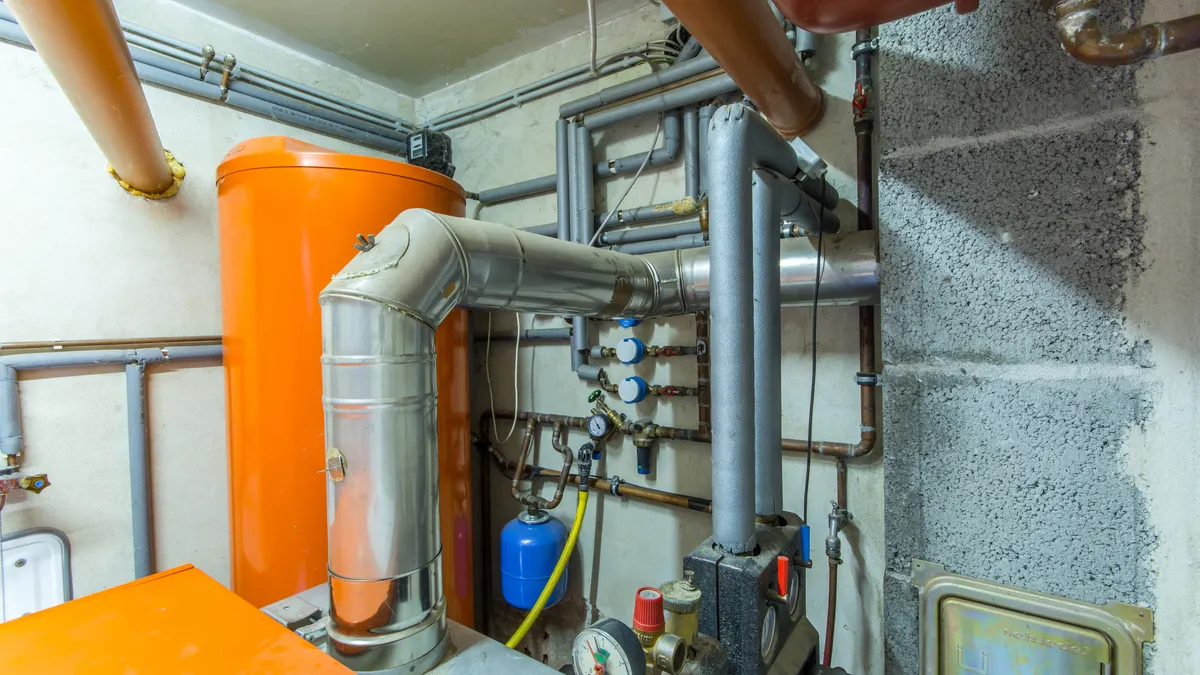
Chimneys are ubiquitous in buildings built before 1990, but they’re often overlooked as a safety risk, experts say.
Over time, the acidic condensation and other byproducts from burning fossil fuels damages chimney interiors, allowing harmful gases to seep into rooms.
“When you’re burning fossil fuels, natural gas, propane or oil, you’re producing combustion gases, including carbon monoxide and acidic condensation,” said Joe Ochal, founder of Chimney Scientists, which provides chimney-related services in the Philadelphia area.
As chimneys age, furnaces and hot water heaters vent combustion gases directly into them, resulting in damage and wear that can cause poisonous carbon monoxide to enter into buildings without obvious warning, Ochal told Facilities Dive.
“When you burn natural gas, one of the products of combustion is water in the form of steam. All of this acidic steam enters into the chimney, and, over many years, corrodes the interior and breaks it down,” Ochal said. “The chimney’s acting like a straw, pulling the gases up, and over time the straw starts to get holes in it.”
As holes start to form, some of those gases stop going up the chimney and instead permeate into rooms and buildings, posing harm to occupants, he said.
Ochal says that, for homes built before 1990 in Philadelphia, his company found 67% tested positive for carbon monoxide in the basement from heating system and chimney leakage. “We’re seeing 5, 10, 35 parts per million of carbon monoxide, where a majority of the gases are going up [the chimney], but a small portion [remains],” he said.
At 35 parts per million, carbon monoxide causes impairment, irritability and tiredness, he said.
Occupants often aren’t aware of the gases, Ochal said. “Why doesn’t anyone know about it? Why isn’t anyone telling me anything about it? It’s because carbon monoxide detectors only go off at about 120 parts per million, [which] is acute harm and hospitalization,” Ochal said. “If you’re going to be in that room for more than five or 10 minutes, you’re going to be throwing up.”
The risk from chimneys and HVAC ventilation more generally should be higher on facility manager’s radar, according to Chris Drew, president and CEO of Burnham Holdings.
“I don’t think people think enough about venting,” Drew told Facilities Dive. “‘How am I going to vent?’ ‘Do I have an existing chimney?’”
Through its subsidiaries, Drew’s company manufactures high-efficiency steel and aluminum condensing boilers, industrial boilers, copper-finned boilers, cast iron and steel gas and oil boilers.
“Venting is one of the largest underrepresented issues in the HVAC space when it comes to fossil fuel,” Drew said. “Not to sound dramatic. We care deeply about the safety of our products [and] we are a highly regulated industry. Venting concerns dominate our installation manuals. We spend more time talking about venting and how to vent safely than anything else in that manual, generally, because it is the thing that potentially can hurt you.”
But among facility operators, “I don’t know that venting gets enough [attention] in terms of how important it is and can be to the proper installation of equipment,” Drew said.
Facility managers can look to several standards covering chimneys to ensure proper installation and performance of the HVAC equipment to properly vent.
Operators must meet NFPA 211, the National Fire Protection Association’s national safety standard that sets minimum requirements for all venting and chimney systems used to exhaust combustion products from heating appliances, fireplaces and solid fuel-burning equipment. Its scope extends to new construction, alterations and the inspection and cleaning of existing installations, according to the National Chimney Authority.
Ventilation for chimneys is also covered by two additional standards: ASHRAE/ANSI Z21 for gas-fired, low-pressure steam and hot water boilers and UL795 for commercial-industrial gas heating appliances. Code 12.4.3.3 of Z21 requires forced draft systems and all portions of induced draft systems under positive pressure during operation to be designed and installed to prevent leakage of flue or vent gases into a building.
Chimneys are also important to remember when considering capital expenditure measures related to HVAC, like electrifying your system, Drew said.
“With a legacy product, I’m going basically straight up through a chimney, [but] with a high-efficiency condensing product, suddenly I’ve got to put multiple penetrations in the wall,” Drew said.
Even after a facility switches away or weans off on-site combustion systems, chimneys still need to be inspected, Ochal said.
“Let’s say you’ve switched over to an electric system, you’re not even heating your house with fossil fuels anymore,” he explained. “You won’t have the carbon monoxide risk, but the chimney structure is still degrading from water getting into it, freezing, thawing and cracking the masonry. The problem with that is it’s one of the things that no one’s paying attention to.”
Once water gets in, it isn’t just carbon monoxide that building operators need to worry about, but leaks and mold that require much costlier remediation efforts, he said. And just because an HVAC system gets serviced every year, it doesn’t mean crews are looking at the chimney, so getting a dedicated chimney specialist that can service it with thermal imaging is the safest option, Ochal said.