Making incremental upgrades to building systems that align with leasing cycles can help owners improve efficiency while capturing demand spilling over from Class A properties, experts say.
Existing buildings are one of the biggest areas ripe for efficiency improvement, says Todd Sims, senior director of regulatory and industry affairs for the built environment at the National Electrical Manufacturers Association.
More than 70% of today’s buildings will still be in use in 2050, according to the World Economic Forum. Although this includes newer buildings, which are already built to the latest energy codes with increased efficiency, a far larger opportunity lies in upgrading existing Class B buildings, like offices, medical facilities and other commercial properties across the country, according to Sims.
The U.S. has approximately 3.4 billion square feet of Class B office space. Improving and upgrading even a portion of that could deliver enormous benefits in energy savings, operating costs and grid flexibility, Sims said in a recent blog post.
Meanwhile, the office market’s recovery is not linear. Trophy and top-tier assets that closed the experience and operations gap are pulling further ahead every quarter, posting double-digit rent growth and holding up far better during downturns than the ones that didn’t, according to Chase Garbarino, CEO of real estate experience platform HqO.
Although office occupiers are overwhelmingly looking for new Class A space, second-generation and other older assets that can differentiate through amenity offerings or strong locational traits are also beginning to benefit, as demand spills over from the top of the market, according to JLL’s Q2 office market report.
“Offices now are designed with an array of advanced amenities and built to a considerably higher standard than the ones from half a century ago,” CBRE senior vice president of office leasing Brendan Sullivan said in a recent article. “Because of the evolving demands of businesses and their people, modern buildings emphasize experience: access to fitness, food and beverage, outdoor spaces, concierge services, natural light and fresh air, efficient floor layouts and state-of-the-art technology integration.”
“The data backing ‘flight to quality’ is real,” Garbarino said in an email. “But the proof isn’t just in trophy towers. We’ve seen older buildings that spent real money on the building itself — the systems, the envelope, the shared spaces tenants actually use — rather than a cosmetic refresh, and it worked,” he said.
Improving assets through bite-sized upgrades
It’s important to invest in upgrades that are most significant for office space end users, Sullivan said. One of those is the energy efficiency of the space, with 40% believing sustainable building practices are either a prerequisite to building selection or a market-standard characteristic, according to CBRE’s 2026 Americas office occupier sentiment survey.
In Boston, LEED-certified Class B buildings were able to charge an average rent premium of $9.18 per square foot compared to non-certified peers, according to a 2023 CBRE study. “For a 50,000 square foot property, that translates to as much as $459,000 in additional annual rent once leases fully turn over,” Sims said.
The proliferation of benchmarking and building performance standards also helps push the case for investing in upgrades, he said.
But the industry faces a major challenge in communicating to Class B office owners and facility managers that it’s possible to upgrade their buildings without significant capital outlays, Sims told Facilities Dive.
“If you stack [interventions], they pay for each [other] in a phased-in approach. That’s an option. [High-performance building upgrades] are achievable in bite-sized pieces,” he said.
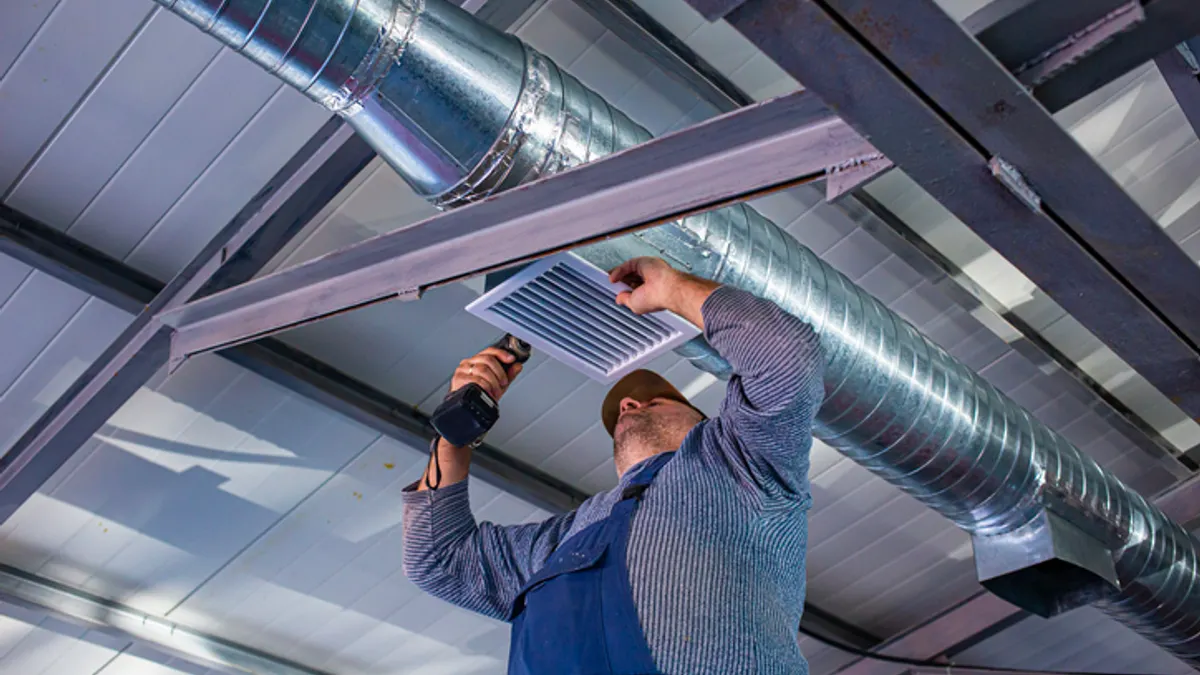
NEMA suggested phased strategy begins with technologies that deliver measurable savings quickly, including LED lighting and controls; energy monitoring and submetering; variable-frequency drives for HVAC motors, pumps and fans; building and energy-management systems; and modernized electrical panels, circuit protection and life-safety systems.
“Just getting started isn’t all that expensive, but [with] the savings from [just] replacing your lighting, you can really start affording further improvements,” Sims said.
CBRE is also advising its clients to “look first at the margins before considering large-scale repositions,” Sullivan wrote.
”Sometimes its the small things that can make the biggest difference,” Sullivan wrote. Instead of spending tens of millions of dollars on a tenant lounge that will see limited use, landlords might instead consider investing in lighting upgrades or repurposing underused space as conference centers or event space, he said.
One case highlighting the small-wins approach is the Portrait Building, in Washington, D.C., which was able to recover its investment in LEDs, occupancy controls and variable frequency drives in just over two years and achieve a 440% return on investment over 10 years, Sims said.
These initial improvements can generate savings that help finance the next phase, with owners then able to add connected controls, resilience technologies, backup power and electric vehicle infrastructure. Although electrification measures can be less effective in older, existing buildings with poor building envelopes, their impacts are set to rise as grids become cleaner, Sims said.
“Take New York, for example. Their grid is becoming more clean, so electrifying, [even] a leaky building may, from a total carbon perspective, pencil out,” he said. “As we are able to bring more distributed energy resources onto local grids, it could make an interesting carbon case for electrifying buildings.”
After these are up and running, facilities can begin to integrate building automation to better participate in demand response and virtual power plant programs, Sims said. These technologies not only help facility managers reduce their own energy bills but also help to lower energy use across the grid.
The importance of cash flow to owners and the high cost to renovate older buildings makes this approach important, especially when energy prices, interest rates and operating costs are rising, like in today’s market, Sims said. Fit-out costs have surged to nearly $300 per square foot on average in North America, the highest globally, according to JLL’s 2026 fit-out cost guide.
The widening divide between prime and non-prime assets means that for Class B, waiting for the market to average back out isn’t a strategy, Garbarino said. Instead, they must figure out which assets have potential to move to the top-performing section of the market and put capital behind them to meet market demands.
“A light retrofit is a different bet than a full repositioning, and the owners getting it right are the ones matching the spend to what the building and the market can actually support, not applying the same playbook everywhere,” he said.
“But if you are looking at creative financing solutions, energy performance contracting is proven to be very effective. Green banks, where they exist, are a good option,” Sims said.
Staging improvements and rolling over savings from upgrades, therefore, is a strategy that allows building owners and operators to align investments with lease cycles, compliance deadlines and available incentives, while minimizing disruption for tenants, according to Sims.
“The result can be a building that costs less to operate, commands stronger rents, and is better prepared for future energy challenges and opportunities,” he said.
“We’re at a generational inflection point with how we use offices. And this isn’t impacting only the top tier of office buildings. It’s affecting all of them,” Sullivan said. “The future of office is now and the opportunity for landlords to meet the moment is here.”
“Full leases, anchor tenants [and] buildings that were written off coming back. That’s the efficient version of this,” Garbarino said. “It’s not about class label or a building’s age, it’s about whether an owner is actually willing to run it, and invest in it, like a business.”