Maintaining and accessing information on their building systems is a big part of what holds back facilities teams from getting out of a reactive maintenance trap, InfraMappa Vice President of Sales Katherine Pfeil said on a webcast the company hosted at the end of March.
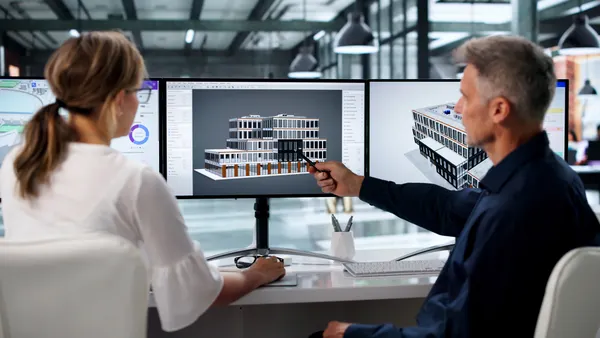
Ideally, facility managers would have everything they need to know about their equipment — make, model, service history — in one place, mapped out in a digital twin, so everyone on the teamcan access the information when something needs work That way the team can take care of problems quickly and keep its focus on a preventive maintenance program that reduces crises, Pfeil said. But for most teams, their operations aren’t like that.
“Sixty percent of facility managers waste up to 20% of their time just looking for information,” said Pfeil, referencing findings from a survey released earlier this year by the International Facility Management Association. “You can't pick your head up. You can't focus on the preventive world and the proactive work that you know you need to do.”
Getting building systems data in one place and keeping it accurate can overwhelm teams, she said. “If you're going to try to undertake this on your own, it could be years [or even be] nearly impossible,” she said.
Maintaining the accuracy of the data over time is also a task. If not done systematically, data maintenance can reduce the utility of the system — something more than 40% of facility managers say describes their situation, said Pfeil, drawing on the IFMA survey.
“Often [there’s] no shortage of documentation” on their systems, she said, “but how accurate is it?”
Pfeil touted her company as a third-party vendor that can inventory the facility’s building and equipment data in a single platform and make it accessible through a map-like interface while the in-house team focuses on its work. There are other companies that do something similar: MaintainX, Limble CMMS and eMaint are among them.
It might take months to incorporate the data into the system but teams can start using the platform right away, Pfeil said.
It “doesn't mean you don't see anything for four months,” she said. Rather, you get “progressive data, so you'll be seeing your information” as it’s being developed. Then there’s a hard launch, “where we … give you all this information” in a final form.
Afterward, the vendor keeps the data maintained over time. “That's the beauty of a cloud subscription,” she said. “If there's a change, it gets maintained on your behalf, so … there's never really an end to this.”
The goal of undertaking such a big data project is to return to facilities teams the 20% of time they spend looking for the make, model, service history and, in some cases, the location of the equipment so they can use that time to do the actual work — a first step to making their maintenance program preventive.
“The mad scramble [facility managers face] is normalized and accepted as part of your job,” Pfeil said. “Things are going wrong around you, and it's just another day, and you're just supposed to stay cool, calm, and collected amidst the chaos. It doesn't have to be that way.”