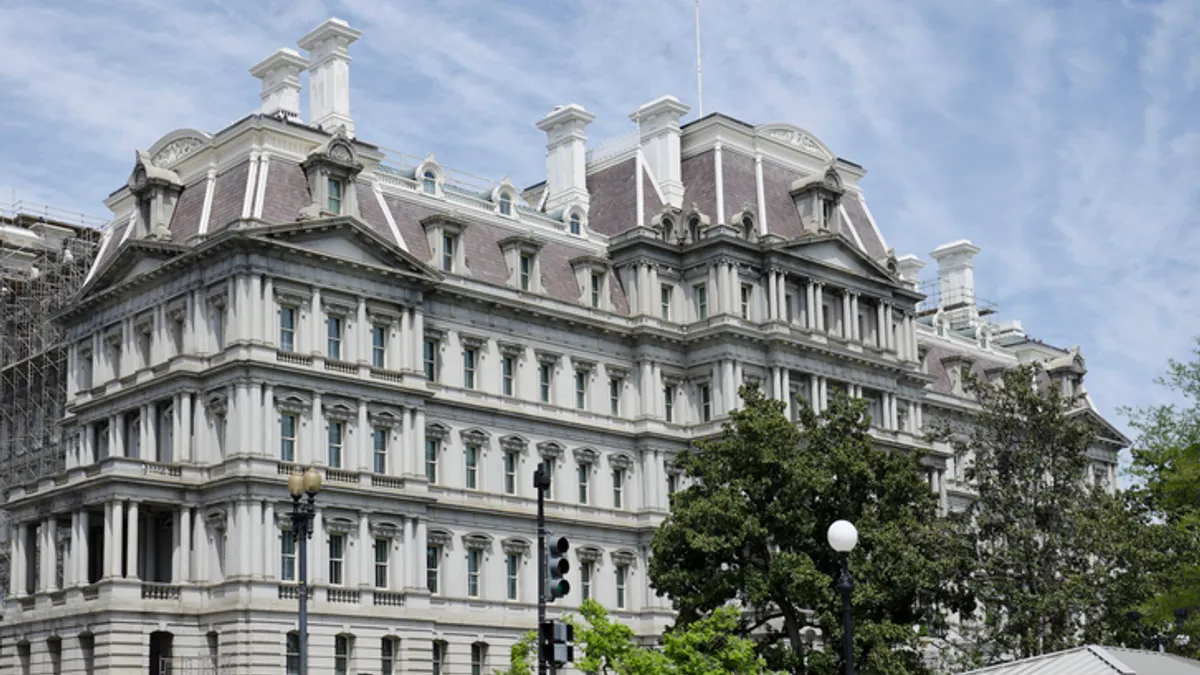
A plan by President Donald Trump to paint the granite facade of the Eisenhower Executive Office Building next to the White House with a white mineral silicate-based masonry paint that he has called a “magic paint” won’t work in the way he has said, according to 25 restoration specialists.
“Mineral silicate paints are not suited for use on granite,” the specialists said in a Q&A prepared by preservationists seeking to stop the plan. “These paints do not chemically bond to granite in the manner necessary to activate their powers to strengthen and protect underlying stone.”
Cultural Heritage Partners, the D.C. Preservation League and others sued President Trump, the General Services Administration and the National Park Service in November for violating federal laws that require work on a historically significant building to be undertaken only after public notice and in consultation with stakeholders.
In the Q&A they prepared, the plaintiffs say President Trump has asserted there exists a “‘magic paint with silicate’” that, if applied to the exterior granite of the building, would strengthen the stone, keep water out, prevent staining, be easy to apply and rarely require repainting. None of those claims is true, according to the specialists.
They say mineral silicate paints are inappropriate for granite because granite doesn’t contain calcium carbonate. “Mineral silicate paints are designed to chemically bond with stone that contains calcium carbonate, such as limestone, sandstone, or marble.”
Other points they raise:
- Making the paint work would require the use of a primer or other acrylic bonding agent, which would undermine the advantage of the paint. “The barrier layer of a primer [would block] chemical bonding between paint and stone,” they said.
- The granite would need to be sanded, which would permanently alter the surface. “Because granite is relatively smooth and non-absorbent, every surface of the … granite would need to be sanded, scarified, etched, or otherwise abraded,” they said.
- The paint wouldn’t protect the granite from deterioration. “At best, it acts only as a surface coating,” they said. It “does not repair internal flaws, prevent cracking, or enhance the inherent durability of granite.”
- It wouldn’t stop water penetration. “Water infiltration is driven by failings at joints, sealants, flashing, and mortar, and building movement — not by the exposed face of granite blocks,” they said.
- Discoloration would continue to be a problem. “Leaching and iron staining can pass through breathable coatings” like silicate paint, they said. If the granite is painted white, as planned, staining would become even more noticeable, they said.
- Removing the paint in the future would be an expensive job, and it wouldn’t be possible without damaging the granite. “It would require mechanical or chemical methods that further damage the stone,” leaving a “hazy, filmy” residue, they said.
President Trump late last year said the gray building facade was deteriorating and didn’t pair well with the White House stylistically. “Gray is for funerals,” he said while talking with Fox program host Laura Ingraham. He disclosed on that program that he had begun work to have the building repainted and repairs made.
The plaintiffs’ complaint says the plans violate the National Environmental Policy Act, the National Historic Preservation Act and the Administrative Procedure Act. They said they also violate Article II, Section 3, of the Constitution, known as the Take Care clause, because it requires the president to “take care” that the laws of the United States be faithfully executed.
The president and the other defendants filed a motion to dismiss the lawsuit at the end of January. In their response to the motion, the plaintiffs reasserted their complaint that the project is unlawful.
“Congress [made] a deliberate choice to require early and meaningful consideration of environmental and historical impacts by federal agencies, precisely so that those considerations can inform decisionmaking before commitments are locked in and irreversible harm occurs,” the plaintiffs said.
The president is also facing lawsuits against his plans to build a ballroom on the White House grounds and to renovate the Kennedy Center for the Performing Arts. A nonprofit group is also reportedly preparing a lawsuit against the president if he goes forward with a plan to demolish several historically significant federal buildings in Washington, including the former headquarters of the U.S. Department of Housing and Urban Development.