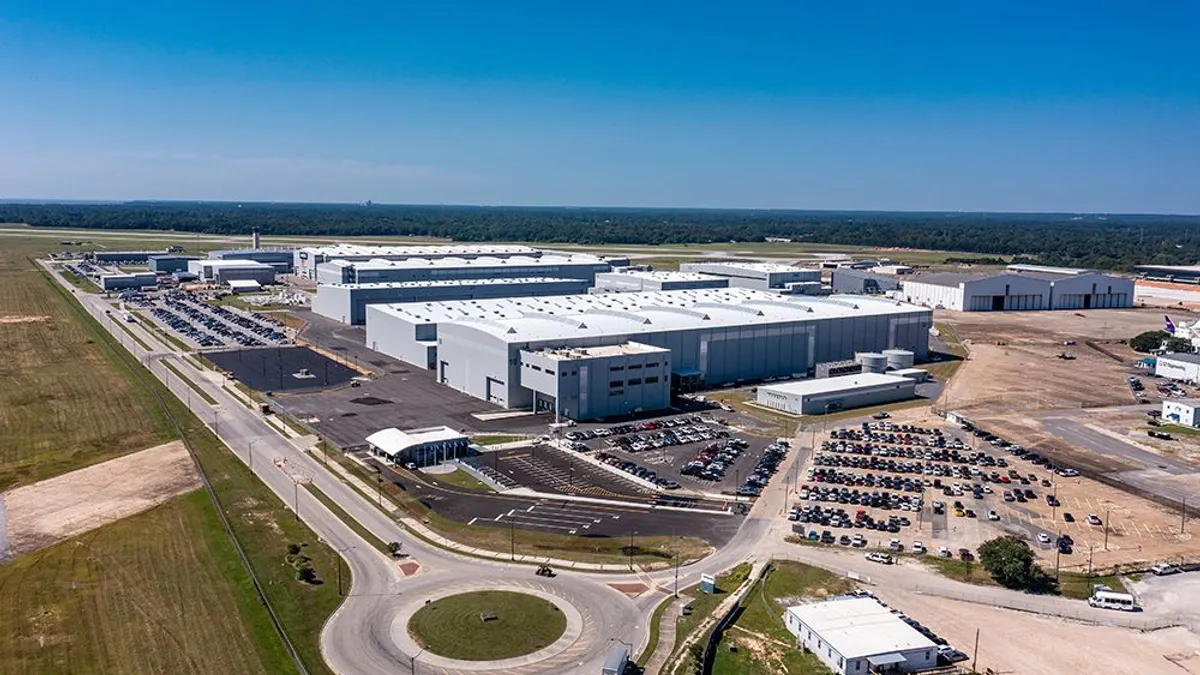
An initiative JLL launched eight years ago to specialize in aerospace facilities management reached a milestone in early May when the company completed onboarding as the facilities manager for Airbus’ 30-building assembly plant in Mobile, Alabama.
“We’re here because there’s a need in the market,” Michael Colligan, work dynamics principal with JLL’s solutions development team, told Facilities Dive in an interview.
The company last year signed a turnkey facilities management contract with WestJet, Canada’s second-largest airline, and will be providing facilities management services at John F. Kennedy International Airport’s New Terminal One, which is slated to open this year, among other work it’s doing in the aviation management space.
But the size and scope of the Airbus assignment makes it a crucial addition to this specialized portfolio, according to Koley MacKay, JLL’s aviation group leader and managing director.
“What we’re really trying to do with our industry segmentation is build a skillset of aviation experts that know how to [work] in a very complex environment,” MacKay said in an interview. “That’s what we’ve been working on over the last eight years.”
The basic facilities management issues are the same in the aerospace environment as they are in other real estate sectors, but the way those services must be provided in the context of a complex production environment like an airplane assembly operation requires a different approach, MacKay said.
“We have technicians that are trained to operate and maintain [the large] overhead doors” in hangars, MacKay said as an example. “If you have a production element where they’re ready to … move a component of an airplane and they can’t get one out of the hangar because the door’s not working, it’s incredibly impactful. So we … make sure we’re not impacting the client’s production in any way.”
Airbus launched its Mobile Aeroplex at Brookley about 10 years ago to provide final assembly of the company’s A320 planes and later expanded the facility to assemble A220 planes.
To manage the campus, JLL has some 30 technicians working alongside Airbus production staff.
“We have multi-skilled building engineers, electricians, certified HVAC technicians, some door specialists and, just given the scale of the campus, generalists [for] painting and appearance-care-type work,” said Colligan.
The way the technicians work is intended to mirror how the production team works, Colligan said.
“The facilities team … is practically an embedded extension of the client,” he said, “mirroring … their shifts and using their work methods and quality systems…. There’s a different level of quality and procedures and playbooks that have to be followed.”
The technicians have a fleet of vehicles for getting around the campus. “We treat the operation as one integrated portfolio,” said MacKay.
To manage coordination, JLL works with an executive in Mobile who is part of Airbus’ corporate real estate team. “That person is the bridge [between us and] the Airbus production stakeholders on the manufacturing side,” MacKay said.
Onboarding began in early March and was completed at the beginning of May, when JLL officially began working as the facilities manager.
“There’s a lot of coordination and trainings on safety protocols, equipment-use protocols, things of that nature,” MacKay said.
To staff up, the company made positions available internally and also tapped new hires. “We go through a rigorous effort to evaluate any incumbent employees we consider for roles and then we’ll go into the local market,” MacKay said. “We have several trades programs that we’re focused on for bringing technical skillsets into JLL for our aviation businesses, whether it’s through our connection with the SkillBridge program [or] an internal channel program that looks at skilled trade internships.”
In addition to the assembly plant, JLL is managing Airbus’ U.S. corporate headquarters in Herndon, Virginia. The company had the contract renewed at the same time it was awarded the assembly plant contract.
“How work gets done within manufacturing environments and corporate environments are obviously different, but thematically, bringing them together made sense for us and the client,” said Colligan.