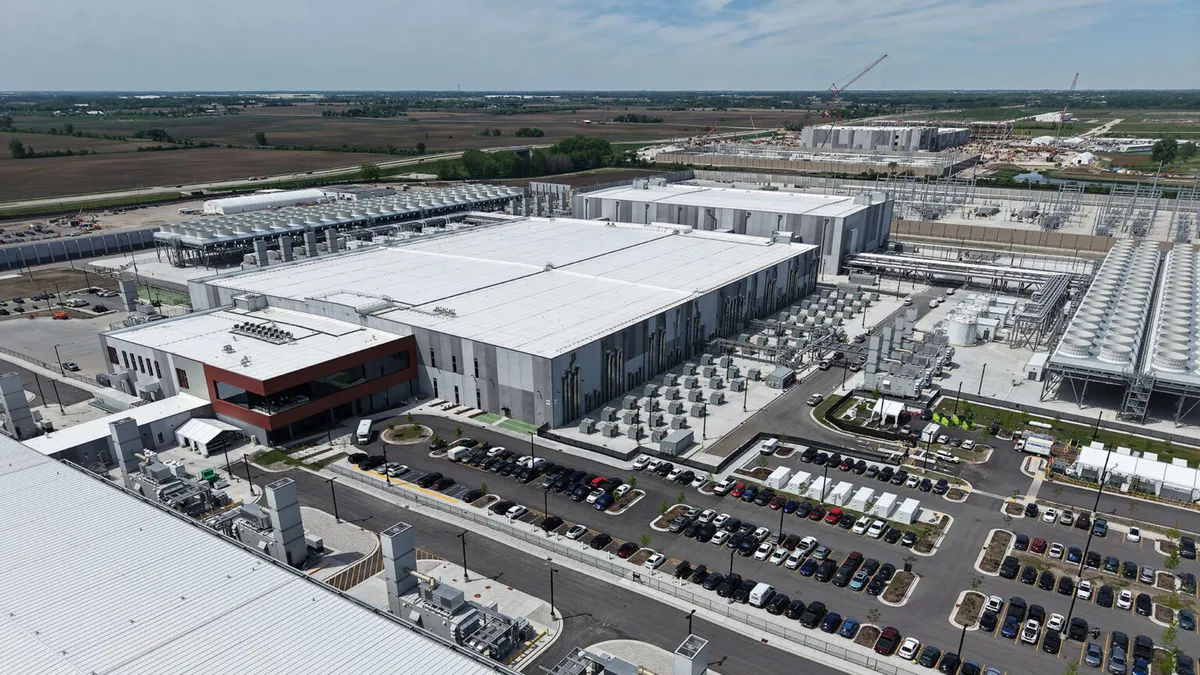
When Virginia lawmakers in April passed a bill directing utilities to offer their large energy customers the opportunity to participate in demand-response programs, it was the latest in state efforts to address strains on the electricity grid.
The law directs Dominion Energy and Appalachian Power, whose service areas cover the highest concentration of data centers in the world, to create demand-response programs for energy customers that have an electric load of 25 megawatts or more.
The programs are intended to relieve pressure on the utility grid by creating incentives for facilities to reduce their energy use when the utility requests it. Some facilities can do so by switching to on-site power.
Virginia’s law prohibits the use of on-site diesel generators for demand response participation. “Carbon emitting resources are not allowed,” Blair St. Ledger-Olson, director of advocacy and campaigns for the Virginia League of Conservation Voters, told Facilities Dive in an email. St. Ledger-Olson said she participated in negotiations when the law was being considered.
Where such resources are not prohibited, there’s still a catch. Because of federal emissions restrictions, facilities with emergency generators can only tap the power from those sources for non-emergency purposes for up to 100 hours a year, and within that limit, there’s a 50-hour cap on use of the power for purposes other than testing and maintenance.
There’s an additional restriction. Since the U.S. Environmental Protection Agency released an interpretive letter last year, organizations operating in the service territory of an independent system operator — the nonprofit overseeing regional electricity systems — can’t run their generators to participate in a demand response program under the 50-hour cap at all. Only those that operate within the jurisdiction of a local balancing authority — a local version of an ISO — can run their generators as part of a demand response program under the 50-hour cap.
“The critical limitation that many data center operators miss [is that the EPA letter] does not extend to Regional Transmission Organizations (RTOs) or Independent System Operators (ISOs),” an analysis by standby power compliance company BackupPower AI states.
Dominion Energy and Appalachian Power are in the jurisdiction of PJM Interconnection, the largest ISO in the United States.
Other areas with high concentrations of data centers, including in California, Illinois and Texas, face a similar constraint.
“The largest data center markets in the United States … all sit within RTO/ISO territory,” the BackupPower AI analysis says. “As a result, the majority of the nation’s data center generator capacity cannot participate in demand response under the current 50-hour interpretation.”
There’s a way around that, BackupPower AI says, but it requires facilities to have their backup generators classified by EPA as non-emergency sources of power. But if they do that, they must meet emission requirements that are more restrictive than what they have to meet for emergency generators.
The more restrictive requirements include EPA hazardous air pollutant standards, regular compliance testing and, in some cases, continuous compliance monitoring. They also must meet what are known as Tier 4 emission standards, which limit emissions to a greater extent than the Tier 2 standards that are permissible for emergency generators.
“Many existing data center generators cannot meet [Tier 4] without replacement,” BackupPower AI says.
The cost of retrofitting generators to meet Tier 4 standards can be high. “Aftertreatment systems such as diesel particulate filters (DPFs), oxidation catalysts, or selective catalytic reduction (SCR) systems [can] cost $100,000 to $500,000 or more per engine,” BackupPower AI says.
Facilities that violate emission standards can face penalties in the hundreds of thousands of dollars, according to an EPA alert.
What’s more, facilities face the risk of EPA classifying emergency generators as non-emergency generators, putting them under the stricter Tier 4 standards and other compliance requirements permanently.
“This is not a penalty that can be cured by paying a fine,” BackupPower AI says. “It is a change in regulatory classification that fundamentally alters your compliance obligations going forward.”One facility that’s caught up in a compliance issue involves Elon Musk’s artificial intelligence company xAI. The company is facing accusations of non-compliance in a lawsuit over its use of on-site generators to power its data center operations.
In a letter stating its intent to sue xAI, the Southern Environmental Law Center alleges the company ignored local and federal emissions requirements before installing three dozen natural gas generators, with a capacity for 421 MW of electricity, at its Colossus data center near Memphis.
“These turbines have the potential to emit more than 2,000 tons of smog-forming nitrogen oxides (“NOx”) per year and numerous other harmful pollutants, worsening Memphis’ already poor air quality,” the group says in its letter. Under the federal Clean Air Act, organizations must provide 60-day notice before filing a lawsuit.
xAI didn’t immediately respond to a request for comment.
Alternative approach
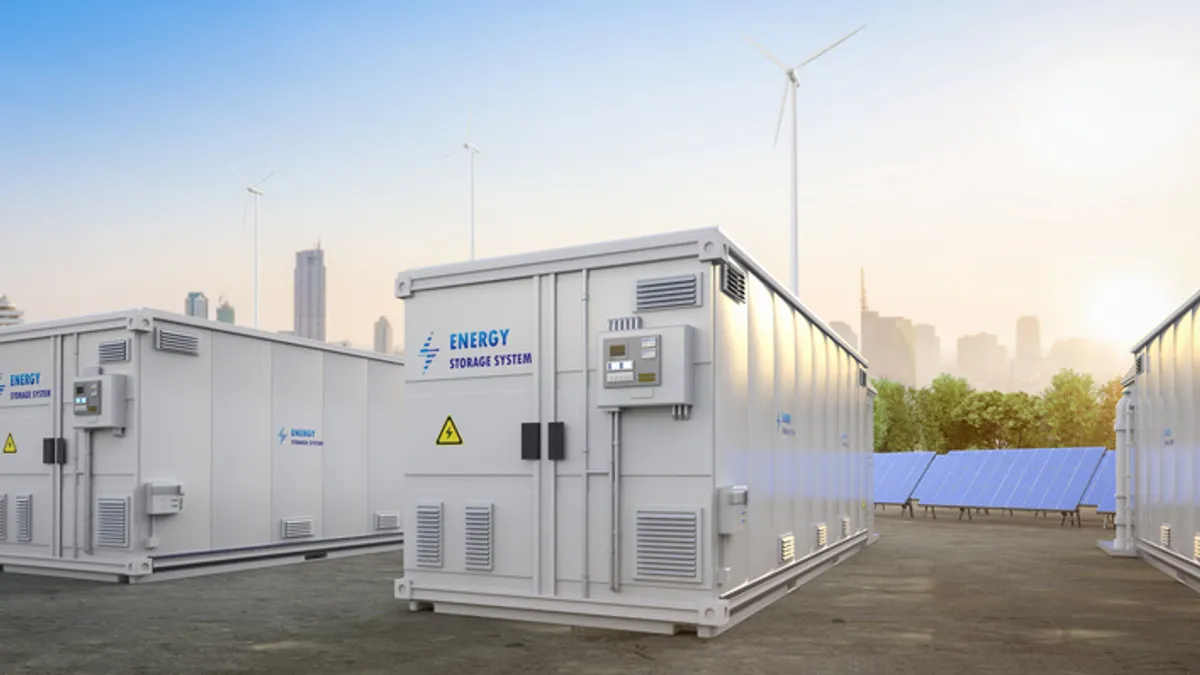
To avoid the complications that come with generators, facilities can deploy cleaner sources of backup power, like battery systems that store solar-generated power — which more facilities are doing, energy specialists say.
Facilities installed almost 10 gigawatt-hours of battery energy storage in the first quarter of 2026, up 32% year over year, according to the Solar Energy Industries Association.
“Energy storage’s remarkable [growth] underscores the fundamental values of this technology,” said Darren Van’t Hof, interim president and CEO of SEIA.
Another Virginia bill enacted into law this spring directs Dominion Energy and Appalachian Power to procure more power from batteries and other energy storage systems than they do today, which means they could be looking to commercial and industrial facilities as sources for procuring stored energy.
“The idea is that the utilities ought to be able to add solar generation and storage where there is this surplus interconnection capacity instead of having to make new investments in grid capacity,” former EPA attorney Ivy Main wrote in an op-ed when the bill was passed. Main is renewable energy co-chair for the Virginia chapter of the Sierra Club.
To help utilities procure stored energy safely, the law directs the Virginia State Corporation Commission to work with an independent auditor to develop procurement criteria and review procurement requests.
The law divides energy storage systems into short-duration and long-duration types. Short-duration types are typically batteries that can store up to 10 hours of energy. Long types are a still-emerging technology for storing more than 10 hours worth of energy. These systems include pumped hydro, thermal and compressed gases, according to Clean Energy Group.
The Virginia utilities in the law are supposed to procure more than 21,000 MW of power from energy storage systems by 2045.
That “hugely expands the [state’s] targets for utility investments in energy storage,” Main wrote.
It could also give facilities a way to benefit from demand response programs without risking the emission problems of generators.
“Virginia [joins] the growing list of states increasing their energy storage targets to stabilize the grid and put downward pressure on electricity prices,” SEIA’s Van’t Hof said in a statement when the law was enacted.
Correction: This article has been updated to note that Virginia’s new law does not allow facilities to use carbon-emitting generators to participate in demand response and to add a comment from Blair St. Ledger-Olson of the Virginia League of Conservation Voters making that point. This article also has been updated to more clearly explain demand response and the requirements of Virginia’s battery energy storage law.