The gunman the U.S. Secret Service apprehended for allegedly trying to assassinate President Trump and others in his cabinet during the White House Correspondents’ Association dinner April 25 at the Washington Hilton Hotel faced increasingly tight security as he moved closer to the event, news reports show. The incident shows the importance of communication among security teams, experts say. New technologies also could help protect attendees at large events, they say.
Alleged shooter Cole Tomas Allen, 31, of Torrence, Calif., checked into the 1,107-room hotel the day before the event. In a message he shared with family and friends prior to his attempt to enter the banquet room Saturday night, he said the event security he saw reflected a “level of incompetence” he hadn’t been expecting.
“I expected security cameras at every bend, bugged hotel rooms, armed agents every 10 feet, metal detectors out the wazoo,” he said in his message.
Allen was apprehended at an outer security ring on the ground floor of the hotel, according to a Wall Street Journal report.
“The system worked,” acting Attorney General Todd Blanche, who attended the event, said on Meet the Press April 26. “We stopped the suspect.”
To get to the ballroom, Allen would have had to get through that first security ring, go down a flight of stairs and then through another security ring to access a door that opened up to the back of the 2,500-seat ballroom, according to the Journal report. Instead, he was caught at the first tier.
“He sprinted through an initial tranche of D.C. police officers milling around,” Ken Dilanian, an MS Now reporter at the event, said on Morning Joe April 27. “But as soon as he got past them, they all drew their guns. Eventually he was tackled.”
In the days after the incident, lawmakers in Congress and others have criticized the Secret Service for letting the gunman get as far as he did.
“Getting past … security was comically easy,” Joe DePaolo, editor-in-chief of Mediaite, said in an essay the day after the incident. “All you had to do was show — not even a ticket to the dinner, or even any of the pre-parties — but just some sort of evidence that you had business inside the Hilton on Saturday night.”
Security specialists told news outlets that there were more protections in place than were visible, including armored plates under the table where Trump was seated, a CNBC report said.
“Hotels … are inherently complex to secure,” an ABC News report said. “Due to the nature of the ongoing business … the Secret Service has to balance its security needs with the needs of the hotel.”
Lessons for facility security teams
Communication among security teams is a crucial part of securing an event like this, Michael Evanoff, chief security officer of cloud-based security company Verkada, told Facilities Dive.
“Real-time information-sharing [is] especially important when multiple agencies collaborate,” said Evanoff, who helped manage security for U.S. embassies and at NATO facilities before joining the technology startup last year.
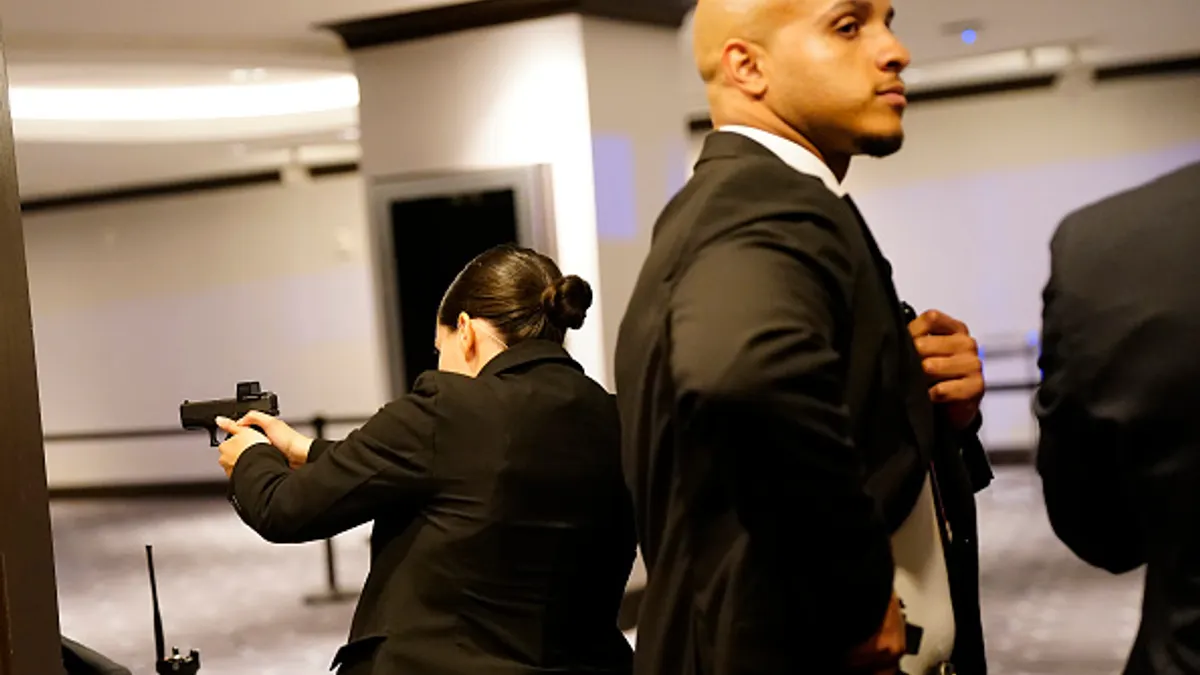
At least three security teams were at the hotel during the event: the Secret Service, the Washington, D.C., police and hotel security. Some attendees, including CBS News Editor in Chief Bari Weiss and California Gov. Gavin Newsom, also had their own security details.
Evanoff said automated access control can help cut through communication confusion and close access points while security personnel are trying to get a picture of what’s happening.
“It’s one thing to have AI-powered cameras with advanced alerting and detection capabilities, but it’s another entirely to have those systems connected with access control to trigger an immediate lockdown,” he said. Or the system can have an automated talk-down — “an emergency warning via speakers,” he said.
The Washington Hilton Hotel has hosted the annual dinner since the late 1960s. The hotel made security-related renovations after President Ronald Reagan was shot while exiting the building in 1981, after speaking at a luncheon hosted by the AFL-CIO. Among other things, the hotel built a private entrance that’s only accessible by car through a covered passageway. Once through the passageway, the car’s occupants enter a private sitting area in the building with an elevator that opens to the back of the ballroom’s stage.
“The president or protectee is never exposed to the outside,” A.T. Smith, a retired Secret Service deputy director, said in the Wall Street Journal report.
“The incident … is a reminder for event venues to pressure-test both their protocols and infrastructure,” Evanoff said. “The good news here is that the layered rings of protection at the Washington Hilton worked, and the Secret Service stopped the assailant before he could cause harm.”