Building automation growth helped drive Honeywell’s first-quarter sales and revenue gains as the conflict in the Middle East impacted some of the company’s other businesses, the industrial automation and process solutions giant announced Thursday.
“We hope for a fast resolution to the conflict,” Honeywell CEO Vimal Kapur said on the company’s April 23 earnings call. “Our guidance assumes the conflict persists through the end of the quarter and the resulting logistics and shipment delays cause a roughly 1% impact to revenue.”
Companywide sales were up 2% in the quarter, to $9.1 billion, led by its building automation segment, where sales grew 8%, driven in part by demand in the booming data center and healthcare sectors.
“Building automation surpassed our expectations,” Honeywell CFO Mike Stepniak said on the call.
This is the fifth or sixth successive quarter in which building automation was one of the company’s growth drivers, Kapur said.
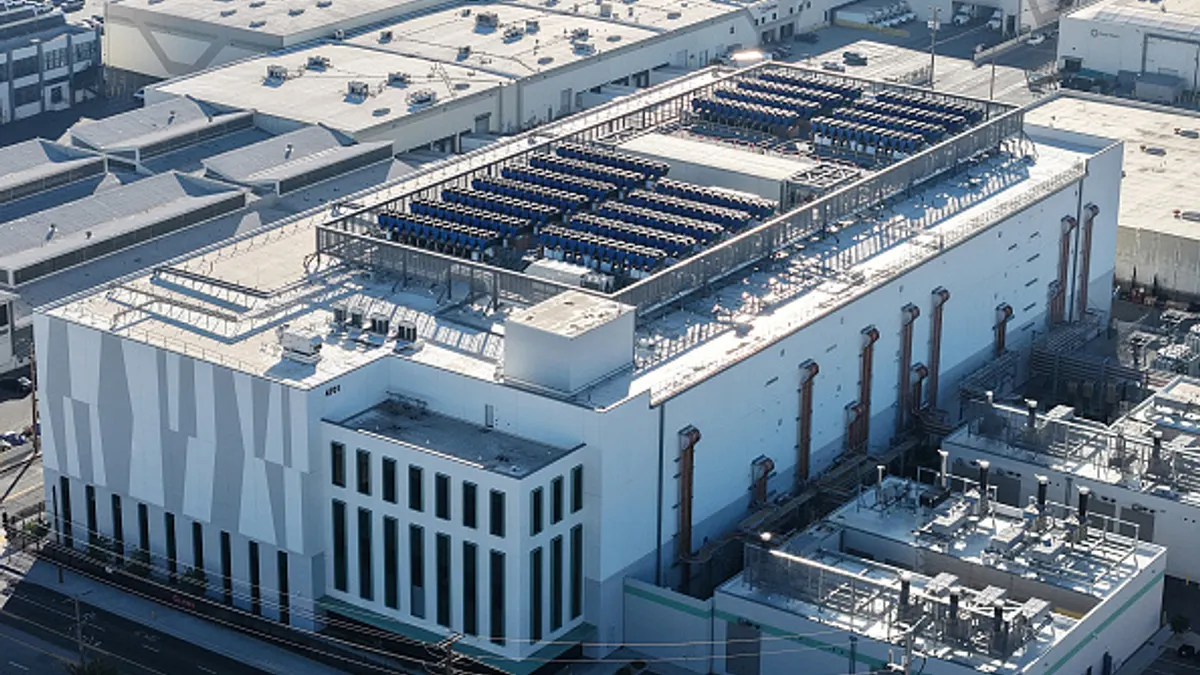
The company’s building automation business will likely continue to benefit from data center growth for two reasons, Kapur said. The first is the shift in the industry to liquid cooling, which requires the kind of controls that Honeywell specializes in.
“If the liquid cooling trend is true, it requires more sophisticated controls compared to traditional HVAC air-based control,” Kapur said. “That is where Honeywell International Inc. technology is going to be very relevant.”
The second is the growth in bring-your-own-power requirements — local governments conditioning building approval on data centers not relying on the grid for their energy — which plays to the company’s strength in power automation products and services, he said.
“We have seen a trend where behind-the-meter power capacity is being set up, and our traditional automation capability is very unique in that space,” Kapur said. “We have always done power plants within a refinery or a paper mill; that is not new for us.”
The company’s sweet spot is working with what Kapur described as “tier-two data centers” — facilities that are big, but not on the scale of those developed and owned by hyperscalers like Amazon Web Services and Meta.
“We have done a great job moving into tier-two data center providers,” he said. “There is a lot of conversation around hyperscalers, but increasingly tier-two providers are becoming very relevant, not only in the U.S. but also in Europe and Asia, and that is where our segment performance is very strong.”
On the negative side, the company estimates that it sustained a 0.5% revenue impact in the first quarter from the Middle East conflict, with much of that loss in its process automation and technology businesses, primarily due to timing delays and lower demand. It expects the resulting revenue hit to grow to 1% in the next quarter.
Over the long term, the company stands to benefit as repairs are made to facilities damaged in the conflict, Kapur said.
The reorganization the company launched several years ago, which included selling its aerospace and other non-core businesses so it can focus on building, process and industrial automation, will be complete by this summer, Kapur said.
“We are tracking ahead of schedule on our separation milestones,” he said.
The company announced it’s selling its warehouse and workflow solutions business to American Industrial Partners in an all-cash transaction. It expects to close that sale, along with the sale of its productivity solutions and services business to Brady Corp., which it announced previously, in a few months.
“The sales allow us to further simplify our portfolio,” Kapur said.
Kapur reaffirmed the company’s 3%-6% full-year growth outlook, which he expects to be fueled in part by making inroads into demand that’s been backlogged because of the Middle East conflict.
“We remain confident in our ability to drive accelerating growth in the second half,” he said.