Dive Brief:
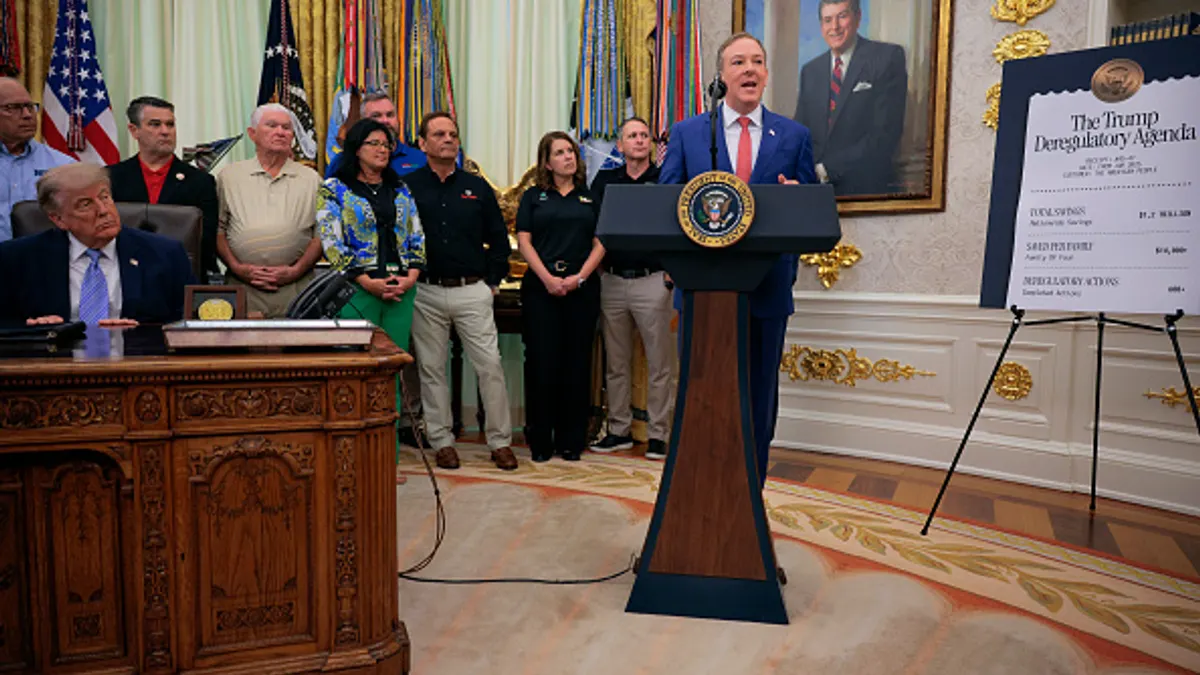
- President Donald Trump last week announced that the U.S. Environmental Protection Agency had finalized rollbacks to a 2023 rule that required the phase-out of commercial refrigerators, HVAC appliances and other cooling systems that use hydrofluorocarbons, or HFCs — refrigerants with high greenhouse gas potential.
- Trump said the rollbacks to the technology transition rule will save consumers $2.4 billion by reducing grocery and retail store operating costs, lowering technology manufacturing costs and enabling companies and consumers to keep installing high-global-warming-potential, or GWP, HFC HVAC systems manufactured before a cutoff date as long as there’s an inventory of them.
- “Under the Biden administration, the so-called technology transition rule, which is crazy, forced companies to adopt specific high-cost refrigerants, massively driving up the price of … refrigerants and various goods,” Trump said at an Oval Office event with grocery and retail company executives in attendance. “At the same time, this rule drove up the cost of living by requiring consumers to purchase higher cost residential air conditioning units.”
Dive Insight:
The 2023 Technology Transition rule implemented provisions in the American Innovation and Manufacturing Act, which Trump signed into law in 2020.
The rule set deadlines by which manufacturers of light commercial HVAC units, commercial refrigerators and some industrial cooling systems had to stop making equipment using high-GWP HFC refrigerants and replace them with equipment using low-GWP HFC refrigerants.
Supporters of the 2023 rule say manufacturers were on board with the phase-out and were making the transition in an orderly way.
“American manufacturers did what Congress and the first Trump Administration asked them to do,” John Hurst, executive director of the Alliance for Responsible Atmospheric Policy, said in a statement. “They invested in new equipment, new refrigerants [and] new production lines.”
The Trump administration said the rollback was needed because it left manufacturers with billions of dollars in stranded inventory — equipment that had been manufactured but that would be illegal once phase-out deadlines were reached.
“After publication of the 2023 Final Rule, manufacturers, importers, and distributors … informed the EPA that the compliance date for the restriction on installation will result in substantial stranded inventory,” EPA says in the preamble to its rule changes.
At the Oval Office event, EPA Administrator Lee Zeldin called the Biden administration’s development of the 2023 rule a “rushed, frantic, reckless sprint … to phase out reliable equipment.”
The Air-Conditioning, Heating, and Refrigeration Institute and the Alliance for Responsible Atmospheric Policy say the idea that the market needs more time is a mischaracterization.
“Next generation refrigerants are widely available and approved for use today,” the groups said in a joint statement. “Today, over 90 percent of new residential and light commercial equipment already uses these next-generation refrigerants.”
David Doniger, a senior strategist at the Natural Resources Defense Council, said the rollback throws a wrench in a competition calculus that manufacturers have already made. It will “leave the United States stuck with outdated technologies of the past,” he said in a statement.
New transition deadlines
Under the revised rule, there’s no longer a deadline for light commercial and residential HVAC units to use refrigerants that meet low-GWP HFC standards. That means units with a GWP above 700 that were manufactured or imported into the United States before 2025 can continue to be sold rather than taken off the market this year, when a required GWP of 150 or 300, depending on the system, was slated to take effect.
Manufacturers of grocery store and retail refrigeration systems can continue to offer units that use refrigerants with GWP limits up to 1,400 rather than 150 or 300, depending on the system, until 2032. Prior to the change, the transition would have been required in 2027.
In addition, grocery stores can expand the cooling capacity of their refrigeration systems 15% without EPA classifying the project as a new system.
Manufacturers of remote condensing units, which are used in retail food appliances, can also keep making systems with 1,400 GWP until 2032 rather than 2027. After the new deadline, the systems will have to use refrigerants of 150 or 300 GWP, depending on the system.
Manufacturers of systems for cold storage warehouses will also be able to keep offering appliances that use refrigerants with a GWP of 700 until 2032, rather than 2027, after which the limit will drop to 150 or 300, depending on the system.
Some other specialized systems will have similar deadline extensions.
The Food Industry Association, which represents grocery stores and suppliers, said the extended deadlines are necessary.
The 2023 rule “imposed significant costs and unrealistic compliance requirements and timelines that threatened to drive up grocery prices and create substantial implementation challenges for food retailers,’' Leslie Sarasin, the group’s president and CEO, said in a statement.
Taking a different position, Stephen Yurek, president and CEO of the Air-Conditioning, Heating, and Refrigeration Institute, said the end result will be higher prices for businesses and consumers. “By extending the compliance deadline, the EPA is maintaining and even increasing demand in the market for existing refrigerants while supply continues to fall,” he said. “So, instead of falling, refrigerant prices are likely to rise, resulting in higher service costs, and higher costs for consumers.”