Dive Brief:
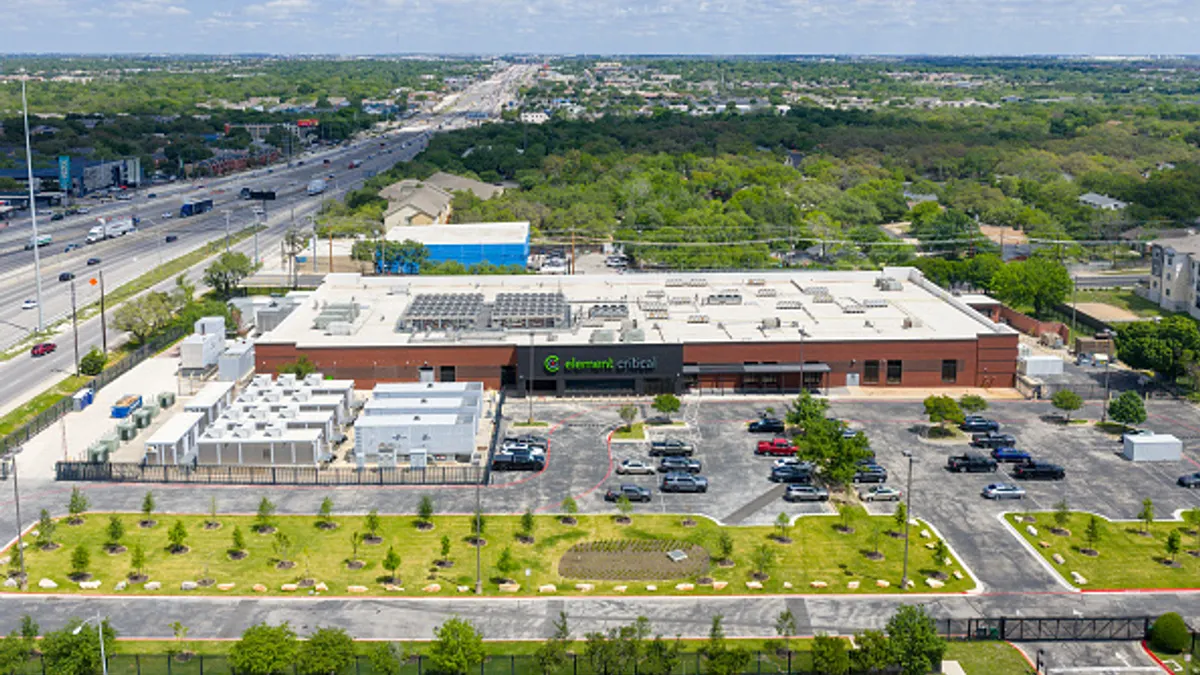
- Air-cooled condenser arrays in four data centers near Phoenix created thermal plumes that raised temperatures between 1.3 and 4 degrees Fahrenheit in neighborhoods a third of a mile away, Arizona State University researchers found.
- The discharge was 14 to 25 degrees F higher than the air immediately around the condenser arrays, according to the study, Data Center Waste Heat as an Emerging Urban Thermal Hazard.
- With the number of data centers in the United States expected to double by 2030, these higher temperatures could pose a problem, says research lead David Sailor, director of ASU’s School of Geographical Sciences and Urban Planning. "Even if these data centers only contribute to an additional heat island magnitude of one degree or two degrees, that can still have a very significant impact on our lives," Sailor said in a Tech Xplore report.
Dive Insight:
By some measures, Phoenix is the hottest metropolitan area in the U.S., with temperatures forecast to be above 100 degrees for much of this summer, according to AccuWeather.
Each one-degree increase in temperature will drive a higher use of air conditioning, which in turn will put more heat into the area, creating “a feedback loop,” the research states. “Data center operations [could] raise the energy burden on surrounding neighborhoods, precisely during the extended summer cooling season,” according to the report.
To measure the temperature impacts of data centers, the researchers equipped cars with sensors and had them drive upwind and downwind of four data centers to measure the differences. The data centers ranged from 36 megawatts and 169 megawatts. All of them used primarily air-based cooling systems.
“Average downwind air temperatures [were] 0.7–0.9 °C warmer than corresponding upwind areas,” or 1.26 – 1.62 degrees F, the report states. Downwind air temperature warmed as high as 2.2 degrees Celsius, or about 4 degrees F.
Although there was a measurable increase, the outcome remains anecdotal, Sailor said in an interview with AI Generation in late March, before the study was published. “It’s highly dependent on a number of factors,” he said. “Wind direction, wind speeds, the turbulence intensity in the atmosphere itself. So, [it’s] different in the morning and overnight hours than it is during the daytime, when there's a lot more of what we call mechanical turbulence mixing the heat vertically.”
The impact of heat generated from buildings generally is not that great, Sailor told AI Generation. When building heat is added to heat generated by cars and industrial processes, there’s a measurable impact on area temperatures, but it’s not as much as some people might think, he said. “It’s typically on the order of 10 to 20 watts per square meter,” he said. Solar radiation during peak summer, by contrast, is about 1,000 watts per square meter at midday.
But when the measurement shifts to energy-intensive buildings, he said, there’s a difference in “magnitudes,” about 100 watts per square meter.
The effect becomes even greater when data centers are factored in, he said. “For a good-sized data center, you can have waste heat emissions on the order of 2,000 to 6,000 watts per square meter,” he said. A 30 megawatt data center “essentially puts as much energy into the environment as 25,000 or 35,000 homes. But it’s in a concentrated area [of] maybe 20 homes. So just imagine that intensity.”
Sailor outlined a handful of steps facilities can take to reduce the impact of the thermal plume.
- Use a more powerful vertical fan to push the hot air higher up into the atmosphere so it disperses more before it spreads to nearby neighborhoods. “The vertical velocity at which the fans are operating will affect how quickly that vertical plume is ejected out,” he said, “The plume then mixes at a higher level and disperses without it going directly into the neighborhoods.”
- Keep the rooftop equipment open rather than surrounded by parapet walls that are only there for aesthetic purposes. “You don’t see the equipment on the rooftop,” he said, but “that helps contribute to potential mixing at the rooftop level.”
- Use some form of evaporative cooling, which converts the air from air-cooled systems into vapor, releasing less warm air into the atmosphere.
Sailor didn’t address the growing use of liquid cooling systems, which submerge computing systems in water or a chemical bath and release less heat.