Dive Brief:
- The controversial decision to close the John F. Kennedy Memorial Center for the Performing Arts in Washington, D.C., for two years for renovations stemmed from the advice of the center’s facilities chief at the time, Joe Floca, according to testimony cited in a court ruling released Friday. President Donald Trump made the closure announcement Feb. 1.
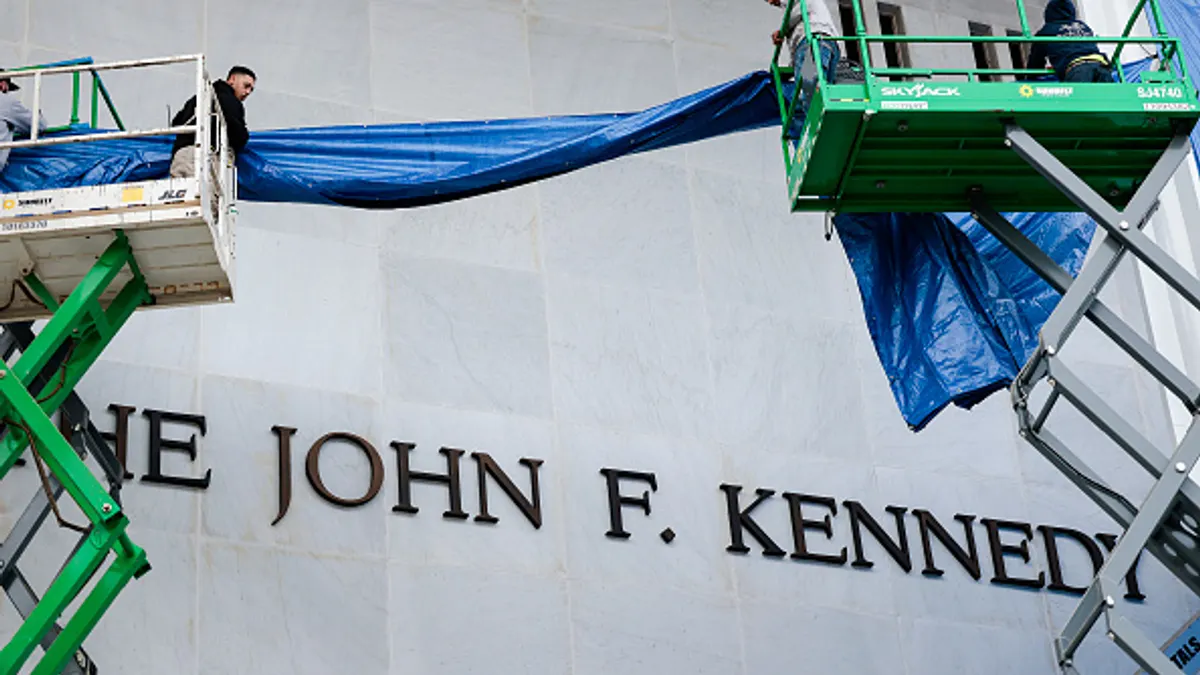
- The ruling by Judge Christopher Cooper of the D.C. federal district court, presiding over a lawsuit brought by an ex officio member of the center’s board, temporarily blocks the plan to close the building to expedite renovations. The ruling also orders the removal of Trump’s name from the building and restores voting rights to ex officio board members.
- As a result of the ruling, Trump said he was ending his involvement in the center. “Unless I am free to do what I do better than anyone else, bring this Institution back, physically, financially, and artistically, I have no interest in continuing what could only be a hopeless journey into ‘NEVER NEVER LAND,’” Trump said in a Truth Social post on Friday.
Dive Insight:
Rep. Joyce Beatty, D-Ohio., filed a lawsuit in December contending that Trump and the Kennedy Center’s leadership acted illegally by approving a plan to close the center, adding Trump’s name to the institution and removing voting rights of ex officio board members like herself.
On the closure issue, Judge Cooper said it’s within the board’s authority to close the institution down for renovations, but the facility must stay open while the board conducts an assessment of whether closure is the most appropriate course of action. He called the board’s approval of the closure an “ill-informed and seemingly preordained decision.”
“The Board based its decision on an insufficient, one-sided presentation of information and neglected to consider the full range of its statutory obligations and potential adverse consequences of closure on programming and memorial functions,” the ruling states. “The deficiencies in the Board’s decision-making thus ‘fall below even a forgiving standard of prudence.’”
Cooper cited testimony from Floca, who said he recommended the closure.
“The idea of full closure apparently came from Mr. Floca, who at some point changed his mind about the propriety and feasibility of carrying out the Center’s needed repairs while it remained open to the public,” the ruling states.
Trump promoted Floca to Kennedy Center executive director and chief operating officer in March. Floca came to the center in 2024 as its facilities chief after several years as the facilities chief for the District of Columbia government.
Floca said in his testimony that closure makes sense from a construction management standpoint because the work can be done more quickly and safely.
“‘There [were] very clear efficiencies, both from a cost standpoint and a schedule standpoint, to not have to work around thousands of patrons moving throughout the campus,’” according to the testimony Cooper cites. “‘Just looking at the labor itself, working second shifts overnight, that’s a 20- to 25-percent increase in just the labor costs.’”
Cooper writes that Floca was concerned from a liability standpoint about the structural work that needed to be done.
“Several ‘critical issues suggest[ed] that an occupied renovation would be unsafe and logistically impractical,’” the ruling states, quoting from a memo that Floca had prepared. “‘Work on the structural steel and concrete deck defects would render the ‘primary public access points unusable’; performing the electrical vault waterproofing and parking garage fireproofing would create ‘significant liability and safety concerns’; operating the building during the requisite mechanical and electrical shutdowns would not be ‘feasible’; and ‘[b]y opting for a full closure, teams avoid the hidden costs of phased construction, such as temporary life-safety systems, after-hours labor premiums, and the constant disruption of the patron experience.’”
According to assessments conducted in 2021 and 2022, the center needs marble and granite restoration and structural repair, a new fire alarm system, overhang roof work, waterproofing, new seats, paint and carpeting, and upgrades to the HVAC system, central plant and plumbing, among other things.
In the ruling, Cooper said it’s not up to the court to decide if closure is the right course of action, but the center can’t go forward with the plan until the board does more due diligence than just rely on Floca’s recommendation.
“The Court would expect an informed Board to insist on receiving input from the Center’s programming and fundraising experts, in addition to Mr. Floca,” Cooper says. “The Center’s lawyers, who appear to have exited stage left, would also have a role to play; the duties discussed throughout this opinion are legal ones, after all.” He granted the preliminary injunction that Rep. Beatty called for on the grounds that she is likely to prevail in her claim that the board acted improperly.
Judge Cooper also said the law creating the institution is clear that it can only be named for President John F. Kennedy.
“Congress commanded that the Center be ‘the sole national memorial’ to President Kennedy,” Cooper said in the ruling. “With a handful of exceptions not relevant here, ‘no additional memorials or plaques in the nature of memorials shall be designated or installed in the public areas’ of the Center.”
The judge’s order requires Trump’s name to be removed from the building within two weeks. U.S. Secretary of the Interior Doug Burgum, who has an administrative role in Kennedy Center operations through the National Park Service, wouldn’t commit to removing Trump’s name when he was asked about it on the CNN program State of the Union on Sunday.
“I’m not sure if that [decision] is going to be appealed or not,” Burgum said. “There’s controversy on both sides of this about that ruling.”
The Kennedy Center didn’t immediately respond to a request for comment.