Facility managers could be spending more to operate commercial appliances in the years ahead if the U.S. Department of Energy gets its way, says Andrew deLaski, executive director of the Appliance Standards Awareness Project, an energy efficiency advocacy organization.
DOE last week announced a proposed rule to change the way it sets efficiency standards for new commercial and residential appliances. Among other things, it would impose standards for new appliances only if they deliver at least 2 quadrillion Btu of full-fuel-cycle energy savings or save at least 10% of the energy that existing versions of the appliances use. Currently, there’s no threshold for when new standards are set.
At the 2 quadrillion Btu threshold, many of the standards that have taken effect over the years, resulting in billions of dollars in savings, would not have been allowed, “eliminating many of the energy-efficiency standards on the books today,” deLaski told Facilities Dive in an interview.
A standard for commercial and industrial clean-water pumps that took effect in 2016 is a case in point, deLaski said. That standard is projected to save facilities more than $1 billion over 30 years, depending on the cost of energy and other factors. Another example is a standard for commercial water heaters that DOE set in 2023 to take effect this year. That standard will effectively require new commercial gas water heaters to use condensing technology to recapture waste heat, saving a projected $149 million annually over 30 years.
Because the savings in both cases wouldn’t meet the threshold that DOE is proposing, the standards wouldn’t take effect under the proposed rules.
“In the past, the agency hasn’t set a bright line for what’s not worth doing,” deLaski said.
Rulemaking hurdles
DOE’s proposed rule makes a number of changes that amount to what deLaski says are a series of obstacles to future standards. “Collectively, they’re designed to bog down the rulemaking process,” he said.
One of the proposed changes would require DOE to use a separate process for new appliance types rather than incorporate that process into the same rulemaking for existing appliances.
DeLaski used overhead refrigerators as an example of an appliance type that doesn’t exist today. “In the normal process, what DOE would do is a technical and economic analysis as part of a rulemaking and set a standard for that just like for other commercial refrigerators,” he said. “What this is saying is, you would have to have an entire separate rulemaking to cover that product, with its own notice of proposed rulemaking, rather than do it as part of the commercial refrigeration rulemaking.”
Proceeding down a separate track will slow the process to the point that it could allow inefficient appliances to enter the market, he said. “What you’d have is a product that is essentially unregulated, because there’s not a lot of drive for efficiency in a lot of these markets,” he said.
DOE’s authority for setting the standards is in the Energy Policy and Conservation Act, or ECPA, the 1970s-era law enacted when the United States was in the midst of an energy crisis. The law requires DOE to evaluate the state of appliance technology at set intervals and, when significant savings are possible based on readily available technology, to set standards for new appliances. Today, roughly 60 categories of appliances have standards set.
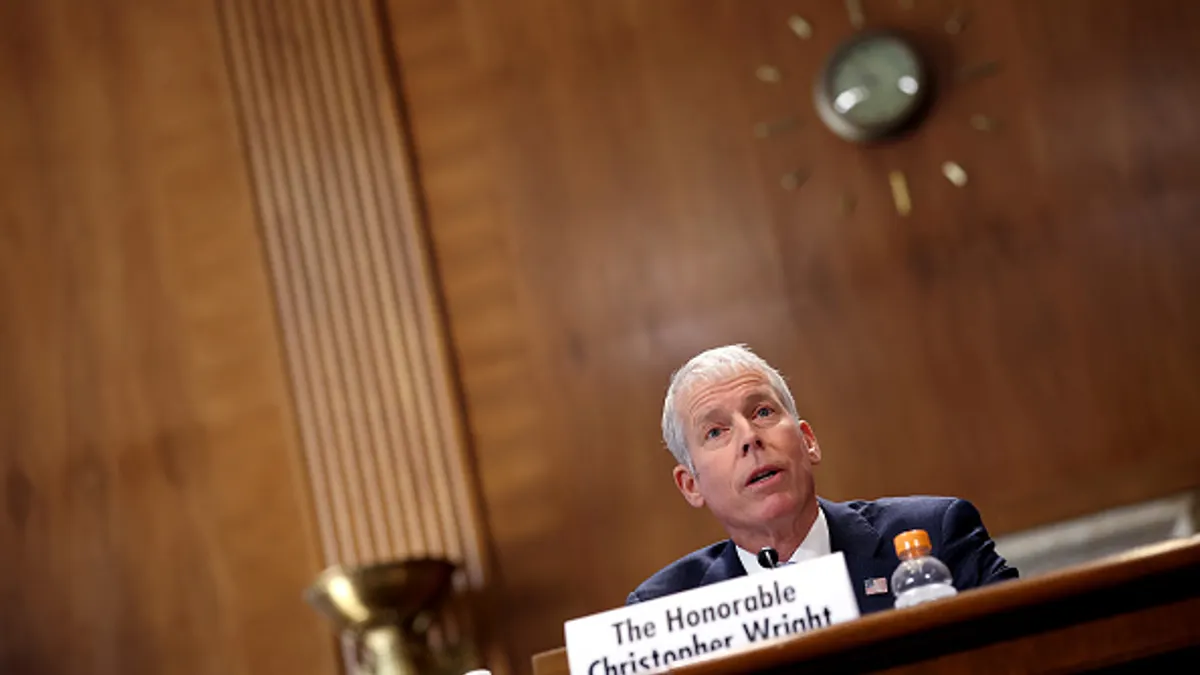
In DOE’s announcement, Energy Secretary Chris Wright said the changes are needed because the current process reduces choice, leading to higher-cost appliances.
“For too long, the American people paid the price for mandates that restricted consumer choice and drove up costs,” said Wright.
Paula Glover, president and CEO of the Alliance to Save Energy, called on DOE to proceed with the proposed changes in a transparent and predictable way to protect what works with the current process.
“These standards … have helped American households and businesses reduce energy costs while maintaining product performance and consumer choice,” Glover said in a statement. “It will be important to ensure that the framework continues to reflect statutory requirements, supports innovation, and enables timely updates that keep pace with evolving technologies.”
The Association of Home Appliance Manufacturers, which released a statement in support of the proposed changes, would like to see Congress step in to make the changes permanent, effectivly ending back-and-forth changes as one administration replaces another.
“The natural next step is for Congress to act — to amend the Energy Policy and Conservation Act and lock these reforms into statute, so that the progress made here endures,” AHAM President and CEO Kelly Mariotti said in a statement.
Along with the proposed rule, DOE is seeking public input on the methodologies it uses for evaluating the energy savings of new appliance technology.