Dive Brief:
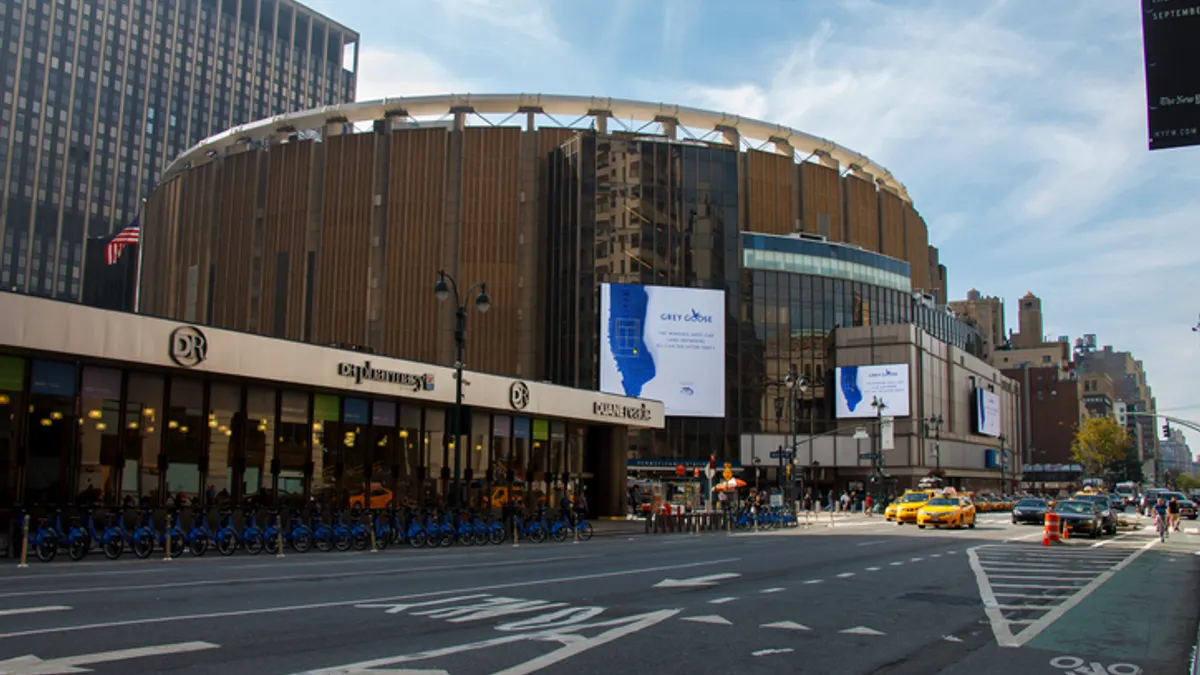
- A man’s death after falling from a balcony Saturday at New York’s Madison Square Garden is the second death at the arena in the last three years. Paul Kueker, an executive with building systems technology company Smartcon Solutions, died June 20 after he fell 150 feet from a balcony in the 300s section of the stands during a concert, according to news reports.
- The 19,500-seat arena has been the subject of lawsuits related to a variety of injuries its visitors have experienced over the years, according to a blog post by personal injury law firm Morgan & Morgan. One involved a person who was injured while standing on an escalator at the venue in 2007. Another involved a person who was in a traffic accident after allegedly being overserved alcohol at the venue in 2008.
- “We are deeply saddened by the loss of a fan’s life at Madison Square Garden,” the venue said in a statement after Kueker’s death. “Our hearts go out to the family and friends of the concertgoer.”
Dive Insight:
In an interview with Facilities Dive, Nicholas Gerschman, an attorney who leads Morgan & Morgan’s premises liability practice, said the standard for liability in facility injuries or deaths is reasonableness.
“These [accident] cases can get technical pretty quickly because you want to look into the maintenance,” Gerschman said. When an accident is related to facility equipment such as elevators, escalators and wheelchair lifts, for example, “What do the records show? Is [a problem] something a reasonable property owner would have noticed? Were there prior incidents? What would an elevator and escalator expert tell me about the cadence, the frequency, at which they’re supposed to be inspecting and [conducting] maintenance?”
The most recent previous death at the facility, in March 2023, occurred after graphic designer Ernest Vogliano Jr. fell over an escalator railing while leaving a hockey game.
The cause of Kueker’s death remains under investigation, the city medical examiner’s office said June 22, and it is conducting a toxicology report as part of its probe, the New York Post reported. Witnesses at the venue said Kueker appeared to be intoxicated, according to news reports, and he may have jumped over a 4-foot-high glass barrier on the balcony, landing on the people and seats below.
“In a case like this … you would be asking questions like, ‘Was the person overserved?’ There are rules along those lines,” said Gerschman, who noted he doesn’t know the facts of the incident beyond what’s been reported in the news.
“Some other people may have been injured. Those people might be saying, ‘Hey, I got injured here, because you overserved this person, and you should have known this person should be cut off, because they had too much.’ It’s just an angle someone may want to investigate.”
A facility like Madison Square Garden can meet all of the safety code requirements that it’s subject to and still face liability under a general duty of care legal standard, Gerschman said.
“To just talk about the code doesn’t cover all of the situations that people might run into,” he said.
Under a general duty of care standard, a facility is expected to take reasonable steps to keep people safe separate from compliance requirements.
“At [a facility] like a Madison Square Garden, the onus is on the property owner to ensure that you have enough staff and procedures in place to keep the venue safe,” he said. If there is a lawsuit related to this death, “Ultimately, it’s going to be a question for a jury or a court, depending on how the case goes, about what was reasonable. Were they doing enough?”
Even a simple slip-and-fall incident due to a wet floor can lead to a major injury, Gerschman said.
“People really don’t appreciate how catastrophic a fall can be,” he said. “It’s certainly up there with car accidents in terms of injuries.”