Dive Brief:
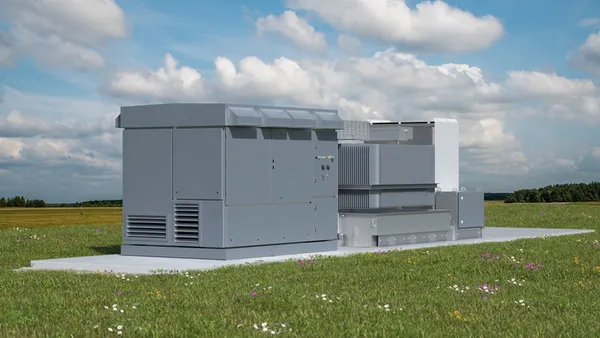
- Trane Technologies and power management company Eaton today released a data center reference design they say can significantly cut copper use and installation costs compared to conventional low-voltage designs.
- The medium-voltage design can boost energy efficiency up to 15% while reducing copper use by as much as 80% and installation costs by 30%, the companies say in a press release. The design is built to work with the NVIDIA Omniverse DSX Blueprint for AI data centers, creating a consistent approach for planning and delivering electrical, thermal and digital control infrastructure, according to the release.
- The companies say this coordinated architecture simplifies setup, reduces risk during deployment and can evolve as emerging liquid technologies and direct current architectures become mainstream.
Dive Insight:
Direct current systems are increasingly popular in data center architectures. Because it requires fewer conversion stages as power moves from the utility down to the equipment-level, relative to alternating current, DC provides energy efficiency benefits that could be meaningful when data centers scale to several hundred megawatts.
“Generating 800 [volts direct current] at the facility level and delivering it directly to 800 VDC compute racks eliminates redundant conversions, improving overall power efficiency,” NVIDIA said in a developer blog. “This architecture supports high-density GPU clusters, unlocks higher performance per GPU, and enables more GPUs per AI Factory, driving greater compute throughput and revenue potential for partners. It also ensures future scalability beyond 1 MW per rack and seamless interoperability across the AI Factory power ecosystem.”
NVIDIA says that with 800 VDC, the same wire gauge can carry 157% more power than 415 volts alternating current, or VAC, reducing copper requirements that result in lower material and installation costs and easier cable management.
With global data center capacity expected to almost triple by 2030, largely due to AI, the reference design provides a more resource-efficient approach to scaling infrastructure, Trane and Eaton say.
By combining Trane’s thermal management solutions with Eaton’s power management solutions, data centers can break down traditional siloed architectures to help data centers respond more dynamically to their needs, the companies said.
“AI factories demand tightly coordinated power, cooling and compute infrastructure to operate efficiently at scale,” Vladimir Troy, vice president of AI infrastructure at NVIDIA, said in a statement. “By aligning with the NVIDIA Omniverse DSX Blueprint, Trane Technologies and Eaton are helping customers reduce complexity and accelerate deployment of next-generation AI data centers. This new integrated approach supports the robust, scalable foundations enterprises need to unlock the full potential of generative and reasoning AI and turn data into faster, smarter outcomes.”