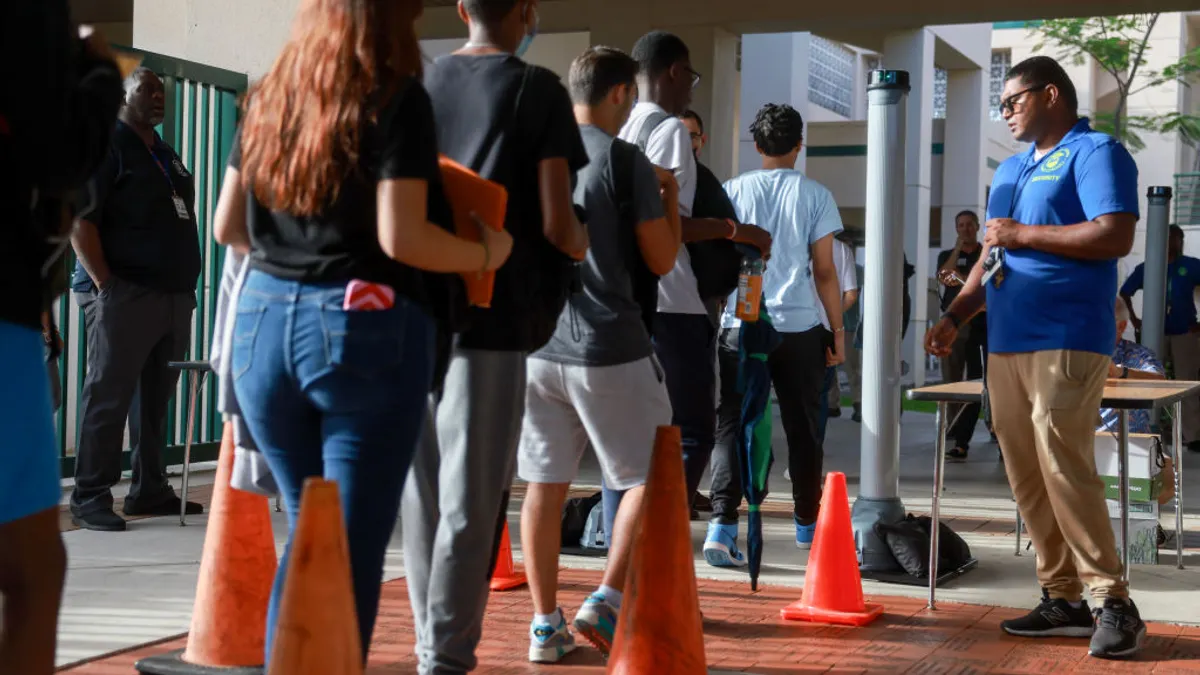
Insufficient staff and inadequate physical security are creating vulnerabilities in school facilities, which a technology company says can be resolved with software solutions. But a school policy organization says too much focus on security can be misguided, and comes with its own consequences.
According to a report by school security software company Singlewire, staffing shortages are the most cited security challenge for schools, and those shortages are growing. Schools that say they have insufficient security staff jumped to 46% from 30% last year. The survey went out to 500 full-time school staff members in the U.S.
The school officials cited access control as another problem. Almost a third said they either can’t limit access to a single point of entry, entry procedures aren’t clear or they have no method for verifying guest identities.
The company provides software for visitor management and dismissal systems, digital hall passes, security communications and safety drill management.
Reliance on analog processes for hall passes and student dismissal has led to a “concerning” lack of real-time visibility into student movement, the company says. At the same time, administrators and teachers aren’t on the same page when it comes to what’s expected in an emergency, which the company says underscores a need for more accessible and reliable methods to request help.
“These findings suggest that current reactive measures are insufficient and hindering schools’ abilities to identify issues and respond quickly,” Singlewire says. “To address these vulnerabilities, schools must transition toward integrated digital ecosystems that enhance both
safety and efficiency. Implementing digital visitor management systems and digital hall passes can automate identity verification and provide centralized tracking of student locations.”
More security
Ramped-up infrastructure and software solutions is becoming the go-to choice for schools, according to the nonprofit Learning Policy Institute. School spending on hardening physical systems is a $4-billion-a- year business now, it says, and yet there’s little evidence to show stepped-up security makes schools safer.
“Evidence that these investments work is thin,” Jennifer DePaoli, senior researcher at the organization, wrote in a blog post.
In some ways, stepped-up security is leading to greater harm, she says.
“Districts can invest in technologies that monitor and sometimes criminalize students, but these measures often come with significant psychological costs for the school community,” DePaoli said.
The intensity of stepped-up security measures can be hard for students to process, said DePaoli, pointing to visitor management systems, weapons scanners, drones, and software that continuously monitors what students type on school devices.
“It is critical that leaders understand the potential harms these tools can pose to school communities,” she said. “Several [of these technologies] have already led to damaging outcomes for students, including suspensions, expulsions, arrests, and wrongful police confrontations.”
One school in Florida shut down after a surveillance system flagged the presence of a suspected weapon, which turned out to be a clarinet, DePaoli said.
There have also been incidents of license data gathered by school district security cameras getting handed over to federal immigration enforcement, which she said raises concerns about whether school surveillance technology purchased for student safety is being repurposed to target students and families.
In her post, DePaoli calls for schools to focus on the psychological sense of safety in addition to physical approaches. That could entail grounding safety plans in the development of environments where students feel a strong sense of belonging.
“Districts should make informed investments in school security while maintaining a focus on the relationships, supports, and school climates that research consistently shows keep students safe,” she said.