Dive Brief:
- Safer battery systems, improved fire detection and specialized fire suppression systems can help reduce data center fire risk, researchers from three universities said in a joint paper.
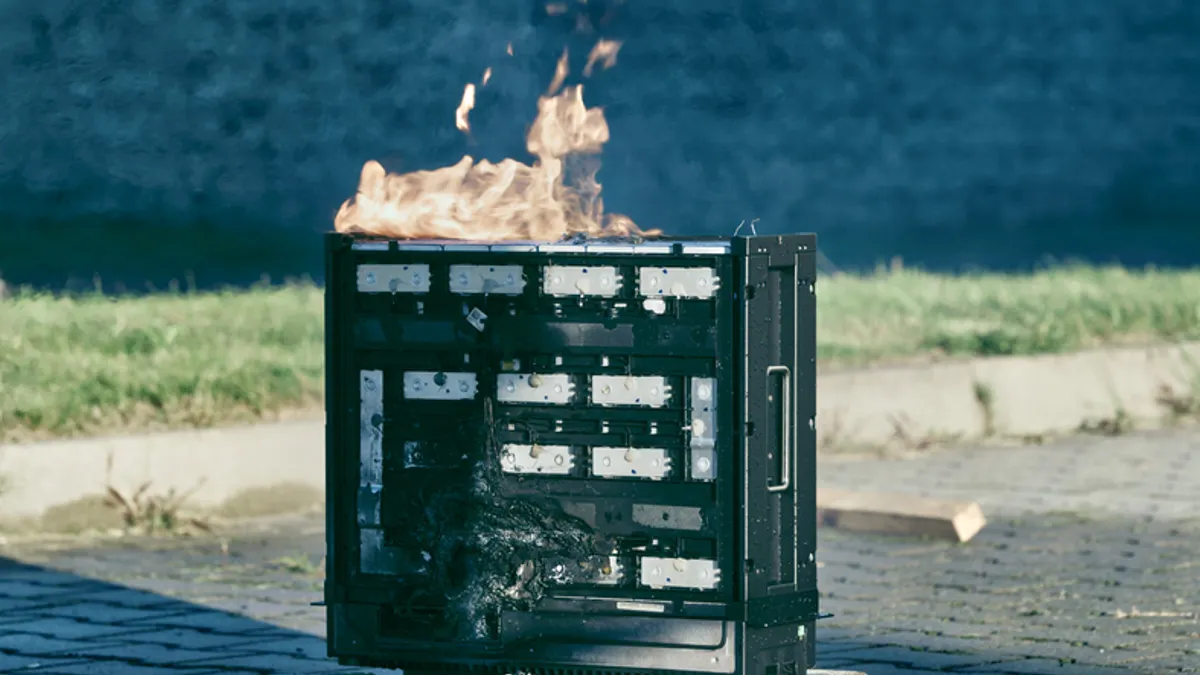
- Water leaks, backup generator faults, arc flashes in electrical cabinets and failures of lithium-ion battery systems are among the big fire risks, the paper states.
- “Modern data centers store enormous amounts of electrical energy, which means failures can escalate quickly if not properly controlled,” Texas A&M University Ph.D. student researcher Tylee Kareck, a collaborator on the paper, said in a statement.
Dive Insight:
Fires have costly repercussions that impact more than the data center, according to the researchers. The paper referenced battery failures and a water leak as causes of fires over the last several years.
“The risk associated with these causes is heightened by minimizing human monitoring, complex building layouts, and air cooling,” the researchers said.
Power generation, storage and distribution systems often are to blame for data center fires, whether due to improper installation or non-human-caused events like short circuits, the researchers found.
“If equipment is incorrectly installed, safety protocols are incorrectly followed, or if maintenance is mistimed or not upkept, equipment can experience catastrophic failure,” they said.
The danger of data center fires is heightened by the presence of materials that can release toxic vapors when burned, they said. High airflow conditions, which can change how fires and fire suppression materials behave, is another compounding factor.
Meeting or exceeding National Fire Protection Association standards — such as siting batteries and electrical equipment separately from servers — can reduce but not eliminate incidents, they said.
To mitigate risk, facility operators should consider implementing novel approaches like AI-based fault prediction and monitoring.
They pointed to a model developed by researchers that can detect impending battery failures up to 15 days in advance with 98% accuracy.
Alternative battery chemistries that pose lower “thermal runaway” risk than conventional lithium-ion systems can also reduce fire incidence and severity, though once-promising alternatives like nickel-zinc batteries have significant drawbacks in data center environments, the researchers found.
Data centers used for AI training and certain other functions can “flex” computational loads to control power demand and reduce stress on the equipment, but economic considerations and customer needs often make taking a flex approach a difficult strategy to follow, they said.
Researchers from George Washington University, the University of California, Berkeley and Texas A&M contributed to the paper.