Dive Brief:
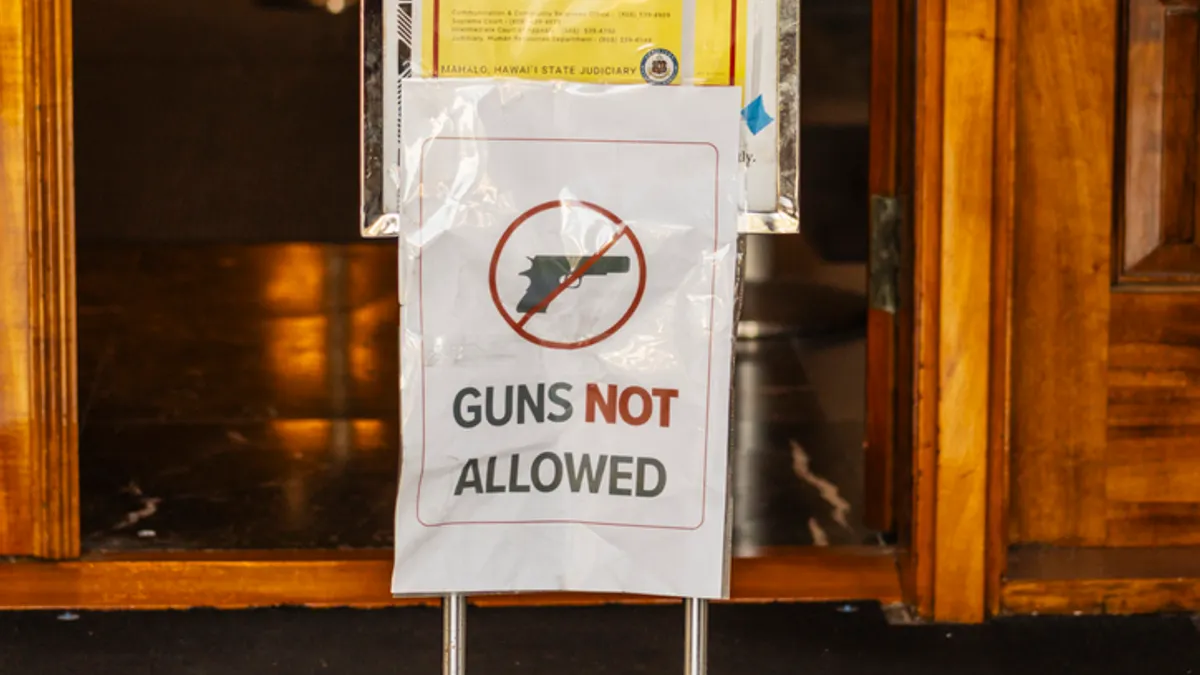
- A federal appeals court Monday permanently struck down as unconstitutional a New York law provision that made it unlawful for someone to carry a gun onto public-facing private property unless the property owner specifically allows it. Now the reverse is true: Property owners will have to communicate where they do not allow guns.
- “We are thrilled the [court] tossed the ban out on its rear end,” Bill Sack, senior director of legal operations for the Second Amendment Foundation, said in an emailed statement. SAF was one of the plaintiffs in the case, Christian v. James.
- New York Gov. Kathy Hochul, D, hasn’t indicated whether the state will seek a U.S. Supreme Court ruling on the decision, and her office didn’t immediately respond to a request for comment. Last week Hochul said curbing gun violence is a priority. “Everyone deserves to live free from the scourge of gun violence,” she said when announcing a 64% drop in shootings in the state since 2021. “My administration will continue to support the hard work of law enforcement, community organizations and local leaders on the front lines of this fight.”
Dive Insight:
Critics called New York’s now-ended gun restriction the vampire rule. In folklore, vampires can’t enter a private home without an invitation; the restriction forbids firearms in public-facing private properties without the property owner’s invitation.
New York lawmakers in 2022 passed the law containing the provision, the Concealed Carry Improvement Act, after the U.S. Supreme Court in N.Y. State Rifle & Pistol Association v. Bruen shot down the state’s concealed carry ban.
Gun rights advocates challenged the restriction as it applies to private property that’s intended for public use — stores, restaurants and the like — saying it prevented people carrying guns from going about typical daily activities.
“Although the Supreme Court had ruled a person had a general right to carry in public [someone lawfully carrying a weapon] could not go to the grocery store. They could not stop for gas or coffee.… They could not drive through an automated car wash,” the National Rifle Association’s Institute for Legislative Action wrote in a critique of vampire rules in January.
Similar provisions in Hawaii, Maryland, California and New Jersey have either been struck down or are facing court challenges, according to the ILA analysis.
A federal district court in New York ruled the provision unconstitutional in 2024 and enjoined it. In the May 18 decision, the federal appeals court for the 2nd Circuit agreed with the lower court and made the injunction permanent.
In its decision, the three-judge panel said the state failed to show the restriction aligns with historical laws that form a national tradition of firearms regulation.
Attorneys for the state pointed to instances in which similar laws were enacted and upheld around the country, but the court found that the laws were too dissimilar to the state’s ban. Most of them applied to private property that was not intended for public use. Others were intended to regulate guns only for some people.
On the question of guns in parks and other sensitive places — schools, public buildings, transit facilities and entertainment venues, for example — the panel said the state showed that the restriction fell within the historical tradition of gun regulation and could stand.
The impact of the decision is limited to property owners in New York, but it also serves as a precedent for similar cases in Vermont and Connecticut, which, along with New York, constitute the 2nd Circuit. It’s also expected to have an impact throughout the country as similar state regulations get challenged.
“Christian is one of many similar cases across the USA,” an analysis by New York “Second Amendment defense organization” SCOPE says. “Many legal experts expect the Supreme Court will have to take on these cases.”