Dive Brief:
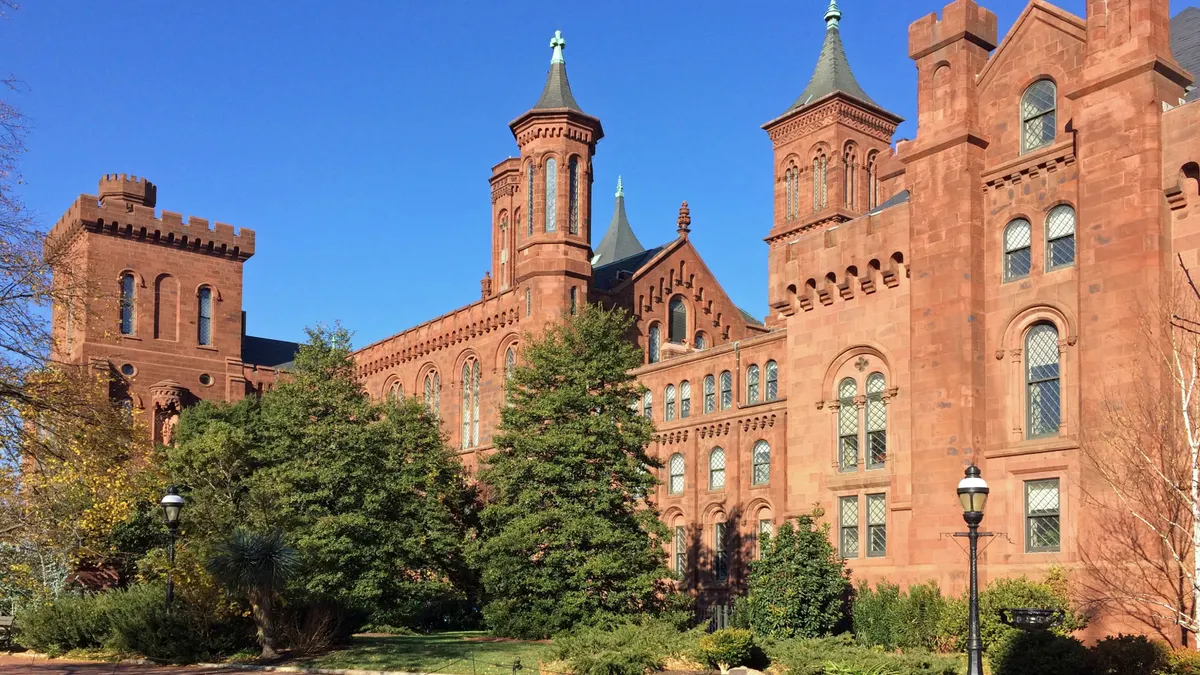
- After three years of renovation work, the 170-year-old Smithsonian castle on the National Mall in Washington, D.C., will reopen in late May for three months so it can host visitors for the 250th anniversary of the signing of the Declaration of Independence.
- Although the building will look much as it did when it closed in 2023, it will get untethered from the ground as part of future work. A moat around its perimeter will be created to protect it from earthquake damage in a process that engineers call base isolation.
- “Base isolation separates the building from … ground motion, achieved by creating a plane of separation between the superstructure and the foundations,” the castle’s renovation plan states. When complete, the project will cost about $530 million, the National Capital Planning Commission estimates.
Dive Insight:
The castle is the original Smithsonian museum, constructed between 1847 and 1855, with funds provided to the U.S. Congress from the estate of British scientist James Smithson, who asked that the money be used to “increase and diffuse” knowledge, according to the Smithsonian Institution’s website.
The institution, chartered by Congress as a quasi-governmental agency, today consists of more than two dozen buildings, many of which form the perimeter of the national mall.
The Smithsonian Institution closed the castle in 2023 to renovate the building from top to bottom. A project team that includes Smithsonian executives, architectural consultants and engineers from EYP-Loring, among others, created the renovation plan in 2022. Its mechanical, plumbing and electrical systems are being replaced and its interior and exterior are being refurbished. It’s scheduled to reopen permanently in 2028.
The castle was heavily damaged in 2011, when a 5.8-magnitude earthquake struck the Mid-Atlantic region, causing shocks within a 90-mile radius of Mineral, Virginia, its epicenter. The ground movement caused cracks in the castle’s beams, damaged interior walls, destabilized roof turrets, collapsed chimneys and displaced its decorative masonry finials, according to a blog post on the project by Christopher Ruiz, principal of TYLin/Silman Structural Solutions, and other sources.
“Though DC is a traditionally low seismic zone, the geometry of the Castle, with slender projecting towers and chimneys built of unreinforced masonry, [makes] this building particularly sensitive to amplified accelerations from ground movements,” Ruiz says in the post.
Engineers recommended base isolation rather than structural supports to protect the visual character of the building, according to the engineering plan. “Seismic base isolation avoids the installation of visually intrusive steel and cable supports,” the plan states.
When the retrofit work is complete, the project will represent what Ruiz calls a landmark example of seismic isolation on the East Coast, a technique that’s common on the West Coast.
“By incorporating the technology of base isolation, and by using modern nonlinear dynamic analysis procedures for nuanced evaluation, the building can be seismically retrofit to meet the Smithsonian’s intended enhanced performance objectives in a way that allows for a more sensitive approach to historic preservation,” he wrote.
To separate the building from the ground, engineers will excavate around the castle perimeter to create a seismic base isolation joint — essentially a trench surrounded by structural concrete walls — covered by waterproofing and a 14-inch-wide moat cover. A gray granite cover plate will top off the moat to provide “a visual transition [that] will not call undue attention in the landscape,” the plan says.
Additional excavation will be done under the building to extend the height of the basement three feet so it can be used for events. A 15-foot-high room will be added underneath the basement to house mechanical equipment and free up space in the castle. “The new mechanical distribution level reduces the impact of new systems on the exterior or historic interior,” the plan says.
The castle will open for roughly three months beginning May 22, during which it will host exhibits and operate retail and cafe space. The federal government and other public and private organizations are hosting events across the U.S. to celebrate the 250 years since the Declaration of Independence was signed, with numerous high-profile events scheduled for July 4 weekend in Washington.
Correction: We have updated this article to clarify that excavation for the seismic moat has not yet begun.