Dive Brief:
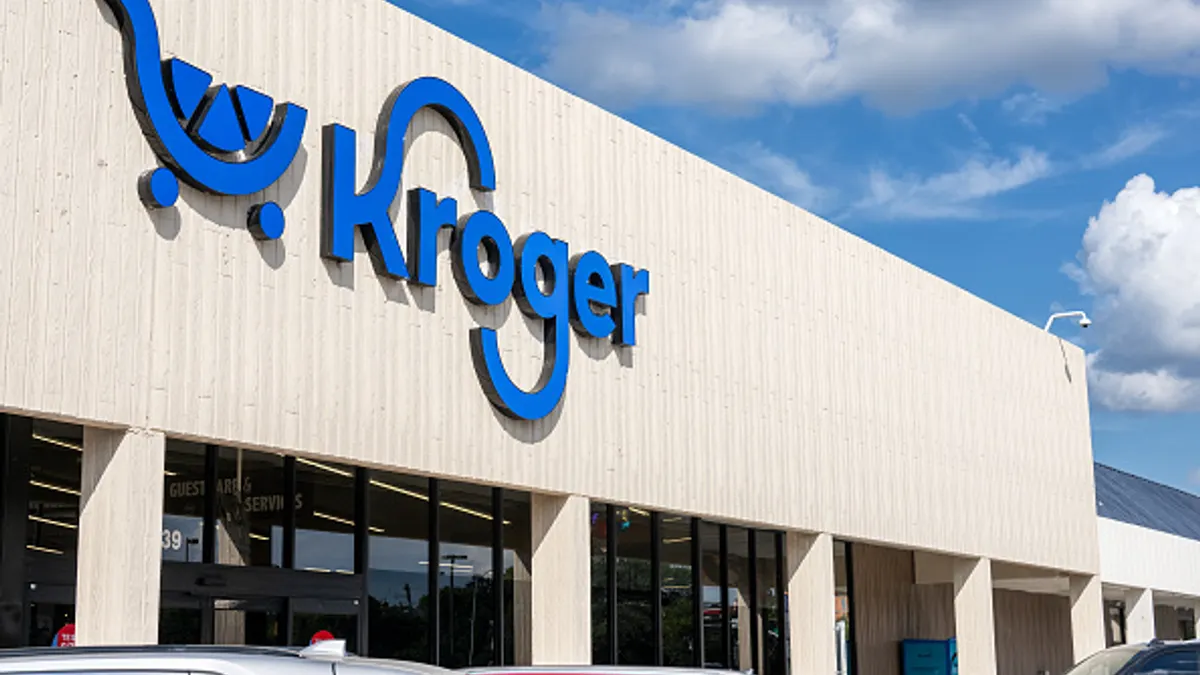
- Grocery giant Kroger has agreed to pay a $2.5 million civil penalty and spend $100 million over two years to retrofit or replace 600 refrigeration units rather than face a court battle with the U.S. Department of Justice over its handling of ozone-depleting refrigerant leaks under the Clean Air Act.
- “Compliance with the Clean Air Act protects human health,” Adam Gustafson, DOJ principal deputy assistant attorney general, said in a statement. “Fixing leaks of ozone-depleting refrigerants makes a real difference in protecting all Americans from the harmful effects of solar radiation.”
- EPA launched an inquiry in 2018 to gauge Kroger’s compliance with requirements to fix refrigerant leaks or replace leaking equipment and report on its refrigeration appliances based on their rate of chlorofluorocarbon leakage. The agency administers regulations requiring organizations that own commercial refrigeration appliances, commercial air conditioners and industrial process refrigeration units of a certain size to keep emissions of CFCs from reaching a certain level.
Dive Insight:
Kroger is the second-largest supermarket owner in the United States by revenue, surpassed only by Walmart, according to Foodindustry.com. It owns roughly 3,000 stores under two dozen brand names, including Kroger, Harris Teeter, Smith’s and Ralph’s, according to MMCG Invest.
Under the Clean Air Act, owners of commercial appliances that operate with a full charge of at least 50 pounds of refrigerants (reduced to 15 pounds in 2024 in some cases) must comply with restrictions on the release of CFCs and hydrochlorofluorocarbons, which EPA says are ozone-depleting substances.
Owners are required to measure the rate of leakage of their refrigeration appliances. If the leakage is more than a threshold level, owners must either retrofit the appliance within a year or let EPA know it plans to replace it within a required time frame. After retrofitting or replacing the appliance, they’re supposed to validate that the appliance meets the threshold and share that with EPA.
Prior to 2019, the allowable threshold leakage rate for commercial refrigeration units was 35%. Since 2019, it’s been 20%. Leakage rates differ for other types of units.
Based on its 2018 inquiry, and then a second inquiry in 2019, EPA says Kroger failed to meet retrofit or replacement requirements under the pre-2019 35% leakage threshold rate on 14 of its commercial refrigeration appliances and two of its industrial process refrigeration units. It also failed to meet retrofit or replacement requirements under the post-2019 leakage threshold rate of 20% on six of its commercial refrigeration appliances. It failed to meet recordkeeping and reporting requirements on its appliances in 17 instances, the EPA says.
Based on EPA rules, the company is liable for $124,426 a day in penalties for each violation, DOJ says in the complaint that it filed along with the settlement.
Under the settlement terms, Kroger agrees to retrofit or replace 600 refrigeration units at its stores that are still using CFC or HFC refrigerants — such as R-22 refrigerants, which manufacturers discontinued in 2020 — with systems that use approved refrigerants. EPA defines approved refrigerants to include A2L refrigerants like R-32 and R-454B.
The company must also implement a refrigerant management system to help prevent coolant leaks and keep its corporatewide average leakage rate to no more than 9.5% per year.
“The settlement resolves Kroger’s failure to promptly repair refrigerant equipment leaks of the refrigerant R-22, a powerful ozone-depleting hydrochlorofluorocarbon (HCFC), between 2014 and 2023,” DOJ says in its press release announcing the agreement.
According to a scorecard released in 2024 by the Environmental Investigation Agency, a nonprofit group, Kroger is far from the worst supermarket chain when it comes to meeting refrigerant emissions requirements. The organization gives Kroger a score of 37% in how well it’s managing its systems and taking other steps to reduce HFC emissions. It identifies Aldi as the best, with a score of 74%, and Southeastern Grocers, or SEG, which owns Winn-Dixie, as the worst, with a score of 1%.
“Kroger uses entirely ultra-low [global warming potential] refrigerants in <1% of stores and most of its distribution centers,” EIA says. “The company is an EPA GreenChill partner, however not all of its 23 banners are part of the program. It has a leak rate of 10.6% but does not publicly disclose its leak reduction goal.”
GreenChill is a voluntary EPA program for grocery-focused companies to lower their refrigerant emissions.
A federal district court in Ohio must still approve the agreement between Kroger and the agencies.
Kroger didn’t immediately respond to a request for comment.