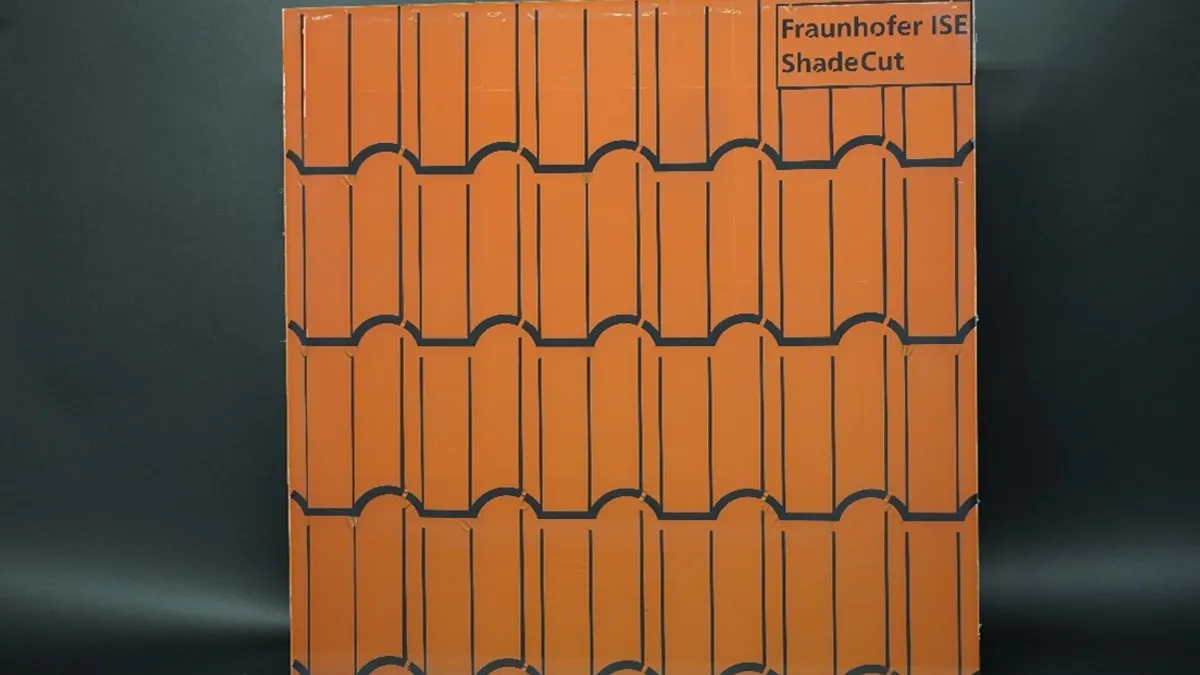
Modules that can mimic the look of tile and other building materials can help facilities embrace solar energy sources while keeping their property visually aligned with the surrounding area, a material developed by the Fraunhofer Institute promises.
Researchers at the nonprofit organization in Freiburg, Germany, have developed a light-sensitive film that can be applied to photovoltaic modules and etched using a laser, according to a summary of the research findings released by the institute.
Sunlight reflects off the etchings in patterns that, depending on the angle and depth of the cuts, gives designers flexibility to mimic materials they want the building to display.
“The technology is particularly interesting for modules intended for integration into facades, roof-integrated PV, or even railings — especially on historic buildings,” says Martin Heinrich, group leader for encapsulation and integration of photovoltaics at Fraunhofer Institute for Solar Energy Systems. “Modules with [the film] can look like masonry or roof tiles and blend in perfectly in terms of color.”
Fraunhofer ISE was founded in 1981 for research into solar power. Last month it introduced a type of solar cell that lowers the amount of silver needed to convert the sun’s rays to electricity by a factor of 10, promising lower-cost cells.
“It would offer many advantages for solar cell manufacturers, even if they have to integrate electroplating equipment into their production process as an initial investment,” Sven Kluska, group leader for electrochemical processes at Fraunhofer ISE, said in announcing the research findings last month.
The technology hasn’t been commercialized yet, but it shouldn't take long, according to Kluska. “So-called nickel/copper electroplating could be firmly established in the photovoltaic market within two to three years,” he said.
The film-coated PV modules work on the same principle as Morpho butterflies, whose colorful wings are the result of reflected light.
“Color is produced through microscopic structures, which are tiny surface patterns that bend and reflect light, rather than through traditional pigments,” a summary of the findings in Tech Briefs says.
“The 3D photonic structures … create an intense and angle-stable color impression through a fundamentally low-loss interference effect,” the institute said.
Adding the film to PV modules reduces their efficiency by a few percentage points, leaving them about 95% efficient, the institute says. That means they’re about the same efficiency, or in some cases more efficient, than standard modules, the Tech Brefs article says.
“The technology [is] superior to comparable solutions on the market,” Tech Briefs says.
The film can be applied to any standard photovoltaic and solar thermal module, so existing structures can be modified visually, the institute says. That’s “particularly attractive for applications in which aesthetic considerations limit solar panel adoption,” it says.
The technology hasn’t been commercialized yet, but in an interview with EE Times, an executive at the institute says translating research into products is part of its mission.
“There must be someone between scientific research and industry who transfers the knowledge and the technology, and that is where Fraunhofer comes into play,” Michael Scholles, corporate business development manager, told the publication.
Tesla offers solar panels that can look like roofing material, according to the company’s website.