Dive Brief:
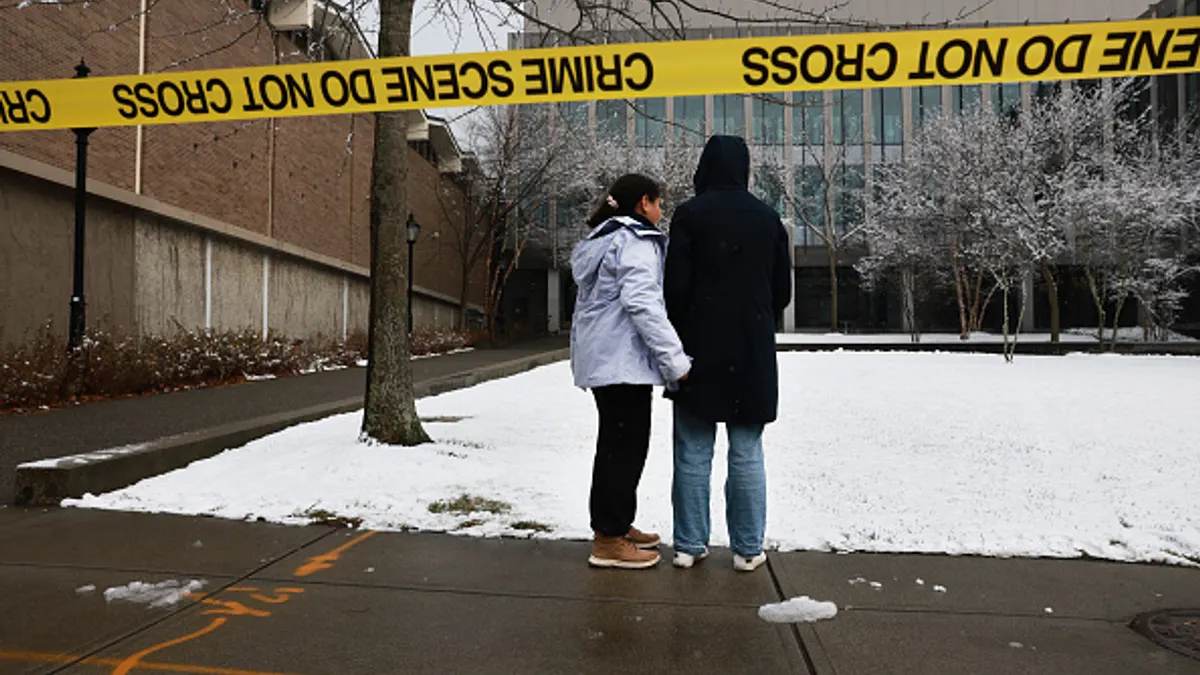
- Three students who survived a shooting are suing Brown University for negligent security and premises liability, among other charges, saying the institution made it too easy for a former student to walk into a school auditorium during exam preparation and open fire with a semiautomatic weapon.
- “Notwithstanding its location within an open, urban campus environment, [engineering building] Barus and Holly was open and accessible without meaningful entry restriction, and neither the building generally nor [shooting location] Tanner Auditorium specifically was protected by secured-entry measures requiring individualized authorization for ingress,” the complaints say. “Students and non-students alike were free to enter and move through the building without meaningful restriction.”
- Cláudio Manuel Neves Valente attended the school as a physics graduate student in the early 2000s. Officials allege he killed two students and injured nine on December 13. Police found him dead by apparent suicide a few days later at a Salem, New Hampshire, self-storage facility.
Dive Insight:
The students accuse the university of failing to provide building access control, surveillance and monitoring, among other security measures, in a breach of its duty to maintain reasonably safe premises.
“A significant portion of Brown's campus, including Barus and Holley, is not a closed or self-contained campus physically separated from the surrounding East Side neighborhood of Providence,” say the complaints, which the students filed anonymously. “Rather, it is integrated into that neighborhood, with public streets, sidewalks, and non-university buildings in close proximity to and interspersed with university facilities. As a result, Barus and Holley was readily accessible from public areas and was not physically segregated from the surrounding community.”
The school was also negligent for disregarding concerns raised by one of the school’s custodians, Derek Lisi, who reported his concern that Valente was acting suspiciously by examining the building and auditorium about a dozen times before the incident.
“During these encounters, [Lisi] observed Valente pacing hallways, peering into classrooms, and moving in and out of bathrooms,” the complaints say. “Lisi reported this suspicious activity to Brown campus security. In particular, Lisi reported that the individual appeared to be surveilling or ‘casing’ the building.”
People showing up repeatedly to a site without having apparent business there is a red flag from a security standpoint, Michael Evanoff, chief security officer of cloud-based security company Verkada, said in an email. “Would-be attackers often scout locations in advance,” he said. “Identifying suspicious behavior early is where proactive security teams can have the greatest impact.”
Best practices for spotting people who might be scouting a location are trained personnel and cameras, Evanoff said. “Both trained personnel and camera infrastructure with analytics … can flag anomalies in real time,” he said.
The complaints said the school only had two exterior cameras and no interior cameras pointing toward the auditorium or the hallways surrounding it.
“Neither the building generally nor Tanner Auditorium specifically was protected by secured-entry measures,” the complaints said.
In an email statement, Brown University spokesperson Brian Clark said the school was reviewing the complaints carefully and promptly.
“Out of respect for the privacy interests of the plaintiffs, we have no details to share on the merits of the litigation at this time,” Clark said.