A lockdown on June 11 at the Pentagon was triggered when building system sensors detected a possible airborne anthrax contamination, according to reports.
U.S. Department of Defense officials gave a same-day all-clear after an investigation that spanned several hours.
“Testing confirmed no hazard exists, and normal operations have resumed,” Pentagon spokesman Sean Parnell posted on X.
Pentagon Shield
The government launched a program in 2004 after the 9/11 terrorist attacks to provide an early-warning of a chemical, biological, radiological, or CBR, attack, according to a 2007 technical paper on the program, called Pentagon Shield. It uses a mix of sensors, air monitors and digital tools to identify and manage potential airborne contamination and includes an automated response system to isolate portions of the building suspected of contamination.
“The Pentagon is one of the most likely targets for a future terrorist attack with CBR weapons,” the paper said.
The program has an external component that uses a network of sensors to monitor airflow around the building and throughout the Capitol area. One of the sensors is a type of aerosol lidar, called a Raman-shifted Eye-safe Aerosol Lidar, that was deployed in two areas outside the building to look for airborne particulate matter.
During the test period, the paper said, the Lidars “revealed complex dispersion paths from a variety of sources, some of which could be identified as mineral dust from nearby excavations, exhaust from jet aircraft in the region, and aerosols elevated over a wide area by high winds from mesoscale phenomenon,” the paper said.
Internally, the system is designed to track potential airborne contaminants and manage movement around the building by using “automatic controls of the heating, ventilation, and air-conditioning (HVAC) system” to close off areas based on where problems are suspected, the paper says.
During the test period, the researchers looked at how well the HVAC system could be adjusted to prevent contaminants from spreading throughout the building.
“An … objective was to manipulate the Pentagon’s HVAC system in real time to minimize indoor penetration of [a] tracer gas,” the paper said.
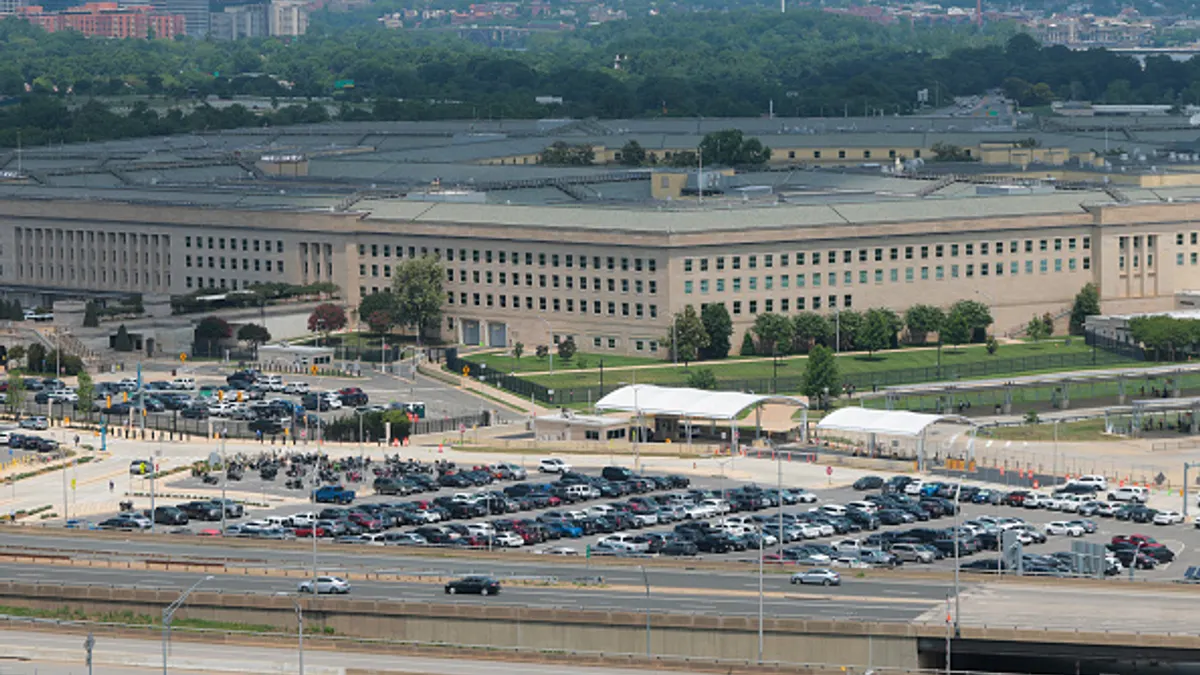
At 6.5 million square feet, the Pentagon was the largest office building in the world until 2023, when the Surat Diamond Bourse in India opened. The building sits on 67 acres, contains almost 18 miles of corridors and can accommodate up to 26,000 people. Its configuration, based on five nested concentric rings, makes it possible to isolate one of the rings, or sections within the rings, without impacting the others.
“The Pentagon’s unique design … makes it possible to divide the building into multiple ventilation zones, allowing officials to lock down affected areas without evacuating all of its … workers,” a New York Post article says.
During the June 11 incident, only some of the sections were locked down, according to Parnell. At the time of the incident, directions to the building's occupants differed based on the section of the building they were in.
“The … shelter-in-place order [was] for the affected area,” he said in his post.
According to a CNN report, floors two through five in corridors four through seven were locked down, impacting the Navy’s main public affairs office and the Secretary of the Army’s office.
The only other known time the Pentagon was locked down was in 2021 in an incident that involved a shooting at a transit hub outside the building.