Dive Brief:
- Helix Earth has secured $12 million to accelerate development of its technology to separate temperature control from moisture management, which would enable commercial facilities to lower energy bills, improve comfort and reduce wear on existing equipment, the company announced.
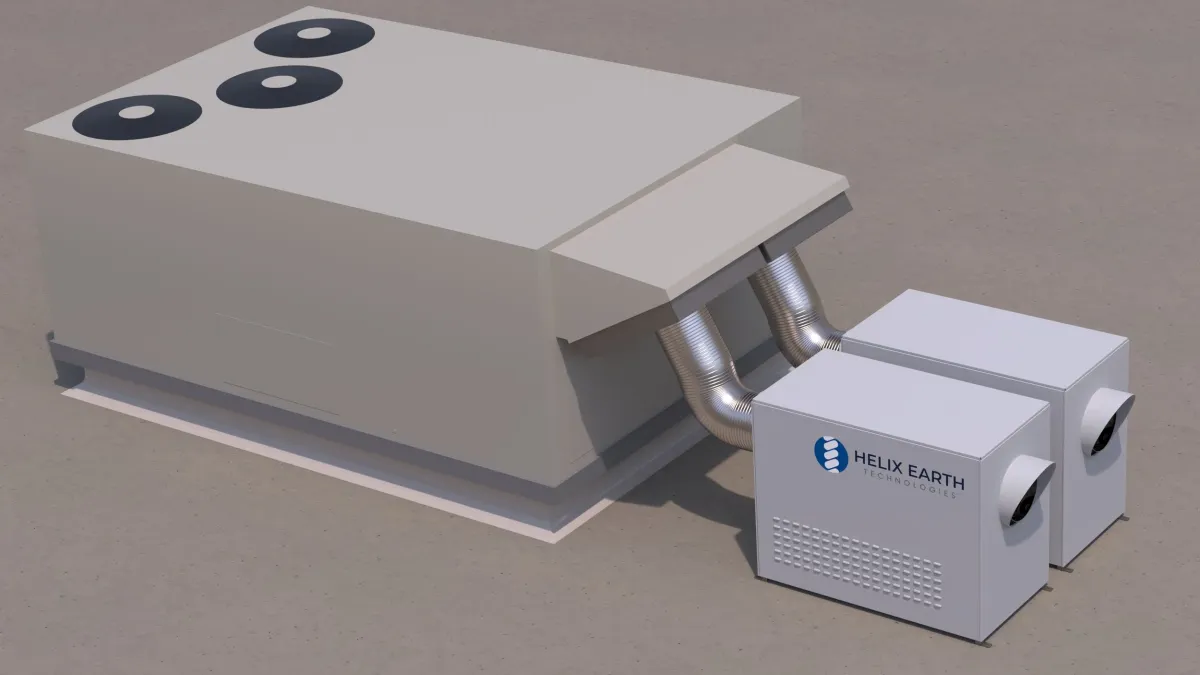
- Founded in 2022, the Rice University spinoff will use the funds to scale manufacturing and accelerate deployment of its first product, a commercial air conditioner add-on that bifurcates the energy required for temperature management from moisture control.
- "We've spoken with hundreds of building owners representing tens of thousands of locations, and the message is consistent,” Helix Earth Co-founder and CEO Rawand Rasheed said in a statement. “They want more comfortable spaces, better air quality, lower energy bills, less product spoilage from uncontrolled humidity, and longer life out of their existing AC equipment.”
Dive Insight:
Traditional air conditioning systems handle temperature control and moisture management simultaneously, which often leads to inefficiencies, excess energy use and inconsistent indoor air quality, according to a release on the funding by Rice University. Up to 80% of the energy used in air conditioning systems is devoted to dehumidifying air in humid environments, representing substantial wasted energy, Helix Earth says.
Humidity control gives facility managers a way to reduce infectious agents, according to some experts. Infectious agents tend to travel farther and impact people’s nasal cavities and sinuses more when an indoor environment is dry, research has shown.
Conversely, persistent high humidity levels fosters mold and microbial contamination in hidden areas such as ductwork, ceiling cavities and behind walls, “posing long-term risks to asset integrity and occupant health,” Duncan Curd, global business development leader at DriSteem, said in an interview with Facilities Dive. “Low humidity also has its problems, causing static electricity buildup and warping, cracking or delamination in materials like wood, paper and adhesives. “
“Viruses are very small,” said David Schwaller, senior application engineer at DriSteem, a company that manufactures humidification systems. “They stay airborne and … move across spaces from very long distances. If you have a properly humidified space, the water droplets don’t evaporate as quickly, so the [viruses fall] to the ground and other places so they don’t get ingested by the breathing process.”
Dry air can cause static charges that can damage fine equipment, like machines used in semiconductor manufacturing, while overly high humidity can negatively affect furniture over time.
As a result, investing in more precise humidity controls can help facility managers safeguard assets by extending the service life of HVAC systems as well as furnishings and room surfaces by reducing wear and stress caused by environmental fluctuations, Curd said.
“The long-term return on investment is substantial,” he said. ”Facility managers can expect reduced repair and replacement costs, fewer unexpected equipment failures, and minimized operational disruptions.” In environments that rely on controlled conditions, such as healthcare, archival storage, or precision manufacturing, effective humidity control also reinforces stakeholder confidence in the building’s reliability and environmental quality, Curd said.
Helix Earth is hoping its product, the Helix MICRA unit, will give facility managers more control over humidity levels. It will be designed to connect to most AC rooftop units or dedicated outdoor air systems and be capable of pre-dehumidifying supply air, “substantially dropping the load on the existing unit and lowering power needs by 50%”, the company says on its website.
“This investment will empower the Helix Earth team to scale manufacturing and accelerate deployment of our first hardware product, a retrofit system designed to disrupt a significant portion of the $150 billion commercial air conditioning market,” Rasheed said. “Building owners are dealing with rising energy costs, uncontrolled humidity, and aging infrastructure with no viable, cost-effective path forward. We are in the field today solving these problems for commercial customers, and this capital puts us on an aggressive path to scale.”
Founded by two Rice University alumni, Helix Earth has been incubated at Greentown Labs in Houston since 2023. The company has received a Phase II SBIR grant from the National Science Foundation, grants from the U.S. Department of Energy and been recognized on the Cleantech 50 to Watch list, the 2025 SXSW Pitch competition and Pepperdine Business School’s “Most Fundable Companies” award, according to the release.
The financing round was led by Veriten with participation from Rua Ventures, Carnrite Ventures, Skywriter LLC, Textbook Ventures and others.