Dive Brief:
- The versatility of LED lighting gives property owners a value-creating lever they can pull if they make the investment, architectural lighting company Color Kinetics says in a report.
- Philadelphia invested $6.85 million in 2024 to install more than 200 color-changing floodlights outside the city’s 123-year-old City Hall to turn the building into a canvas for expressing what’s happening in the city. This “real-time civic platform,” Color Kinetics says in the report, “enables the City of Philadelphia to respond to events, causes and celebrations through lighting.” Some $12 million in economic value can be traced to the project, the report claims.
- The report showcases three other lighting projects that together have generated roughly $10 million in economic value by turning the built environment into a focal point that attracts additional investment. “Public lighting,” the report says, can “contribute to tourism, economic development, community pride, and urban revitalization.”
Dive Insight:
Since facility managers started leveraging the technology to reduce energy costs in the early 2000s, LED lighting has grown into the second most common type of lighting in commercial buildings, behind fluorescent bulbs, according to the U.S. Energy Information Administration. Forty-four percent of U.S. commercial buildings used LED lighting between 2012 and 2018, compared to 68% which had standard fluorescent bulbs in that time, EIA says.
In its report, Color Kinetics says the programmable nature of the technology makes LED lighting a kind of media that can be deployed creatively to give a dynamic quality to the built environment, leading to projects that have “economic, cultural and social impact.”
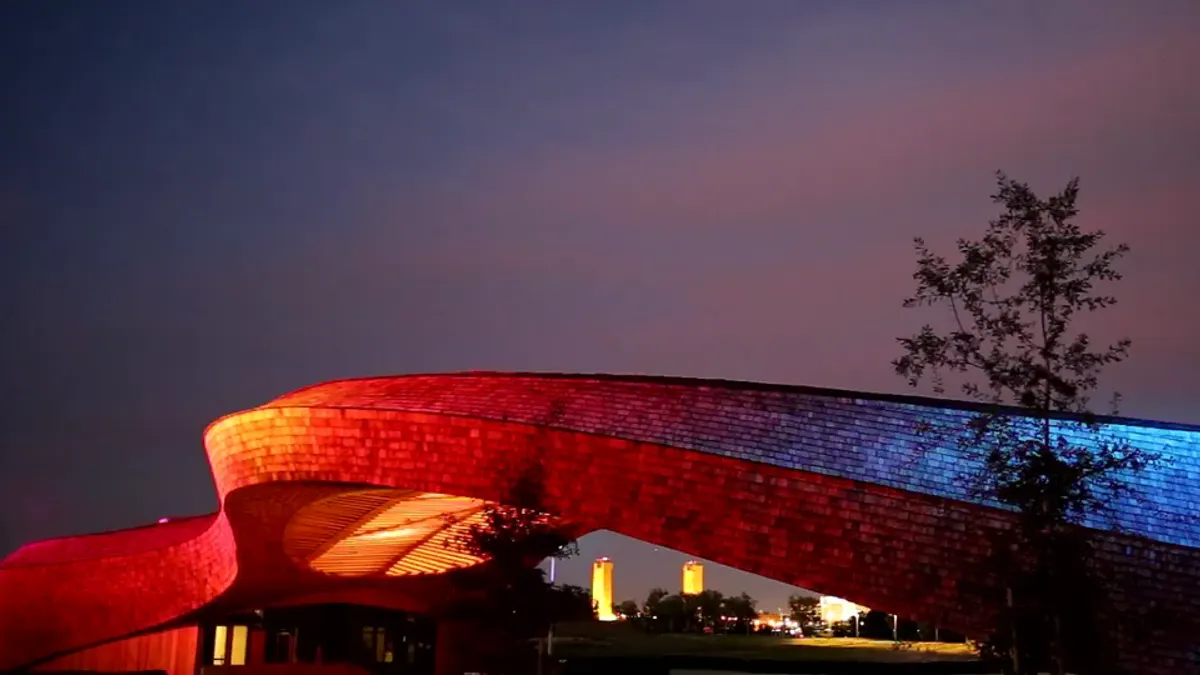
In West Sacramento, California, private developer and property manager Fulcrum Property partnered with the city in 2017 to build an open-air multi-use space called The Barn that helped generate economic interest in what was a neglected industrial part of the city. The building is now “the anchor of West Sacramento’s rapidly developing riverfront area,” the report says.
“The west bank of the Sacramento River was a watery ghost town,” says an SF Gate article when The Barn was completed 10 years ago. It was “‘the other side of the tracks, the place your mom said don’t go after dark,’” then-West Sacramento Mayor Christopher Cabaldon said at the time.
The developer invested $70,000 to install colored lighting around the building that has helped make the facility a visual landmark, the Color Kinetics report says.
“Its architectural lighting and open-air design [is] frequently featured across social media, tourism content, and event promotion,” the report says. “The illuminated canopy regularly appears in Instagram Reels, TikTok videos, Yelp photography, and nightlife-related content, where it serves as a visual identifier for the venue.”
The report claims the lighting portion of the development is responsible for creating just under $114,000 in economic value, led to $35,000 in payroll for the workers who installed it, raised $4,900 in state and local tax revenue and contributed $54,000 to the area’s gross regional product.
“The Barn’s lighting plays a critical role in extending the usability of public spaces beyond traditional hours, increasing foot traffic and creating a more vibrant and active environment,” the report says.
In Philadelphia, installing lights around the city’s historic City Hall building was more costly — almost $7 million — but at more than $16 million, the economic return was greater, the report says. The project supported almost 70 jobs at a payroll of almost $6 million, raised almost $470,000 in state and local tax revenue and boosted the area's gross regional product by $9.5 million, according to a Color Kinetics economic impact analysis.
The lights “transform one of the nation’s most iconic civic buildings into a dynamic and programmable visual asset,” the report says.
One factor in the cost of the lighting was the complexity of the installation. “Lighting [was positioned] on the roofs of 10 surrounding buildings” as a way to turn the city hall and its 548-foot clock tower into a canvas, the report says. With “the integration of dynamic and programmable architectural lighting, the building has been reimagined as a truly modern civic asset that bridges historic legacy with modern lighting expression,” the report says.
Following the Philadelphia Eagles’ Super Bowl LIX win in 2025, the building was illuminated in green. “Images and videos of the illuminated building circulated widely across Instagram, user generated content, and news outlets like USA Today and The Temple News, as a visual symbol of the citywide celebration," the report says.
The other lighting projects are infrastructure-related.
A nonprofit group put together by business and civic leaders in 2018 invested $4 million to install lighting on the Daniel Hoan Memorial Bridge in Milwaukee. The lighting has had an economic impact of more than $7 million, supported 30 jobs at a $2.5 million payroll, raised $240,000 in state and local tax revenue and contributed more than $4 million to the area’s gross regional product.
In Nashville, Tennessee, a LED-lighting-based public arts project called Loqui on the county fairgrounds, commissioned in 2024 by the city and county and a local arts group, has had a $5 million economic impact, supported 17 jobs at a $1.9 million payroll, raised $141,000 in state and local tax revenue and contributed $3.5 million to the area’s gross regional product.
“The success of Loqui highlights the role that intentionally designed, experience-driven spaces can play in district level development,” the report says.