A modular approach to data center design and construction could help overcome bottlenecks like labor availability, land constraints and long lead times for power and electrical equipment while boosting performance once operational, an executive with data center solutions provider Flex told Facilities Dive last week.
Chris Butler, president of Flex’s embedded and critical power business, said the company’s modular approach is gaining traction among data center developers following decades of use in other critical industries, such as wastewater treatment and fossil energy extraction.
Flex says modularity can slash the need for on-site testing and cabling by 70% while trimming data center project timelines by 30% overall. Building more components in controlled factory environments enables procurement of long-lead-time equipment earlier in the development process, ensures more consistent equipment performance and reduces risks to worker safety, the company says.
Sixty percent of data center projects that plan to come online in 2027 have not yet begun construction, raising questions about whether they’ll stick to their announced timelines, J.P. Morgan analysts said last month.
Multiple forces are aligning to slow data center development in parts of the United States. Ongoing issues such as tight supply of power generation equipment and electric transformers, competition for suitable sites and a finite pool of skilled construction and trade labor have been compounded by growing public pushback on large-scale computing facilities. At least 20 projects representing nearly $42 billion in investment were canceled in the first quarter of 2026 due in part to permitting challenges, according to data collected by Heatmap.
Butler said similar challenges have vexed European data center developers and end users for years — especially the continent’s relatively high labor costs, made worse by national regulations that limit cross-border labor portability. Strict building codes add to the pressure on construction costs and timelines, he said.
In response, Europe’s IT industry began shifting toward modular solutions a few years ago, Butler said. U.S. data center developers and tenants are now following suit.
“It’s becoming more of the de facto standard for any large-scale data center installation,” he said.
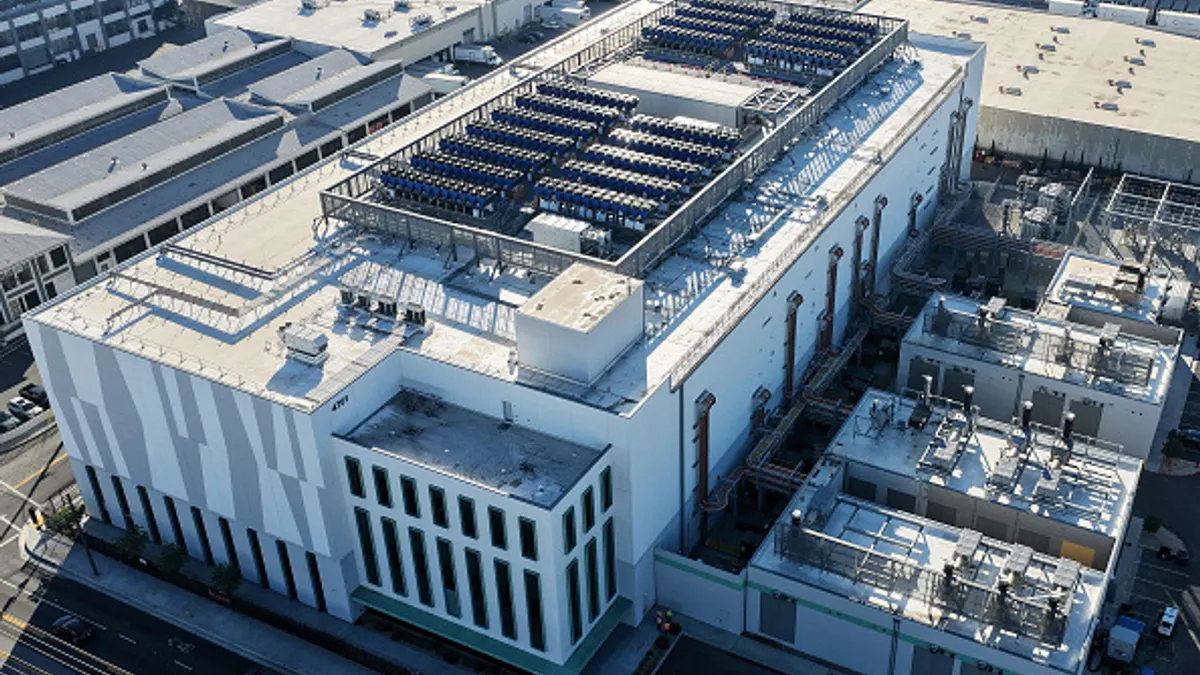
Flex initially gained traction in the data center market with a “power pod” architecture that sits outside the concrete shell of the data center or inside the facility on skids. Either placement increases flexibility in a fast-moving industry — where chips considered cutting-edge today may be obsolete in as little as two years — “because once you build a data center and put the [electrical] conduit in concrete, you can’t change it,” Butler said. “Or you can, but it’s very expensive.”
It’s now common for not just power infrastructure but cooling hardware and IT equipment to sit “outside” the data center in modular buildings that can be reconfigured or changed out as needed, Butler said. Flex is working with NVIDIA, the chipmaking giant, on the shared goal of creating “future-proof” designs compatible with the 800-volt, direct-current power architecture that NVIDIA says will be needed to power next-generation server racks as soon as next year, he said.
Though market and media attention tend to focus on massive data centers running the “latest and greatest” graphics processing unit chips for AI model training runs, perhaps 80% of the computing facilities that get built “for the foreseeable future” will be lower-powered designs running conventional central processing unit chips, Butler said.
If those facilities’ owners do want to upgrade to more powerful chips, “those racks are built modularly,” he added.