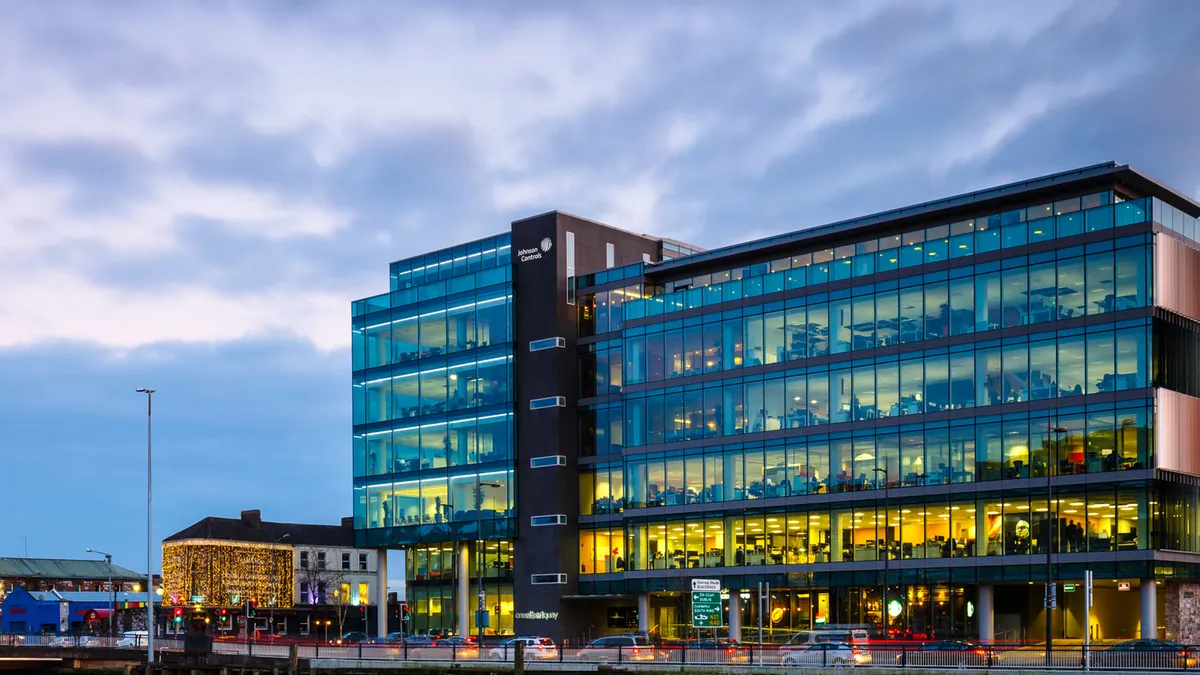
With their big energy appetite limiting where their facilities can go, hyperscalers and other data center companies can have more siting options if they lower their power demands by redeploying their excess heat into cooling, Johnson Controls CEO Joakim Weidemanis said Wednesday on the company’s third-quarter earnings call.
That calculation is opening the door for the smart building technology giant to leverage its absorption chiller portfolio to help companies scale back their energy needs and, by extension, expand where they can locate their facilities, Weidemanis said.
“Local communities being concerned about the impact on power prices and things like that … really leads the data center [owners] to make more careful choices about where they go,” he said. “It’s easier to find more locations the less power you need.”
The company earlier this week released a reference design, or blueprint, for how a large-scale absorption chiller would add enough on-site power to hyperscale-sized data centers to reduce cooling electrical demand by 44%, which the company says would unlock 97 megawatts of additional computing capacity in a 1 gigawatt-scale AI factory.
“We now have an absorption chiller portfolio geared to the data center space that will allow our customers who generate power locally to capture a meaningful part of that excess heat and put it to use within the thermal management architecture,” Weidemanis said.
Absorption chillers convert heat waste that would ordinarily be lost to new energy.
On the earnings call, the company announced that its organic sales grew 10% to $6.6 billion for the quarter. In addition, because of strong sales, it increased its guidance for organic sales for the fiscal year from 6% to 8%.
“Our strong third quarter result … gives us the confidence to raise our fiscal 2026 guidance,” Marc Vandiepenbeeck, the company’s executive vice president and CFO, said.
Weidemanis said the company’s specialty in thermal management positions it to capitalize on the macro trends dominating the economy.
“This is the age of thermal management,” he said. “AI factories, advanced and biopharma manufacturing, large research hospitals and universities require thermal management solutions … at unprecedented scale.”
The company announced that the backlog for its products increased 32% year over year to $21 billion. Order volume grew 27% year over year, led by a 37% increase in the Americas, according to the earnings presentation.
Looking ahead, the need for thermal management will grow, he said.
“As rack densities increase, new chips are launched and put into use, the amount of heat generated in data centers [will] increase,” he said. “And, by the way, there are other things that generate heat, too. Think of the 800-volt DC [battery]. So, the amount of heat that needs to be extracted out of a data center will continue to increase. And so … thermal management becomes even more critical.”
Weidemanis said the company’s focus isn’t just on hyperscalers. In part because of their energy demands, data centers will shrink into more specialized “edge” facilities that are located closer to end users for fast, targeted computing.
To position itself for that segment, the company earlier this year invested in a modular data center company called Armada that uses Johnson Controls’ thermal management products in its units.
“Think of them as data centers in a shipping container,” he said. “All the products that we sell [are] in that shipping container.”
The modular units are critical for organizations to meet computing needs in remote locations — oil and gas explorations, for example, or defense applications — but the market is moving beyond that, he said.
“There will be decentralization,” he said. “There will be a world where there are … different kinds of models of data centers.”
Weidemanis said the company’s network of manufacturing facilities gives it enough control over its supply chain that it can operate effectively even in volatile economic conditions.
“We don’t make every single thing,” he said. “We don’t dig iron ore out of the parking lot. [But] we are more vertically integrated than some in our industry, and in a high-growth environment, that of course means that we control more of our own supply chain.”