Dive Brief:
- The John F. Kennedy Memorial Center for the Performing Arts is so dilapidated that it warrants being torn down and replaced if it doesn’t get the renovation work it needs, which depends on money that President Donald Trump and the Trump administration are uniquely positioned to deliver, the U.S. Department of Justice argued in a court filing this week.
- “The Center will deteriorate further into an unsafe, decrepit structure that will be required to be taken down,” DOJ says in its filing with a D.C. federal district court. “Without the prominent recognition of The Trump Administration, and President Trump’s efforts, the donors will not contribute, and the Center will continue to be in a financial and structural death spiral.”
- DOJ says that a resolution that the Kennedy Center board passed August 13 to recognize Trump’s role in spearheading the renovation and funding effort by inscribing “Renovated and restored by President Donald J. Trump” on the building facade is consistent with a ruling in late May that required the board to remove his name from the building. It is “plainly lawful … to recognize the Trump Administration’s unique contribution to the Center’s viability,” DOJ said. The resolution would also name an adjacent plaza after Trump.
Dive Insight:
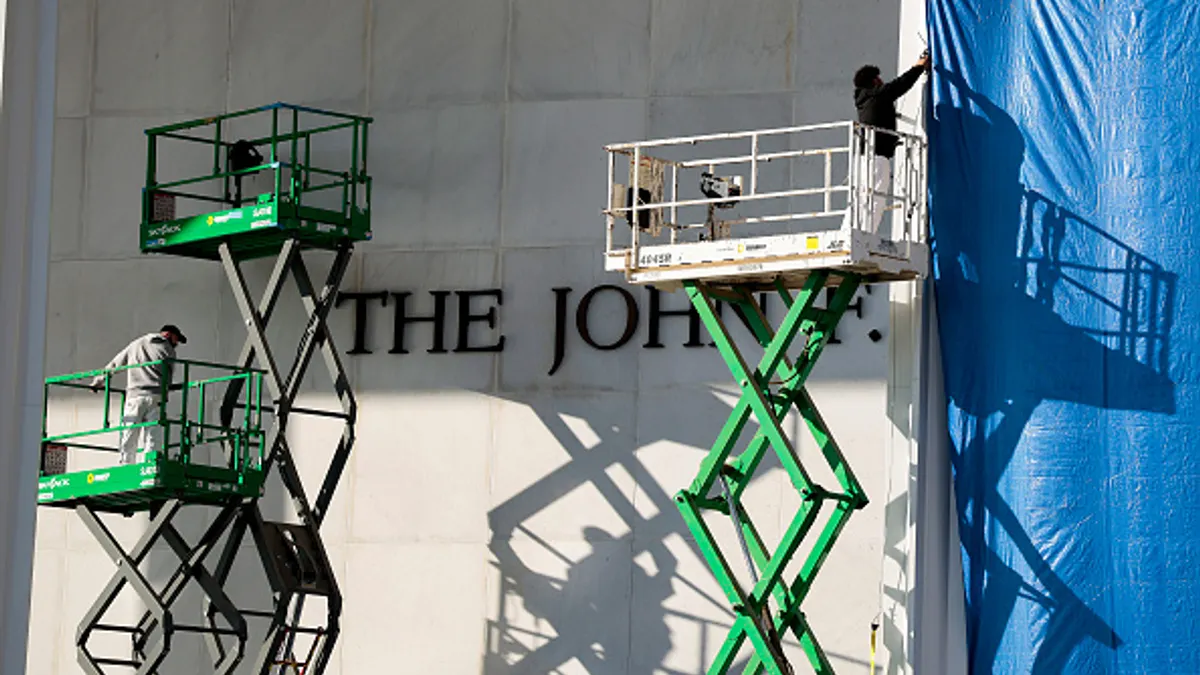
DOJ’s filing responds to a request for an emergency injunction filed Aug. 21 by Rep. Joyce Beatty, D-Ohio, an ex officio member of the Kennedy Center board, to stop the board from adding Trump’s name to the facility despite the court’s earlier ruling blocking it. The late-May ruling directed the board to remove Trump’s name because the building was authorized by Congress as a memorial to President Kennedy and only his name can go on it.
If the building is torn down, DOJ said, the board might replace it with an amphitheater, a proposal that’s been around for several years. “A large outdoor amphitheater overlooking the Potomac River … will fail to adequately honor President John F. Kennedy, but would be simpler and more economical to build, operate, and maintain,” it said.
Attorneys for Beatty say DOJ is using the prospect of tearing down the center as a threat to get Trump's name back on the facility. “This is unconscionable,” the attorneys said in a statement, ABC News reported. “It is unbecoming of the Department of Justice to even put this in a filing.”
Internal analyses that the Kennedy Center had undertaken on the facility’s backlogged repair needs found that, while the problems are extensive, they’re not so bad that the building must be shut down for the work to be done, according to a summary of the analyses included in the late-May opinion.
Comprehensive building plans that the board had prepared in 2021 and 2022 said the facility needed roof work along with a new fire alarm system, waterproofing and replacement of some piping, chillers and boilers, along with cosmetic repairs like new marble and painting. Another analysis identified water intrusion at the base of the building’s exterior columns and in the building’s main electrical vaults. Work on the structural steel and concrete supporting the center’s deck is also needed.
“Although the [comprehensive building plans] and external reports recommended an assortment of renovation projects, none called for the complete closure of the Center in order to accomplish the repairs,” U.S. District Judge Christopher Cooper wrote in the late-May opinion. The renovations “may involve demolition and reconfiguration of component parts of the building [but the court] is not persuaded that the building will be razed to the ground or stripped to its studs and reconstructed.”
In a report prepared by Matt Floca, brought in as the center’s facilities manager in 2024 and then named executive director by Trump in March, the renovation work was originally envisioned as a phased project that would be undertaken while the center remained open. Floca later recommended closure, according to the late-May opinion.
“Mr. Floca … at some point changed his mind about the propriety and feasibility of carrying out the Center’s needed repairs while it remained open to the public,” Judge Cooper said in the opinion.
The board in July voted to close the center for two years to undertake the work, but that decision is tied up in separate litigation.
In its filing, DOJ credited Trump with persuading Congress to provide $258 million in funding as part of the One Big Beautiful Bill for the renovations and raising donations as part of a privately funded endowment.
“These efforts promise to raise hundreds of millions of dollars … to make the Center structurally safe from collapse or calamity,” DOJ said.
The idea that Trump is crucial to the center’s financial future isn’t supported by the institution’s financial records, according to a report the Washington Post published August 25.
Since Trump replaced the center’s board with hand-picked members last year and had his name added to the building, both ticket sales and donations have dropped, the report said.
“‘The center took a huge hit when the takeover happened,’” the Post reported, quoting a Kennedy Center official. “After the name change, ‘it was just an absolute fiscal cliff. Donors disappeared, ticket sales disappeared, artists disappeared — like it was doomsday.’”
The center had budgeted roughly $220 million in revenue for the 2026 fiscal year, which ends Sept.30. By late May, officials projected the venue would bring in $124 million, according to the Post report. Even after officials cut projected expenses by a third, the center was still projected to have a $23 million deficit.
“Blocking the Board from appropriately recognizing President Trump will cause donors to flee, financial contributions to dry up, and structural rehabilitation to stop,” DOJ said.
The Kennedy Center didn’t immediately respond to a request for comment.