Dive Brief:
- Life sciences markets are turning a corner, with top life-sciences regions reporting heightened demand and facility owners diversifying their tenant base to backfill oversupply built following the pandemic, according to reports.
- Boston, the San Francisco Bay Area and San Diego all saw positive net absorption in the second quarter as life sciences capital markets rebounded, with M&A surging, venture capital recovering and IPO exits growing, according to a second-quarter report from global real estate advisory company Newmark.
- Landlords are diversifying their tenant rosters as users in life science-adjacent industries — AI, quantum science and advanced-engineering technology — help backfill demand from more traditional life science users. Tenants still have the upper hand, though, with user preferences likely to remain concentrated on top-tier assets in core clusters, Newmark says.
Dive Insight:
The market is still recovering from a significant overbuild in capacity that occurred in the years following the pandemic, according to Mark DiNapoli, managing director of design and construction at Longfellow Design Build, an architecture, construction and engineering firm in the life sciences space.
“I don’t think it’s any secret to anybody [that] there was a tremendous build and a tremendous move towards life science or R&D real estate that started just prior to COVID, and there was a big run-up through 2022 into 2023,” DiNapoli told Facilities Dive. “There was an enormous overbuild in terms of inventory in all of the major markets, and … we are still seeing that inventory in the marketplace.”
That space, particularly high-quality R&D life science product, is slowly being absorbed, and the industry is seeing green shoots in terms of build-to-suit opportunities for some of the larger players, he said.
Global competition from Asia is rising, driving big pharmaceutical companies to start investing in emerging biotech ecosystems, according to Newmark’s report. This growing competition has the potential to reshape what operations will remain in the U.S., Newmark says.
Despite concerns related to internal upheaval and staffing turnover at the U.S. Food and Drug Administration, the agency continues to approve new drugs, lending positive demand for the market, per the report.
“We’re beginning to see some interest in [build-to-suit] when [biopharma firms] have a particular need that can’t be fulfilled,” said DiNapoli, citing North Carolina’s Research Triangle as an example of one market that didn’t overbuild to the extent of other major markets and is now seeing construction activity.
In San Francisco, many AI and AI-related businesses have begun to absorb inventory that was built for life science lab real estate.
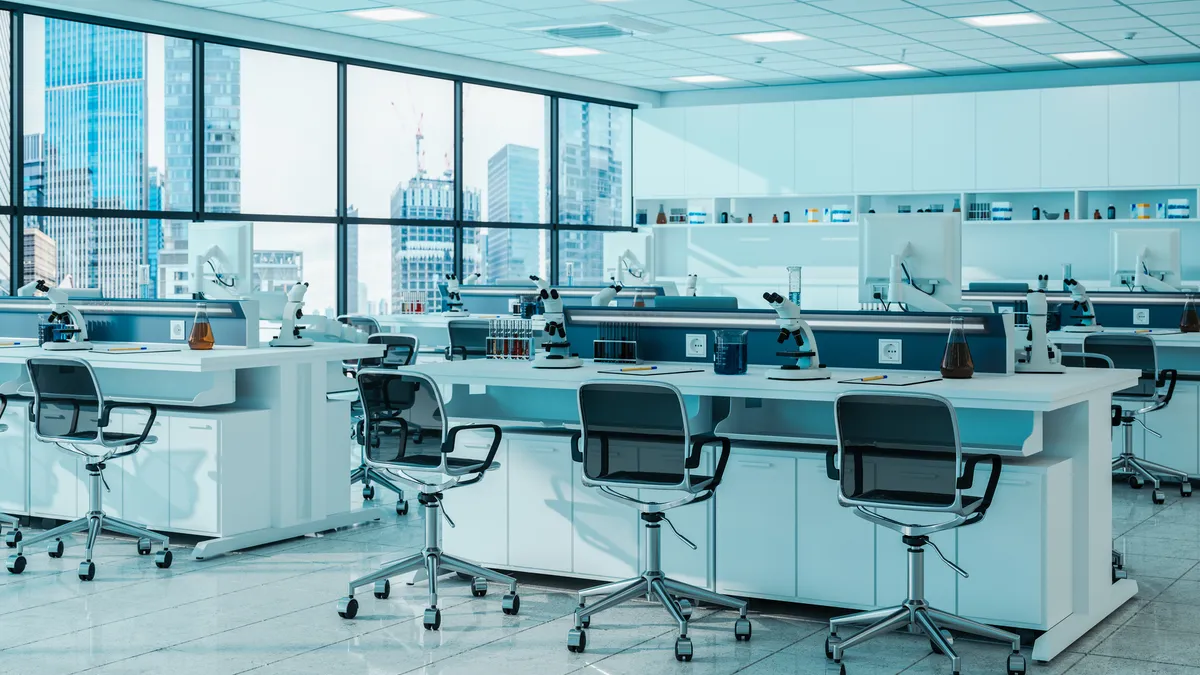
“There’s a lot of inventory that was delivered for lab and never occupied,” DiNapoli said. “That inventory in some, not all, cases is really ideally suited to more of the advanced technology type of industries.” This includes medical device companies and semiconductor or AI hardware users, he said.
Non-wet lab users continue to reshape tenant demand, per the report. “Lab-ready space will remain desirable among ‘tough tech’ companies looking to scale within traditional R&D properties given similar infrastructure needs, which bodes well for improving market conditions,” Newmark said.
“It’s not wet-lab R&D like we would traditionally see,” DiNapoli said. “It’s a really interesting time in terms of what’s going on and seeing green shoots of life sciences beginning to sprout. There’s so much inventory finally being absorbed … by alternative users rather than traditional life science users.”
Some key infrastructure specifications make facilities built for life sciences applicable for other markets, including basic requirements around the rate of air changes and ventilation in the building, floor and clear height spacing that allows them to make changes and the amount of power they have access to, he said.
“The floor loadings are very commonly the same because of the equipment and the vibration criteria that an R&D life science user needs,” he said. “Those buildings have high floor loads to control vibration. An advanced R&D user on an upper floor needs high floor loads because of the weight of their equipment. So different reasons, same results.”
Power is another spot where many of these facilities can be retrofitted to handle more advanced technology companies’ needs, he said. While life sciences typically want about 25 to 30 watts per square foot in their space because of equipment, high advanced technology users may be looking for 35 to 40 watts per square foot.
“So it’s way more than office, not that much more than life science,” he said. “When you talk about adaptability, office to life science can be a gap that has to be closed power wise.” But for life science space transitioning to be used by advanced tech or other types of innovation, “it’s a smaller reach, also attainable, but also very important to … address,” he said.