The growth of integrated building systems and the addition of artificial intelligence to the platforms companies use to manage equipment are helping facilities managers better use their technicians’ time — an important objective while the skilled labor shortage persists, a Johnson Controls executive says.
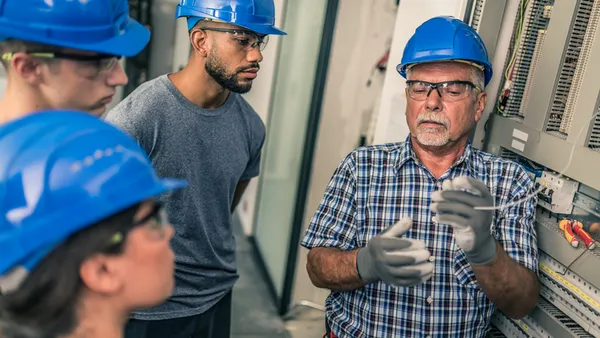
Companies like Johnson Controls are doing what they can to boost the talent pipeline as veteran technicians retire, says Brandon Jackson, Johnson Controls’ vice president of HVAC and controls in the Americas. The company operates almost a dozen building system training facilities in the United States and is working with technical schools and community colleges on certification programs.
“We’re investing heavily in training industry professionals,” Jackson told Facilities Dive in an interview.
By some estimates, only two technicians are available to replace every five who leave the field. Although technology can’t close the gap, it can help reduce the impact by making technicians more productive, Jackson said.
“You can scale a worker’s ability to do more with less [by] bringing in as much data as you can to the fingerprints, to the hands, of the operations employees,” he said.
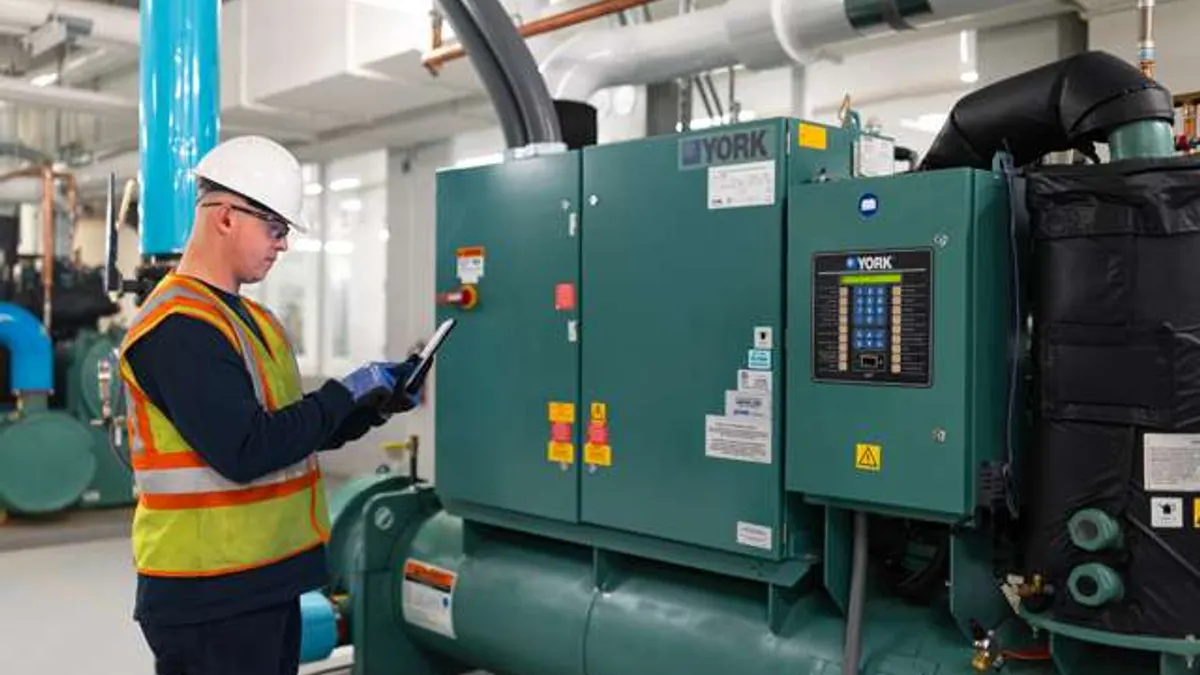
Jackson pointed to a facility he worked with that was seeing increased pressure in its chiller. By analyzing data from the connected systems in its central plant, it learned that the problem wasn’t in the chiller, but stemmed from clogged tubes leading to the cooling tower.
“The data was telling us the cooling tower had chemical water treatment issues,” he said. “So we didn’t even have to roll a truck” to the facility, saving time and money.
Contractors, facility managers and original equipment manufacturers like Johnson Controls are all dealing with too-few technicians, so having equipment integrated into a data platform helps all sides of the relationship, he said. The facilities manager can spot problems while there’s time to fix them without costly disruption — what Jackson calls predictive failure diagnosis — and the OEM, or a contractor, can be more efficient in when and how often it needs to dispatch technicians.
“We’re not sending multiple trips of technicians to sites where we may have in the past,” he said. “We’re not rolling for the first time to see what’s going on, with no data for understanding why their system is down or what’s trending outside of tolerance.”
AI helps by spotting patterns and recommending courses of action, but it remains a tool that requires a human to decide what action to take, he said.
“Our technology absolutely informs us what’s going on, and then we’re deciding to dispatch a technician after talking with the client,” Jackson said. “We’re not at the point where our technologies automatically dispatch a technician, [although] that’s not far from where we are.”
Hardening building systems
To reduce the chance of security breaches, Johnson Controls’ product lines have platforms in which the data flows in only one direction — out. And, unlike some of its other systems, particularly in the industrial space, these transmit data over a cellular connection rather than an ethernet connection.
“There’s no way in,” Jackson said. “We would receive the data and then we’re able to see what’s happening… . We have no way to go in and make any changes [remotely], so that’s one way our customers have built confidence in using technology-connected services.”
The company also uses firewalls and, in some cases, an “airwall” system that the company says makes data invisible. “It locks down every endpoint across your network, isolates issues instantly, and accelerates containment and recovery,” the company says on an information page about its OpenBlue airwall system.
A high-profile breach of refrigeration controls used in hundreds of European grocery stores two weeks ago shined a spotlight on building system vulnerabilities.
“As you apply more modernization, and more improvements around technology in a building, what comes next … is cybersecurity risks,” Jackson said. “So, that’s a growing concern that we’re solving.”
At the end of the day, technology won’t close the labor gap, but it can help, especially with integration becoming cheaper as protocols are standardized, Jackson said.
“I would say both the cost of technology and services have come down,” he said. “The ability to integrate into a system [is] at a much lower cost [for systems that use] the more common integration protocols.”