Dive Brief:
- Workers believe AI is putting white-collar jobs at risk, driving Gen Z and the workforce overall to look more into skilled trades as industry groups launch initiatives to help fill spots left by retirees.
- Most, or 82%, of Gen Z believe skilled trades offer better long-term job security than many office jobs, but it isn’t just how they perceive these roles that is changing, according to a Thumbtack survey of over 2,400 U.S. adults. Nearly half of Gen Z respondents have started learning or are seriously considering a career change amid uncertainty in the job market, per the survey.
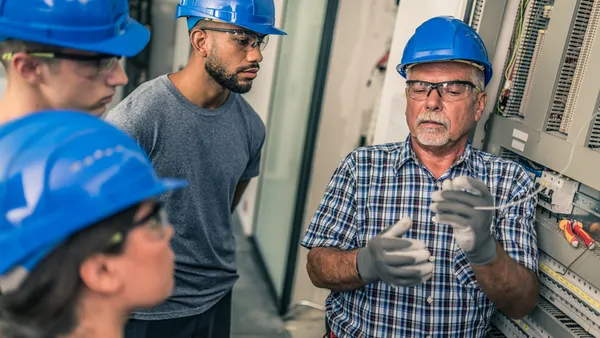
- Public and private initiatives are contributing to the momentum toward skilled trades. The Home Depot Foundation’s Path to Pros Skills Explorers program, for example, combines interactive online modules with hands-on learning to introduce students to the skilled trades.
Dive Insight:
The U.S. has been battling with a skilled trades and workforce shortage as a significant number of workers retire and infrastructure investments increase. An estimated 2.1 million skilled trades jobs could go unfilled by 2030, creating potential economic losses of up to $1 trillion annually, according to the U.S. Department of Education.
Low labor force participation and skills gaps are particularly acute in manufacturing, construction and other skilled trades, including facilities management, where only two replacements are entering the workforce for every five who retire, according to the Education Department. More than 4 million skilled trades jobs are expected to open over the next decade, Home Depot says, but only 6% of young people have expressed interest in pursuing these careers.
The crisis is driving states, organizations and coalitions to create programs that can generate interest among younger workers.
In January, the Department of Education launched the Connecting Talent to Opportunity Challenge, a state-led national competition and capacity-building initiative. In June, the program announced $15 million in prize funds and technical assistance that will go to 10 states, including Alabama, Arizona, Arkansas, Georgia, Hawai’i, Massachusetts, Montana, South Carolina, Tennessee and West Virginia.
Earlier this month, Lowe’s Foundation launched a skilled trades coalition with more than 75 organizations, including NVIDIA, AT&T, Bank of America, Carrier, General Motors, Dewalt and Duke Energy. The group’s goal is to train 1 million people in the trades by 2035.
The coalition aims to strengthen “every stage of the talent pipeline,” from recruitment to career advancement, in part by changing the perception of careers in the skilled trades, investing and scaling proven training and credentialing solutions and measuring progress from training to employment that can help the coalition understand what’s working.
These insights will be used to strengthen connections between training providers and employers to improve the pathways to in-demand jobs, Lowe’s said when announcing the coalition Sept. 1.
The focus is leading to some successes.Maryland’s Plumbers & Steamfitters UA Local 486 union this year accepted 170 apprentices out of 1,300 applicants, compared with 70 accepted out of 500 applicants five years ago, WNY Labor Today reported.
Ryan Ambrose, business agent for the Rosedale, Maryland-based union, said it would have accepted more into its apprenticeship program if there were enough space. The union will build a new training center in late 2028, he said.
Data center building and maintenance needs, as well as growth in the life sciences sector, are driving interest, WNY Labor Today reported.
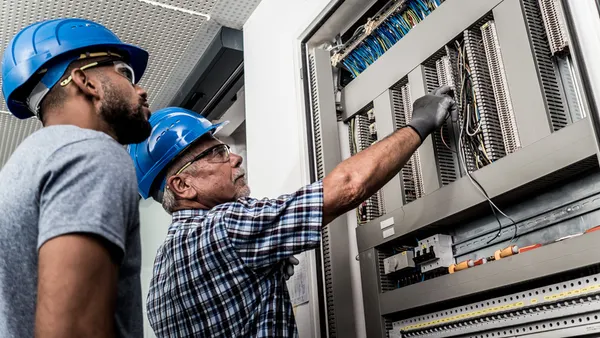
“There’s a lot of interest from young people who want to learn the trades, but they need opportunities to get on a jobsite and put those skills to work,” Deon Marcheau, owner of Antillean Restoration, said in the Thumbtack report. “Bringing apprentices onto our team gives us a chance to develop talented people who can grow with our business or take those skills wherever their career leads.”