Dive Brief:
- The U.S. office market’s vacancy rate declined 60 basis points from a year ago to 18.2% in the third quarter, marking the fifth consecutive quarterly decline as the market rebalances, according to CBRE’s Q3 office report.
- Asking rents grew 3.1% year over year to $37.95 per square foot, the largest jump since 2016, with leasing activity up 4% in the past year to 63.8 million square feet. CBRE estimates that annual leasing activity will surpass 2022’s record level.
- Low-performing buildings are being offloaded through demolition, decommissioning and conversion to multifamily, while flex operators are adding space in many markets, according to a report by Hubble, a Yardi company. “This phenomenon in conjunction with enduring demand for premium space is contributing to gradually decreasing vacancies while driving moderate rent growth in some markets,” Hubble says.
Dive Insight:
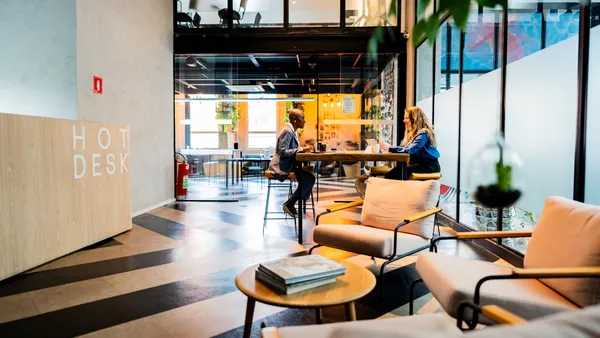
Nationally, coworking inventory grew by 2 million square feet in Q3 to reach 168.4 million square feet, with locations growing to 9,612, per Hubble. At the end of September, coworking space made up 2.5% of the office stock, up from 2.3% in June.
“With the flight to quality continuing in today’s office market, property owners are increasingly offloading low-performing properties,” Hubble says in its report. “At the same time, coworking inventory continues to grow at a steady pace nationally, with some variation across markets.”
As more office space gets picked up by flex operators and older office stock declines, coworking share of the U.S. office market continues to tick up, the company says.
“If the first half of 2026 was about coworking holding its ground, the third quarter was about where it chose to plant new flags,” Coworking Cafe said in a separate report. While the majority of new spaces emerged on the West Coast, particularly in Los Angeles and San Francisco, much of it happened away from flagship metros, the company said.
“Some of the bigger swings we have seen in market growth and contraction are from large management agreements and landlord-led in-house brands. This is a segment we are paying close attention to over the next year as buildings look to offer more options and flexibility in terms and space,” Peter Kolaczynski, director of Yardi Research, said in a statement.
Markets outside the top 50 saw their coworking footprint expand, but major markets still hold 77% of all U.S. coworking locations, Coworking Cafe says. Some large markets also saw a pullback, with Washington, D.C., and Houston both shedding coworking space during Q3, Hubble says.
Because location count grew faster than total space, the national average coworking space shrank for the third quarter in a row, down 1.2% to 17,515 square feet.
“This continues a pattern we’ve flagged all year: new entrants tend to be smaller, more nimble formats, which pulls the average down even as the overall footprint expands,” Coworking Cafe says. The five largest coworking brands — Regus, HQ, Industrious, Spaces and WeWork — added 91 locations in Q3, contributing roughly 40% of all net new locations during the quarter, per the report.