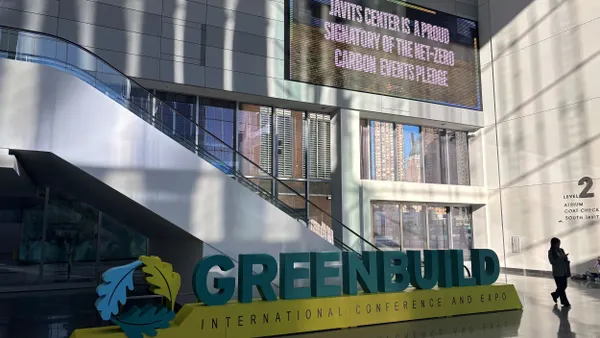
An office-to-residential conversion in New York City highlights the opportunities and challenges for sustainable adaptive reuse as conversion rates spike, speakers at the Greenbuild sustainable building conference said during a panel discussion Wednesday.
A project by Rudin Management Co., at 355 Lexington Ave. in Midtown, is transforming a building constructed in 1959 by adding four floors and approximately 280,000 square feet of space to provide 297 market-rate and affordable apartments.
The biggest sustainability factor for conversions is how much of the building itself can be reused, according to Hrisa Gatzoulis, vice president of sustainability at Rudin.
“The existing structure, the facade, the elevators, the existing stair openings, and then looking at all of this together … is one of the biggest decisions that we made,” Gatzoulis said during the panel. “This circularity component was the most exciting part.”
As part of the effort, the team walked through the building and took inventory of everything to decide what could be reused, recycled or otherwise salvaged, she said. Although the building’s age meant that some elements, like those containing asbestos, couldn’t be reused, many were.
Gatzoulis pointed to New York City’s City of Yes zoning law changes, which the city enacted two years ago to speed development, as a crucial element that helped enable the conversion. The changes make it easier to generate renewable energy and reduce restrictions on wall thickness, height and other regulations that affect building electrification and retrofitting, the NYC Department of City Planning says.
“The project still has to pencil out,” Gatzoulis said. “The zoning incentives, construction costs, the affordable housing component, all those economics [had] to be able to add [up] for this project to pencil out, so the City of Yes was a big component.”
In addition to looking at what components can be reused, the project team looked at what components can be returned to manufacturers that have takeback programs, Rebecca Schmidt, New York regional sustainability manager at Turner Construction, said on the panel.
For example, “if you have acoustic ceiling tile that is not contaminated, but is in proximity to other materials that are [contaminated], the manufacturer will not take those materials back,” said Schmidt. Other hardware and materials, like interior glass partitions, furniture and door hardware, were able to be returned, recycled or resold, which helped the project leaders boost their embodied carbon reuse scores as they pursued LEED certification.
“Building reuse is a clear winner here,” when looking at how these decisions impact the LEED v5 Building Design and Construction rating released last year, said Tanya Eagle, director of sustainable buildings at JLL.
Under LEED v5, the building product selection and procurement credit rewards products that optimize across more than one impact category, Eagle said. “For example, a product should not just reduce embodied carbon. It should also be better for human health, circularity and ecosystem health and social equity,” she said. “Under this new credit, materials that are reused max out the available multi-attribute score at five. So materials that are reused in a project are very much rewarded in this credit under [version 5].”
To accomplish a successful sustainable conversion, owners and project stakeholders need to set expectations and stay engaged through the process, Gatzoulis said.
The design-construction team and the general contractor and tradespeople, for example, play an important part in integrating the building deconstruction with labor, safety and logistics needs and use of the reuse marketplace to find pathways for materials.
“This is where the human element matters,” Gatzoulis said. “Everyone approaches the project through a different lens, and everybody’s lens is important. Keep all these stakeholders [engaged], rally them, and celebrate small wins. Because you can’t just scale reuse with one sustainability person. You have to get the whole team [to be] a part of this.”