Dive Brief:
- CBRE’s facilities management revenue rose 13% year-over-year in the third quarter of 2026, driven by growth in both its enterprise and local business segments. It also benefitted from an 80% surge in critical infrastructure services, which helped to boost its building operations and experience segment revenue 17%, the firm reported Thursday.
- Local facilities management revenue grew more than 25% in the Americas, while technology, financial services and energy clients led enterprise facilities growth, CBRE CFO Emma Giamartino said on the company’s earnings call. Leasing revenue in the U.S. was up 4%, reflecting a small dip in office leasing.
- The company expects its building operations and project management segments to maintain consistent growth, but its capital markets and leasing businesses could cool as a result of elevated interest rates. “When companies are nervous about the economic outlook, they’re a little more cautious,” CEO Bob Sulentic said on the call. “It’s hard to quantify, but there probably has been some pressure in leasing [from] that economic uncertainty.”
Dive Insight:
CBRE’s revenue grew 13% year over year to $11.5 billion, the company reported. On a net revenue basis, its project management business grew 11%, driven in part by growth in infrastructure projects. That segment “is a very large part of our project management business [and] more than [offsets] the slowdown in real estate,” Giamartino said.
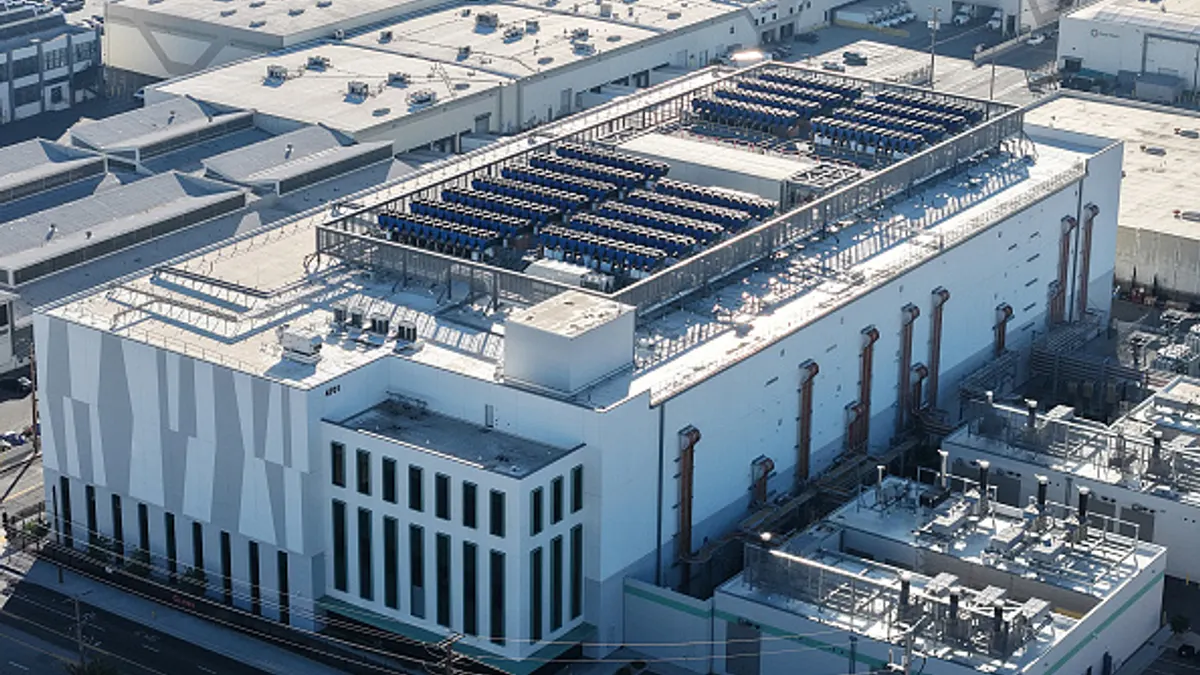
CBRE’s critical infrastructure services business — which includes network infrastructure, mechanical, engineering and plumbing projects and facilities management for data centers — is expected to generate nearly $4.5 billion of revenue in 2027, according to Sulentic.
Its acquisition of a global IT infrastructure company, Onnec Group Limited, will help drive the growth, said Sulentic, adding that even if data center growth in the U.S. eases, growth is expected to increase in other countries.
“Our acquisition of Onnec, which we announced today, fits within this line of business,” Sulentic said.
The $610 million cash deal provides CBRE with technical capabilities related to design, deployment and maintenance of network, fiber and data center infrastructure, a specialty area that’s critical to data centers, per a release Tuesday.
If the business achieves the entirety of the deal’s earn-outs, the deal will end up costing CBRE a little over $1 billion, which the firm is using as an incentive to continue to generate strong growth, Giamartino said.
The firm expects to close the acquisition by the end of the year, said Giamartino, noting that if the acquisition were included, the firm’s critical infrastructure services business would have generated approximately $3 billion in revenue over the past 12 months.
Although the company’s enterprise facilities management posted solid growth, it’s facing pressure from a handful of problematic accounts. “That’s happened from time to time over the years,” Sulentic said. “The market gets frothy, it gets more and more competitive and you … end up with some broker hires or outsourcing or enterprise accounts that don’t have the characteristics you would want.”
CBRE’s project management revenue slowed, up 3% year over year, as corporate clients acted more conservatively due to uncertainty in the economy, Sulentic said.
“We do a lot of work for big tech clients that have moved their spending away from … traditional legacy real estate-type investment into infrastructure, critical infrastructure, data centers,” he said. “I think you’re seeing some of that.” The firm also saw “a little bit of concentration slowdown in healthcare,” he said.
“What we really need is for rates to stabilize,” Giamartino said. “The volatility and the uncertainty is what’s driving a pause or a hold or even delaying deals to 2027. We expect that stability to come in the back half of next year…. Of course, if that doesn’t come or things change, the results will be different.”
In the U.S., leasing revenue rose 4%, supported by industrial, which was up 16%, while office leasing dipped 2%, Giamartino said.
This dip, which contrasts with a broader office recovery occurring in the market, is the result of some big deals that slipped into Q4, “which is in part why we have confidence that we’ll see double-digit growth in leasing in Q4.,” she said.
Despite the cautious economic outlook, Sulentic believes that even if things slow down in the U.S. — either because of the interest rate or political environment — CBRE believes growth will accelerate globally, especially in the data center sector.
“Onnec puts us in a great position to take care of that,” Sulentic said. Even if data center growth slows in the U.S., there should be plenty of business involving existing facilities. “We think that in data centers, you’re going to see potentially some pressure on the amount of new build,” he said. “And then what’s happening, and we’re already seeing it, is a lot of refit of existing data centers.”
Outside of its critical infrastructure business, CBRE’s infrastructure services work consists of overseeing the construction of transportation and energy assets along with data centers within project management, as well as sales, leasing and financing for data centers and advisory services. When taking this work into account, CBRE expects its total infrastructure services revenue to spike 40% from this year to $7 billion in 2027, Sulentic said.