Facility walls would need to be 4.5 feet thick to mitigate the kind of low hum that data centers typically make, according to Kasey Fowler-Finn, a biology professor at Saint Louis University.
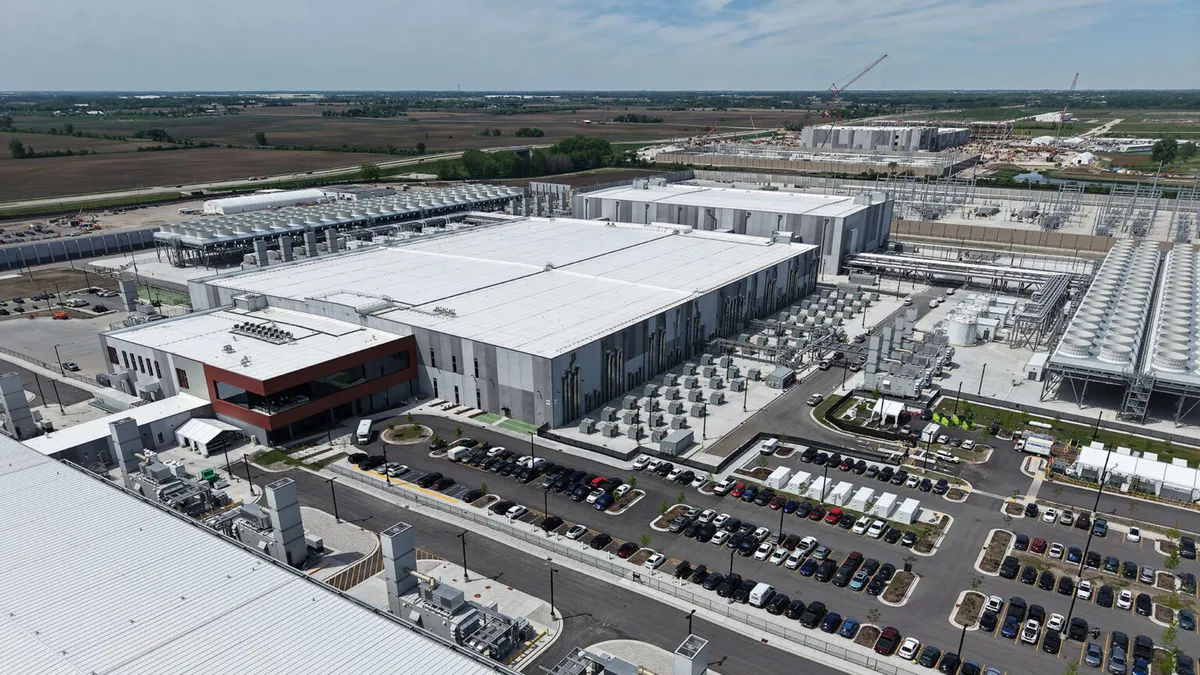
The low-frequency noise emitted by the facilities’ large-scale cooling and HVAC systems travels further and is more noticeable than the high-frequency noise that many noise ordinances are directed at, Fowler-Finn said in an interview last week.
“Data center hums [are] concentrated in single frequencies and they really stand out from background noise no matter how loud or what frequency that background noise is in,” Fowler-Finn told Saint Louis Public Radio Sept. 24.
Model data center noise guidance that Fowler-Finn released last month, based on research that she says she’s been conducting since 2001, focuses on the unique wavelengths of the low-frequency hum that large HVAC and cooling systems tend to emit.
“A facility can be compliant on paper while still delivering audible — or, for very low frequencies, inaudible but still physiologically relevant — daytime and nighttime noise exposure linked to numerous health concerns,” Fowler-Finn says in the guidance.
All sound loses its intensity as it spreads out geometrically, she says. It will weaken 6 decibels every time it doubles its distance from the source and weaken by 30 dB by the time it spreads 3,000 feet. It also loses intensity as it’s absorbed by structures that are in its path. But absorption has less impact on low-frequency sound because of the length of the wavelength, she says.
“Low frequencies … pass through walls and windows with little loss, since ordinary building materials are, for practical purposes, ineffective at attenuating them,” she says. “Low-frequency sound can also generate secondary noise by inducing vibrations and rattles in nearby structures.”
A 4-inch wall is sufficient to mitigate a typical high-frequency noise like a vacuum cleaner, which can reach about 1,000 hertz, but to mitigate a low-frequency noise at 63 Hz — which is typical of large scale HVAC and cooling systems — the wall would have to be 4.5 feet thick, she says. And for a noise as low as 20 Hz, it would have to be 14 feet thick — “not a remotely practical thickness for a building enclosure,” she says.
Commonly used A-weighted and C-weighted decibel measures are sufficient as a starting point for noise testing, but they need to be paired with what Fowler-Finn calls third-octave band sound pressure testing, which captures sound levels between 20 Hz and 200 Hz.
“Any tonal or narrow-band component of the facility's noise is independently identifiable [using that testing] rather than averaged away into a single broadband number,” she says, “so that a facility cannot pass an overall dBC allowance by averaging a single loud low-frequency band against several quieter ones.”
In her guidance document, Fowler-Finn calls for setback distances of at least 1,500 feet, well above what’s typically required for data centers, which are often permitted based on 100- to 600-foot setback requirements for industrial buildings. “These setbacks are generally written for ordinary or broadband industrial noise,” she says.
Of half a dozen lawsuits filed this year against operational data centers, five listed noise as the main problem. “That holds across very different jurisdictions,” Fowler-Finn says. Jurisdictions with lawsuits pending include Vineland, New Jersey, Dowagiac, Michigan, North Tonawanda, New York, and Hood County, Texas, according to an alert from law firm Winter Hale.
Results from a survey released in September by Science for Georgia and Quiet Communities found that more than 80% of people with a data center in their area can hear the facility noise inside their home and more than 70% said it interfered with their ability to relax. Almost 70% said they’ve considered moving because of it.
“Many described avoiding outdoor spaces, experiencing chronic sleep disruption and feeling unable to escape the constant noise,” the survey report states.
“Instead of fighting to put these in where people live and work, [building owners] should be working on technology that makes these friendlier to the environment,” Fowler-Finn said.