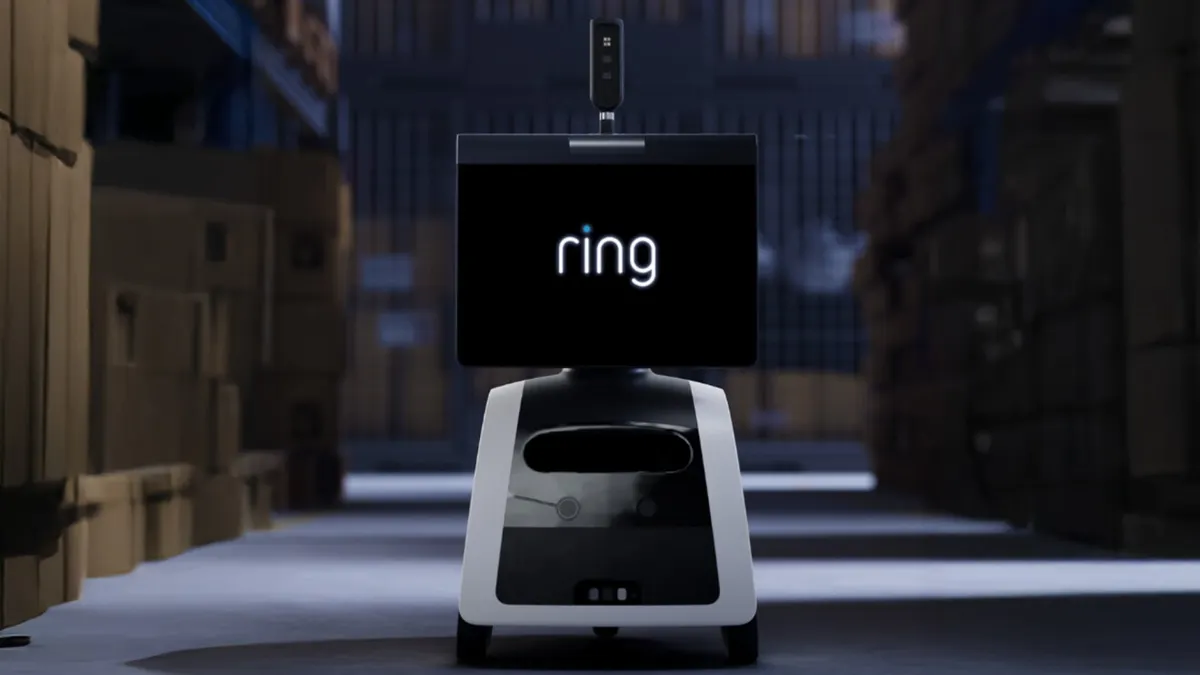
Amazon subsidiary Ring Robotics last week announced it would be making a business-focused roving camera available starting in December that travels programmed routes around floorplans, responds to alerts and, when directed, confronts intruders with lights, a siren and two-way audio.
“Customers told us they wanted eyes in the places a fixed camera couldn’t reach,” Jamie Siminoff, founder and chief inventor of Ring, said in a statement.
The roving cam is a security-only iteration of an earlier Ring product, called Astro, that was marketed as a personal companion that interacted with users, played music and offered other entertainment features.
“The Ring team … leveraged the best of Astro [for] a purpose-built security robot,” the company says.
The roving cam is configured to travel routes while streaming 4k video, enabling users to see areas stationary cameras might miss, the company says. The camera is mounted on top of a periscope that can extend up to four feet, which the company says enables users to see on top of counters, shelves and other obstacles. “It’s like having a guard on patrol,” the company says.
The device will retail for just under $1,000 and is self-contained. It activates at programmed times to make security runs around programmed routes and contains a motion detector that can activate it when it’s triggered. But if users want to access all its features and have it activated on the basis of other sensors — like those positioned at entryways and other points — the product has to be tied into the broader Ring ecosystem, which comes with its own costs.
“The supplied materials do not identify the qualifying tier, price, or whether a business’s existing subscription covers the robot,” a GearBrain review says.
Nor is it clearly compatible with other sensor systems that a business might already have in place. “No universal third-party integration is established in the supplied materials,” the review says.
There are physical limitations as well. It can’t go up and down stairs, for example, and it would have trouble following an intruder outside. “The wheeled robot is only designed to operate within a single-floor, indoor environment,” an Ars Technica review says.
And anything other than flat floors and angled rooms would give it trouble, according to the review. “The Rover is not compatible with ‘curved edges, sunken areas, flooring transitions greater than 1.375 inches (3.5 centimeters), and black glossy floors,’” says the review, referencing Ring specifications not included in the company’s announcement.
Facility managers programming the device should think about the spaces they want to cover, a MarketScale review says. “A manager might choose a stockroom entrance, a counter or a corridor as a test location,” the review says. “Is the relevant detail visible from the chosen stopping point? Does the camera position provide the intended view? Can the operator understand the image well enough to decide on the next step?”
Ring Robotics also debuted a consumer-focused security drone, which makes programmed and sensor-triggered flights.
“When a Ring camera, sensor, or alarm is triggered, Ring Drone automatically flies to previously set patrol points to investigate,” the company says. “With a 148° field of view and the ability to rotate 360°, Ring Drone provides a whole-room view in clear 2K video.…Two built-in LED lights activate automatically in low-light environments, so you always get clear, crisp video.”
The drone retails for just under $250 and will be available starting in early January.
The company says both devices reflect best practices when it comes to privacy, although the commercial-facing roving cam, unlike the consumer-facing drone, stays on until it's directed off. “Ring Drone powers down in its dock with its camera off, waiting until a flight is triggered to begin recording. With Ring Rover, Sleep Mode retracts the periscope and turns off the microphone with a single tap.”
The company’s devices have raised privacy concerns in the past. The company settled with the Federal Trade Commission in 2023 over access its employees retained over data that its video security devices generated. As part of the settlement, the company has to verify regularly that its employees aren’t accessing data from the devices. “At least once every twelve (12) months … the Defendant [must verify it’s] restricting access to Covered Home Security Recordings,” the agreement says.