The next version of the ANSI/ASHRAE/IES 90.1 standard for energy efficiency in new commercial buildings won’t have greenhouse gas-related addenda that were added last year, reflecting a shift among the standards-writing organizations to refocus the standard on its core mission.
“Standard 90.1 will maintain its primary focus on energy efficiency and energy cost justified requirements,” AHRAE said in announcing the change last month. The standard, which provides minimum requirements for energy-efficient design and construction of new sites and buildings and their systems, as well as criteria for determining compliance with these requirements, serves as a key benchmark for commercial building energy codes in the U.S. and around the world.
Addenda M and N, which the organizations added last year to provide standards on curbing greenhouse gas emissions, will remain as part of an optional publication, giving jurisdictions “a template for … reducing operational emissions [and using] renewable energy,” ASHRAE said.
Splitting off greenhouse-gas reductions as optional addenda enables the standard to “respond to emerging market needs without losing sight of the proven energy efficiency principles at the heart of Standard 90.1,” ASHRAE President Sarah Maston said in a statement.
Standard 90.1 was released in the 1970s and is officially known as the Energy Standard for Buildings Except Low-Rise Residential Buildings. It’s updated on a three-year cycle, with the next versions slated for 2028 and 2031.
Adding the emission-related addenda last year and then making them optional this year reflects shifting priorities of stakeholders, including the U.S. Department of Energy, which is part of the standards-writing committee.
“Are they telling us what to do on this or that? No,” Tom Culp, a Wisconsin-based building glass expert and co-vice-chair of the Standard 90.1 committee, told Facilities Dive. But “one of the mantras [we have as a committee] is ‘transparency, affordability and choice’ [and DOE] can file comments like any other stakeholder.”
In addition to having members on the committee, DOE provides funding to Pacific Northwest National Laboratory, which helps the committee model the impacts of proposed changes to the standard, according to Richard Lord, a senior fellow at Carrier Corp. and chair of the Standard 90.1 committee.
Addenda M and N remain an important option going forward, the committee members said.
When the Biden administration was in office, it was making billions of dollars in funding available for renewable energy and other technologies to help reduce greenhouse gas emissions from buildings, which accounted for about 37% of U.S. emissions in 2023.
Starting in 2022, the committee wanted to move toward a “carbon-neutral standard” by the time the 2031 version of the standard came out, Lord told Facilities Dive.
In 2024, DOE said the 2022 version of Standard 90.1 would reduce buildings’ energy consumption by 9.8% and cut emissions by 9.3%. When factoring renewable energy into these results, improvements were even higher, according to DOE’s technical analysis.
Major cities like New York and populous states like California and Washington have aggressive building-decarbonization frameworks, and nearly half of the world’s largest companies have committed to carbon neutrality by 2050 — including major owners and occupants of commercial real estate, such as Walmart and Target, Lord said.
These and other entities that have emissions-reduction mandates or targets can still base their approach on addenda M and N, although it’s not clear when the optional publication will be released, Lord said.
Jurisdictions typically adopt new versions of Standard 90.1 on a one- to eight-year lag. “Bigger, coastal” states and cities tend to move faster, he said.
New York City, for example, began enforcing the 2025 version of Standard 90.1 in March.
New levers amid “diminishing returns”
The committee made other notable changes to Standard 90.1 during its latest update cycle.
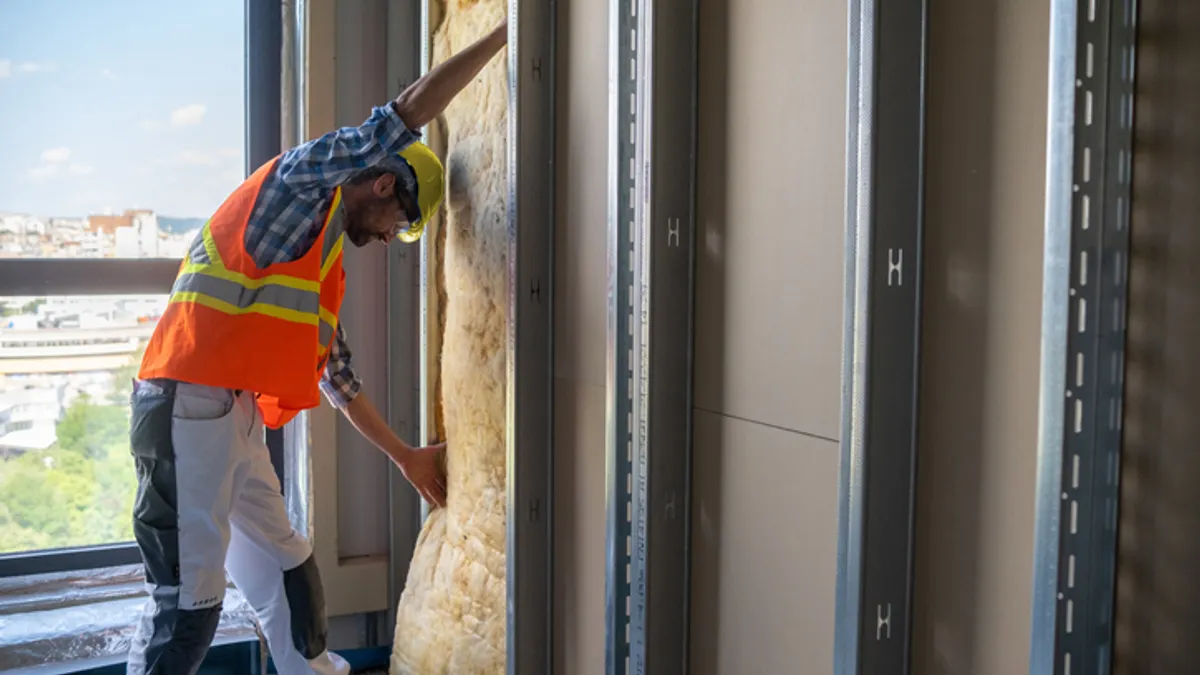
The section on the building envelope, for example, includes “incremental” changes to insulation levels for opaque elements like walls and fenestration elements like windows and skylights, Culp said.
Changes to the mechanical sections include increased minimum efficiency requirements for a wide range of equipment, including water-source heat pumps, cooling towers, fans and dedicated outdoor air systems.
The mechanical sections also include new provisions for gas-fired heat pump space and water heaters to meet prescriptive energy-efficiency requirements and qualify those systems to earn energy credits.
Beginning with the standard’s 2022 version, new buildings must comply with the baseline efficiency standards and earn a minimum number of energy credits, which ASHRAE also calls efficiency points. Building owners can choose from almost 300 credits across more than 30 categories, Lord said.
The goal of the energy credits framework is not simply to layer on new compliance requirements, but to ensure a standard that covers a wide range of commercial real estate gives building owners more latitude to choose cost-effective, common-sense efficiency investments that work for them, Culp said. What makes sense in a high-rise office building might not work in a strip mall or a school, he added.
“This is purposely meant to provide flexibility,” Culp said. “We want you to achieve a certain amount of energy efficiency, but we aren't going to tell you how.”
Culp and Lord said flexibility is increasingly important as new buildings get more efficient. Building efficiency has improved dramatically since Standard 90.1 first emerged, and gains continue today: The 2025 version of Standard 90.1 aimed for a 7% to 8% efficiency improvement over the 2022 edition, Lord said.
But in at least some categories, like lighting and ventilation, “we are seeing diminishing returns,” Culp said.
In response, Lord said the committee is looking at technologies whose efficiency potential isn’t even close to tapped out.
One of those is building controls, which enable both fine-tuned and “holistic” building energy management that can reduce peak demand and overall consumption, Lord said.
These technologies improve the performance of energy management techniques that have been studied and used for decades, such as “precooling” buildings to reduce air conditioning loads during the hottest parts of the day. A recent precooling demonstration in the Chicago area saw a large commercial building cut its peak energy load by 20%, Lord said.
Renewable energy is another high-potential area, Lord said. This is a broad category that includes not only rooftop solar panels and direct purchases from remote, grid-connected solar systems but also onsite ground-source heating and cooling systems that can significantly reduce the energy intensity of space and water conditioning.
In 2024, Lord told Facilities Dive that the standard aims to increase onsite renewable energy systems’ share of buildings’ total power supply from the single digits today to about 35% eventually. This month, he said energy storage systems would likely play an important role in boosting renewable energy use — particularly for nighttime loads, when direct solar consumption isn’t an option, and for heavy power users with strong financial incentives to manage power loads.
ASHRAE is working with Oak Ridge National Laboratory to scale deployment of thermal energy storage systems that use “phase change materials” with higher melting points than ice, an effective but comparatively inefficient energy carrier, Lord said. For example, thermal batteries developed by Sunamp, a British company, use a proprietary phase change material to improve efficiency by 40%, he said.