Dive Brief:
- Johnson Controls has stepped up its capacity to deliver on its order backlog and has given its field technicians and sales staff flexibility to meet customers’ needs with less higher-level input, CEO Joakim Weidemanis said Tuesday on the company’s fourth-quarter earnings call.
- A $900 million investment the company is making to improve its manufacturing capacity, along with business process changes it’s been implementing, will help it get ahead of demand from its clients and manage more backlog, Weidemanis said.
- “We’re able to, for many of our product lines, stand up new physical plant capacity within 12 months,” he said. “With the lean manufacturing, the business system, we’re able to create meaningful capacity within quarters in addition to what we get with the hard capacity that we create.”
Dive Insight:
Johnson Controls increased its sales 10% year over year, to $7.1 billion, in its fourth quarter, according to the company's earnings presentation and press release. Orders grew 44% organically, helping to fuel a $23 billion backlog.
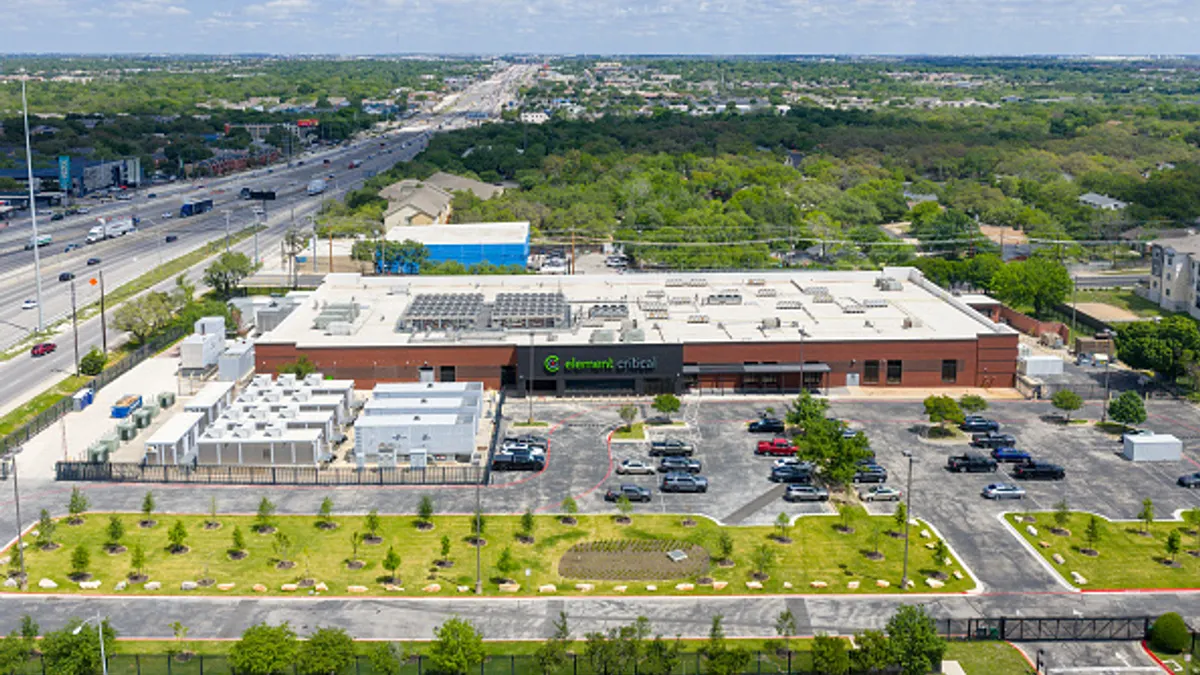
The company is doubling down on providing comprehensive thermal management solutions to data centers and what it calls “mission-critical” businesses, like advanced manufacturing and biopharma operations, that are heat- and energy-intensive, need tightly controlled systems and have a low tolerance for disruption.
Its chiller systems remain the biggest part of its business in these segments, but it’s also boosting its total addressable market of data center clients by offering coolant distribution units and cold plates, the company said.
“We’ve increased our offering[s],” Weidemanis said. We’ve “added CDUs [and] acquired a cold plate company so that we’re now making good progress with several major customers.”
The company is also expanding its push into modular data centers, which use pre-built components to create smaller-scale computing facilities at edge locations — places closest to computing demand.
“We plan to build 500 megawatts of distributed edge compute capacity in 2027,” Weidemanis said. The effort brings together the company’s thermal management technology, engineering capabilities and global manufacturing scale, he said.
The company earlier this year acquired modular data center manufacturer Armada to help it compete in the space. “We are really the infrastructure provider of [Armada’s] containerized modular edge compute sovereign AI pods,” he said.
Johnson Controls’ focus on critical infrastructure is changing its mix of business, Weidemanis said. “Incremental revenue [is less from] the traditional fire and security business and more [from] the higher-end-margin chiller, where we differentiate more and we have the ability to really deploy our technological advantage,” he said.
Growth in the more traditional areas has been subdued, he said, particularly in the security part of its portfolio, and that’s impacting how it’s approaching its service contracts with customers.
“We have done work to look at what kind of contracts we want to be involved in, the growth run rate and the profitability of those,” he said. “As we’re repositioning a little bit in the security service side of the business, we’re still seeing a little bit of subdued growth there.”
Within a few more quarters, business should pick up, he said. “We still probably have another one or two quarters ahead before we’re on the other side of that,” he said.
To help its 50,000 field technicians and sales staff do their work better, Johnson Controls has given them AI tools and increased the decision-making they can do — “moving accountability closer to customers,” Weidemanis said.
“There’s … a chunk of investment [we made] related to … productivity in the field that will, with AI and digital approaches and tools, enable our field to serve and win more customers,” he said. “Our field footprint is one of the industry’s largest.”
To help the company keep its focus on data centers and critical infrastructure, it’s revamping other areas of operation, he said.
“Our restructuring actions are concentrated primarily in other parts of our portfolio outside our most technology-differentiated mission-critical verticals,” Weidemanis said. “We’re optimizing our manufacturing and warehouse footprint [and] streamlining the functions that support those operations.”