Dive Brief:
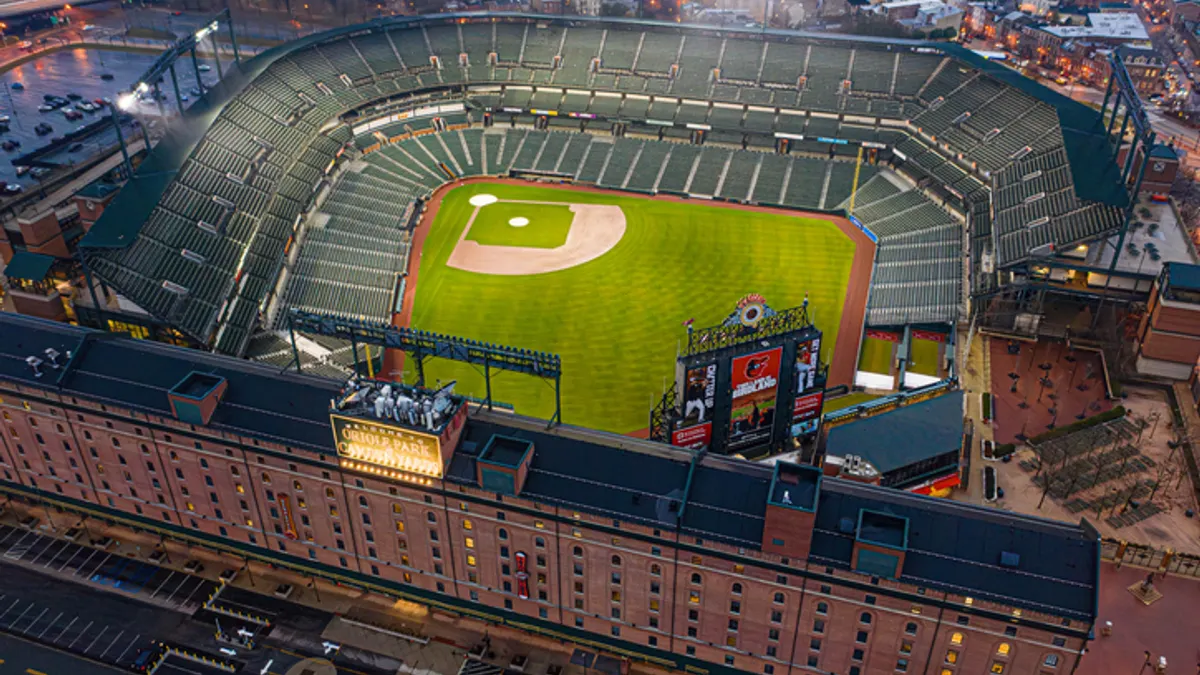
- Since Levi’s Stadium in Santa Clara, California, achieved LEED Gold status in 2014, 31 stadiums in North America have been certified by the U.S. Green Building Council under its Leadership in Energy and Environmental Design program.
- MetLife Stadium in East Rutherford, N.J., home of the New York Jets and the New York Giants professional football teams, is the most recent stadium to be recognized, receiving Gold LEED certification in May. The stadium uses on-site solar generation, LED lighting, motion sensor lighting and hybrid-electric vehicles as part of its energy conservation strategy.
- USGBC in June released an interactive map detailing the features that help the facilities operate efficiently notwithstanding their size and complex operations. These “year-rouund civic landmarks … demonstrate what good stewardship looks like at scale,” Rhiannon Jacobsen, managing director, U.S. market transformation and development at USGBC, said when the map was released.
Dive Insight:
Levi’s Stadium, the home of the San Francisco 49ers, can accommodate more than 68,000 people. The 12-year-old facility has 1,162 solar panels, low-flow plumbing fixtures and grows more than 40 crops in a 7,500-square-foot rooftop garden, called Faithful Farms. It’s the largest on-site farm at a stadium in North America, USGBC says. Its crops include broccoli, squash, eggplant, peppers, artichoke, strawberries, garlic and herbs.
The produce shows up in hors d’oeuvres passed around in suites, salads served in premium clubs and menu items made available in concession stands. Surplus produce is donated to local food banks.
“It’s not just for show,” Jon Severson, the regional executive chef for Levy, the hospitality team at Levi’s Stadium, said in a Food & Wine article in February, shortly before the stadium hosted the 2026 Super Bowl between the Seattle Seahawks and the New England Patriots.
In Canada, the 54,500-capacity soccer stadium BC Place in Vancouver has the world’s largest retractable roof at more than 80,000 square feet. The roof is central to the stadium’s Gold certification because of the natural ventilation it enables.
Estadio Banorte in Mexico City is the largest stadium in Latin America with a seating capacity of almost 88,000 people. The 60-year-old home of Mexico’s national football team underwent a $159 million renovation in anticipation of the 2026 FIFA World Cup. The work included replacing its mechanical infrastructure with high-performing systems to help the stadium achieve LEED Platinum status. The HVAC and other renovations enabled it to achieve a better-than-median energy use intensity of 135.66 kilowatt hour/m2. To supplement that, the stadium offsets some 6,000 tons of greenhouse gases through the purchase of carbon credits, according to an Estadio Banorte stadium report.
Efficiency measures at the LEED-certified sports facilities are summarized in the USGBC interactive stadium map.