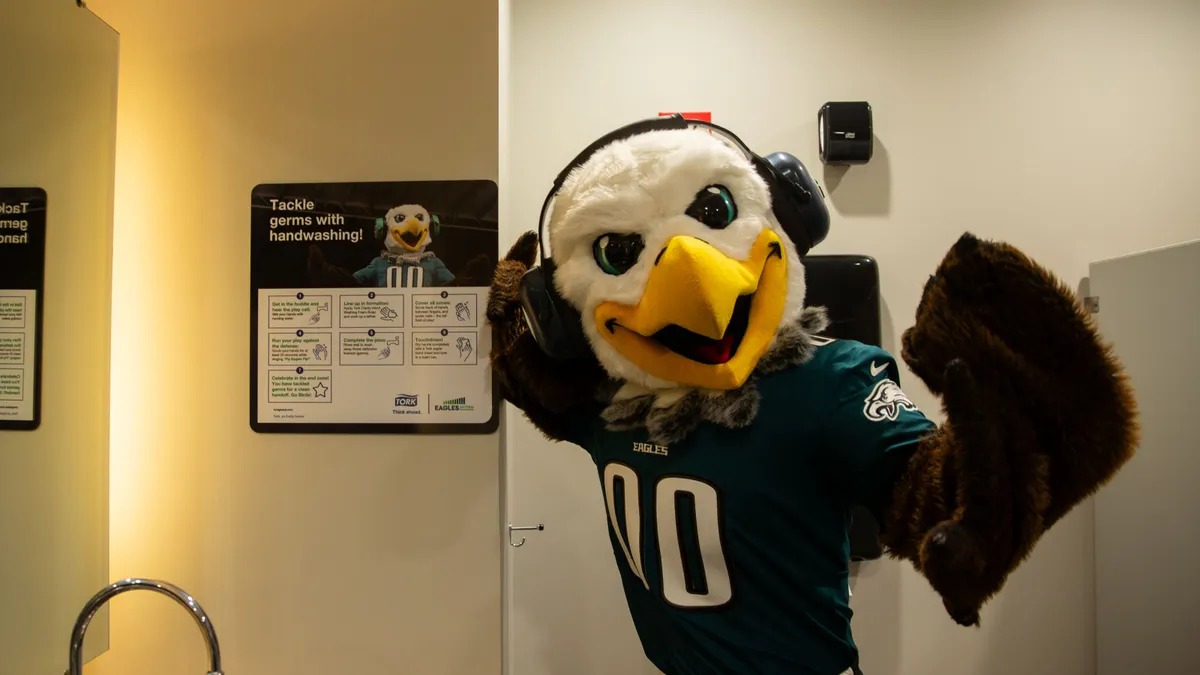
When the Philadelphia Eagles announced it was adding calming music and soft lighting to some of the restrooms at its Lincoln Financial Field last month, it was an example of how facilities are embracing the idea that inclusiveness extends to people with sensory sensitivities.
"These upgrades align perfectly with our mission to create accessible environments where individuals of all abilities can participate alongside their peers,” Ryan Hammond, executive director of the Eagles Autism Foundation, said when the upgrades were announced.
In addition to the music and lighting, the three restrooms closest to a sensory room that the stadium created a few years ago were upgraded to include higher urinal and stall dividers for privacy, adult changing stations equipped with disinfectant wipes and continuous air freshening. They were also equipped with soft tissue paper and organic soap to accommodate people with skin sensitivities.
The additions “align with the Eagles Foundation's values about sustainability and social engagement and gave us a mutual representation of what [this type of inclusiveness] could mean in the public,” Audrey Wesson, sustainability manager for global hygiene company Tork, told Facilities Dive in an interview.
As many as three out of every 20 people in the United States have some form of sensory processing disorder, according to the Cleveland Clinic. That figure draws on a decade-old National Institutes of Health research paper, so the number could be different today.
The symptoms include light, noise and skin sensitivities and discomfort in shared or crowded spaces, the Cleveland Clinic says.
Lincoln Financial Field’s sensory room includes sound conditioning to keep external noise to a minimum, bean bag chairs, visual light panels, bubble walls, tactile artwork and sensory bags, among other things. Sensory bags are available to guests and include squishy toys and other items intended to help people reduce stress.
“The need for sensory-friendly resources … is at an all-time high," said Hammond when renovations to the sensory room were announced in 2023.
Tork last year released what it calls an inclusive hygiene playbook that shares best practices for facilities managers to make their restrooms more accommodating to those with sensory sensitivities.
“Restrooms often contain hidden hygiene barriers that negatively impact user experience, affecting more people than you might think,” the company says in the playbook. “Individuals with … sensitivity to loud noises, incontinence issues, and skin conditions” are among the impacted group.
Wesson said the company has conducted research that can help frame the issue to facilities managers by showing the cost to an organization if people avoid using a restroom because it triggers anxiety issues.
“It helps you think about the restroom in a new way,” Wesson said.
Almost a third of 11,500 people the company surveyed last year say they’ve spent less time at a venue when the restroom experience was negative, while almost a quarter say they limited how much they ate or drank to avoid using the restroom. About 10% say they told others to avoid the venue if they had a bad restroom experience.
“A poor restroom experience can trigger powerful emotions and measurable business consequences,” the company’s survey report says.
The findings mirror those of another commercial restroom provider, Bradley Company, which found that almost 85% of 1,000 people it surveyed form an unfavorable view of an organization if its washroom is unclean or unpleasant. The company has been conducting the survey annually since 2009 to see if people are getting more or less sensitive to restroom issues.
“If a restroom appears poorly maintained or understocked, it can discourage proper handwashing,” Jon Dommisse, the company’s vice president of business development and strategy, said when the findings were released in May.
If the restroom is well-maintained, about three-quarters of people are more likely to return to or spend more time at the facility, according to Bradley. One trend it’s seeing is an increase in people who say people are more likely to leave a restroom without washing their hands.
Restroom sensitivity appears likely to increase, because younger people are more attuned to a negative experience, the Tork survey shows. About 20% of people between 18 and 34 say they won’t return to a venue with poor restrooms. That’s almost twice as high as for the general population, according to the company’s survey.
This trend could lead to more attention paid to restrooms going forward, Wesson said.
“As younger users set higher expectations, businesses are going to invest in hygiene as much as they are in sustainability and customer experience,” she said in a Q&A she conducted with Green Seal, a nonprofit that certifies organizations’ sustainable business practices.