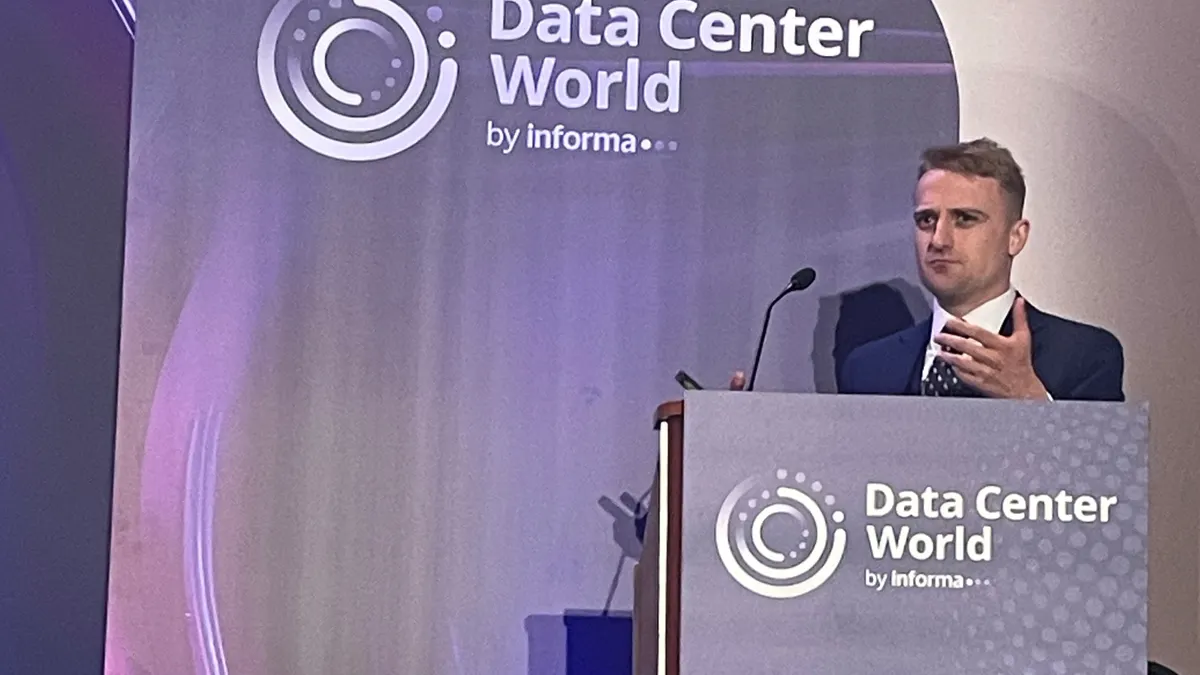
WASHINGTON – Facility managers can be central to keeping insured data center losses down, Alistair Blundy, CEO of London-based ATA Insurance, said this week at Data Center World.
Insurers are only now getting a handle on how to underwrite data centers because of the concentration of value they represent and the range of risks they’re exposed to, Blundy said at the conference.
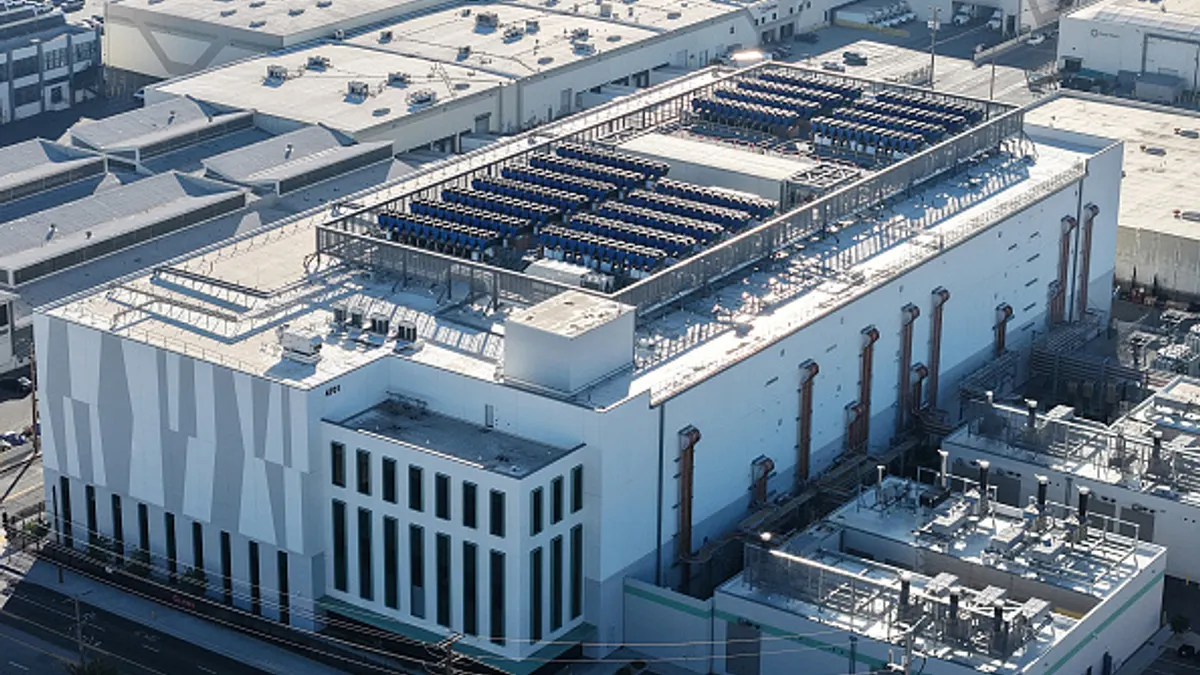
A football field-sized data center houses on average of $13.6 billion worth of graphics processing units, or GPUs, the core technology in the facilities, he said. Filling that same area with Porsche sports cars would average insurable exposure of about $150 million, or about $105 million if the field were filled with MacBook laptops, he said.
“So we’re an order of magnitude above” other exposures, Blundy said. “We’re just not used to having that much insured equipment on one site.”
Insurers have yet to face a catastrophic loss in the data center insurance market, though there have been a number of incidents. Iran’s targeting of data centers in the United Arab Emirates and Bahrain in March were signal events, he said. “That impacted about 100 cloud services, so it wasn’t a small impact,” he said.
Insurers have recently started rethinking how to approach underwriting the sector, he said. They’re learning that the traditional way of dividing up insurable risk by coverage verticals — commercial property, machinery and equipment, and energy, among others — doesn’t work for data centers because the facilities cross over into so many verticals.
“The conventional way of approaching specialty insurance is in siloed lines of business where underwriters understand the coverage they’re providing,” he said. “Data centers are too complex for that.”
There’s the traditional property risk, he said. But there’s also the risk to the computers inside, the energy risk created by the on-site generation infrastructure, the intellectual property risk of the data flowing through the computers, the casualty risk of the professionals hired to advise and work on the sites, and the environmental risk posed by the batteries, coolants and other systems in use. The list goes on, he said. The facilities cross about a dozen traditional insurance lines in all.
“What the insurance market is doing now is what needed to happen, which is to draw up new coverage [that] is bespoke and brings that patchwork of coverages into one policy,” he said.
Risk mitigation
Based on the risks Blundy outlined, there’s a role for facilities managers in minimizing exposure for owners and preventing insurance losses. Here are a few operational issues that facilities managers can watch for.
Battery fires. There’s not much facility managers can do if the data center’s original design is flawed because of poorly located battery backup power, Blundy said.
“The risk is baked in when you’re about halfway done with the build on the site,” he said. “If you made poor design decisions or poor site selection decisions, by the time [the facility] is halfway built, there’s not much you can do about the inherent exposure going forward because of things like proximity of the buildings to one another or where the lithium backup battery is on site [or] how the gas [gets turned] off.”
Proper maintenance of the batteries over time can help, he said.
“Lithium batteries [are getting] a bit older now,” he said. “Some of them are 10 years old at sites. There is a risk they just sat there and weren’t maintained properly,” increasing the chance of them catching fire.
That’s an important issue, he said, because fire is the single biggest property risk insurers face.
Water leaks. In a recent incident in the United Kingdom, a small leak caused water to drip into the data center’s electrical room, resulting in a 24-hour shutdown of the facility. “Multiple tenants all across Europe were affected,” he said. “It was a tiny leak. It cascaded because it wasn’t caught. So, the key takeaway is the interdependency of where one failure area can quickly impact others.”
Having redundant systems could help, but even redundancy isn’t foolproof, he said. “With redundancy, you would have gone [to backup] before the loss was appended, [but it shows] a simple issue like that could knock it out.”
Automated and AI-assisted leak detection systems, including those using infrared sensors, are increasingly available for facilities management.
Adequate cooling. Another U.K. incident, in 2022, was caused by extreme changes in weather that facilities weren’t prepared for, he said. “It was 40 degrees Celsius,” he said. That’s more than 100 degrees Fahrenheit. “That’s really hot — like Las Vegas-level hot. It was a heatwave for a sustained period of time and put stress on the [data center] cooling system. They had multiple layers of redundancy, across power and cooling, but several components failed simultaneously…. You can have something come in and knock everything out.”
Blundy said an increasingly popular strategy among insurers is to build into the premium what he called a bursary — a small grant — that makes money available to the facility to cover the cost of an assessment and then implement small but targeted improvements to reduce risk.
“Risk bursaries [are] not well known but work well,” he said. “The insurer builds into the policy, say, a $20,000 risk bursary. The policy holder can spend pretty much on whatever they want outside of their business plan: ‘Here’s a stack of cash that you can just go and spend on improving your risk in some sense.’ Usually that means hiring a risk engineer with an area of expertise. Insurers love that, because they get to identify some areas of risk that can be improved, and the clients love it because it wasn’t on their balance sheet and it’s built into the premium. We’re seeing a lot of that at the moment.”
Some 2,000 people are attending Data Center World this week.
Editor’s note: Data Center World is hosted by Informa, parent company of Informa TechTarget, of which Facilities Dive is a part. Facilities Dive makes editorial decisions independent of Informa.